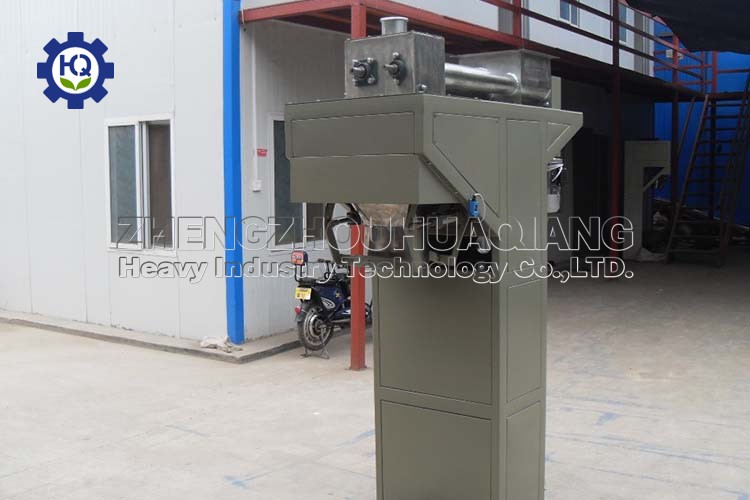
Equipment introduction
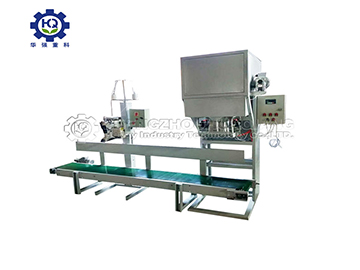
The powdered fertilizer packaging machine, also known as the powder quantitative packaging scale, is a special automated equipment for the packaging of organic fertilizers, water-soluble fertilizers, and inorganic powdered fertilizer products. It adopts the core solution of spiral double-speed feeding + weighing and measurement to specifically solve the industry pain points such as powders that are prone to dust, moisture absorption and caking, large measurement errors, and strong corrosiveness.
(1) Two mainstream models (special for fertilizers)
1. Open bag powder packaging machine: suitable for 20-50kg woven bags and paper bags, equipped with sewing machine, suitable for large-volume packaging of organic fertilizer powder and phosphorus and potassium raw material powder;
2. Valve bag powder packaging machine: automatic pressure filling, self-sealing bag without sewing, extremely low dust, suitable for high-value powder fertilizers such as monoammonium phosphate and water-soluble fertilizer.
(2) Core advantages
1. Accurate measurement: fast and slow double screw feeding, dynamic weighing error ±0.3%~±1%, meeting agricultural input measurement regulations;
2. Anti-corrosion and dust-proof contact materials: 304/316 stainless steel, fully enclosed filling + negative pressure dust collection, workshop dust meets standards;
3. The anti-blocking and anti-bridging silo has built-in vibration arch breaking and stirring devices to solve the problem of moisture absorption and bridge building of fertilizers that prevents unloading;
4. High degree of automation, automatic bagging, hemming, bag sewing, and palletizing linkage are optional, reducing 3–4 operators in a single shift;
5. Suitable for various bag types such as woven bags, cowhide valve bags, and inner membrane composite bags. The measuring range is adjustable from 10 to 100kg.
Equipment Structure and Composition
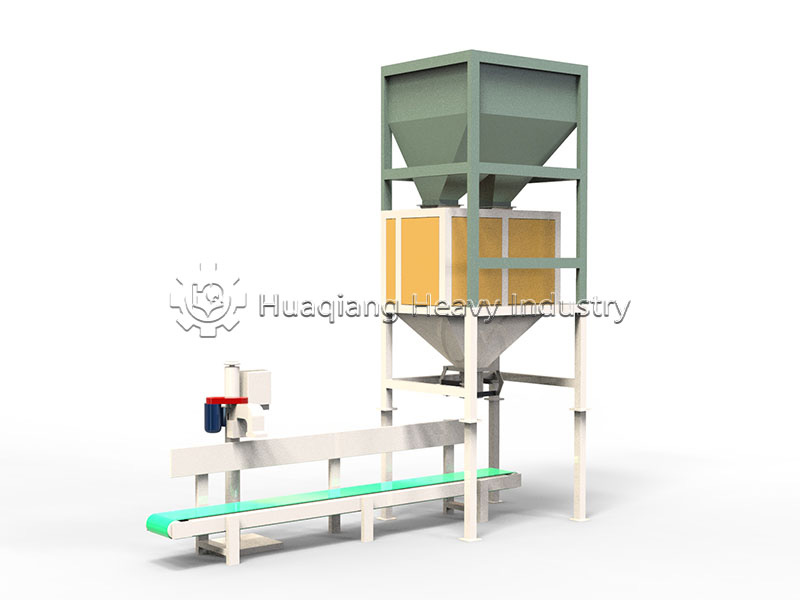
The powder fertilizer packaging machine mainly consists of four core parts and several auxiliary equipment:
(I) Feeding and Weighing System
1. Silo (Transfer Silo)
Used for temporarily storing powder fertilizer to be packaged. The silo is usually made of 304 stainless steel and equipped with a forced feeding device (vibrator or arch breaker) to prevent powder from clumping and becoming loose inside the silo. The silo is connected to the upstream equipment with a soft, moisture-proof, and sealed design.
2. Screw Feeding Mechanism
The core feeding component of the powder fertilizer packaging machine. It adopts a single or double screw feeding method, and the screw speed is controlled by a variable frequency motor. Common feeding methods are fast, medium, and slow three-speed graded feeding:
Fast feeding: large flow rate coarse feeding, quickly filling most of the weight
Medium feeding: transition stage, reducing the impulse
Slow feeding: fine feeding, ensuring final accuracy
3. Weighing Device
Uses an independently suspended weighing sensor (such as a Mettler Toledo high-precision sensor), ensuring stable signal transmission. The sensor transmits the weight signal to the instrument for data processing, enabling automatic tare, zeroing, and measurement.
4. Control System
Based on a PLC (Programmable Logic Controller), and equipped with a high-brightness LED display window, it allows independent input of packaging weight and displays the weighing value. It has automatic storage functions for shift production, daily production, and cumulative production.
(II) Bag Clamping and Filling System
Pneumatic Bag Clamping Device: After manual bagging, a light touch of a microswitch activates the bag clamping cylinder to grip the packaging bag. The equipment has automatic detection functions for each action state: fast filling, medium filling, slow filling, weighing, stabilization, bag clamping, unloading, and bag dropping.
(III) Conveying and Sealing System
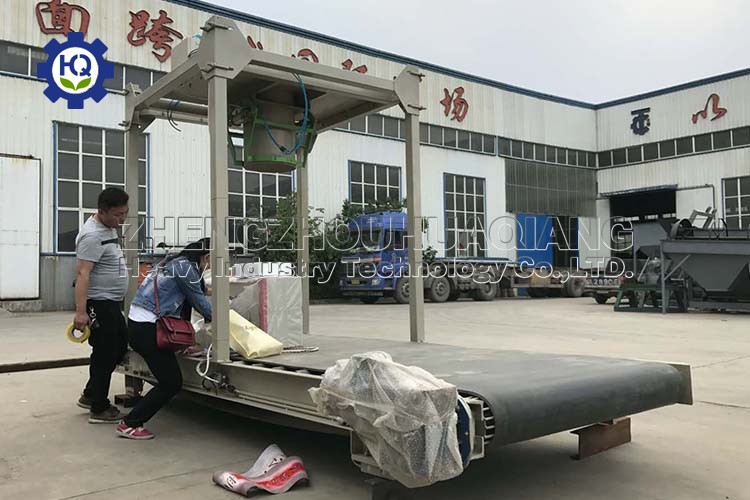
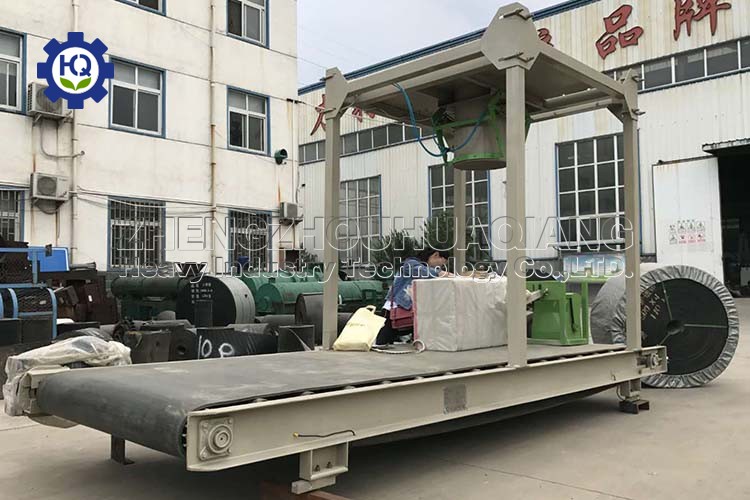
1. Conveying Device
Typically, an idler roller belt conveyor is used. The conveyor belt is wear-resistant and corrosion-resistant, and the continuous idler roller structure ensures that material does not accumulate under the conveyor belt and that slippage does not occur.
2. Sealing Device
Selectable based on packaging bag type:
Sewing device: Suitable for woven bags, automatic sewing
Heat sealing machine: Suitable for composite film inner bags, sealing temperature and speed adjustable
(IV) Auxiliary Systems
Dust removal system: Air intake, dust collector, controls dust overflow
Feeder: Lifts materials to the packaging machine's hopper
Air supply system: Provides compressed air (usually 0.4-0.6 MPa) required for pneumatic actuators
Arch breaking technology: Prevents material from clumping and bridging during screw feeding
Working Principle
Utilizing a dual-speed screw feed + closed-loop weighing compensation process, the entire filling process is dust-free and sealed:
1. A bucket elevator at the front end feeds powdered fertilizer into a buffer hopper, where a vibrating motor continuously breaks up clumps to prevent material bridging and breakage.
2. After manual/mechanical gloves are put into bags, a cylinder automatically clamps the bag opening, and a dust-collecting skirt adheres to the bag opening to activate negative pressure dust collection.
3. PLC controls the coarse screw to feed at high speed. When the set weight is reached (80%), the coarse screw stops, and a fine screw is switched to provide micro-feeding.
4. A weighing sensor provides real-time weight feedback, and the fine screw is cut off 0.5 seconds in advance to compensate for the material's inertial impulse. Once the standard weight is reached, all screws stop.
5. The bag-clamping cylinder releases, and the bag filled with powder falls onto a belt conveyor, which transports it to the sealing station for sealing. The finished product is then transferred to the warehouse.
6. Dust generated during filling is drawn into a dust collector by a ring-shaped dust collection hood for filtration and recovery. Fine powder is returned to the hopper without waste.
Applicable Raw Materials for the Equipment
The powder fertilizer packaging machine is mainly suitable for the following types of materials:
| Material Category | Typical Material Examples |
|---|---|
| Organic Fertilizer Powder | Humic acid powder, bone meal, fish meal, earthworm cast powder, compost powder, plant ash powder |
| Chemical Fertilizer Powder | Phosphate fertilizer powder, potash fertilizer powder, nitrogen fertilizer powder, compound fertilizer powder, superphosphate powder |
| Water‑Soluble Fertilizer | Macro‑element water‑soluble fertilizer, humic acid water‑soluble fertilizer, potassium fulvate |
| Functional Fertilizer | Microbial fertilizer powder, soil conditioner powder, trace‑element fertilizer |
| Other Powders | Pesticide powder, additives, flour, feed powder |
Material Adaptability Requirements:
1. Suitable for powdery, powder-granular mixtures, and flake materials.
2. Suitable for uniform fine granules and non-sticky powder materials.
3. For materials with a certain degree of moisture, or those that are loose or sticky, a special model (such as the XYC-P series) must be selected.
4. For materials with poor flowability, a belt-type graded feeding or a double-screw forced feeding method must be used.
Application of Powdered Fertilizer Packaging Machines in Production Lines
Complete Powdered Fertilizer Process Flow:
Raw Material Crushing → Batching and Mixing → Drum Screening (Fine Powder Purification) → Finished Product Silo → Powdered Fertilizer Packaging Machine → Conveying and Sewing → Palletizing and Warehousing
Section Support Logic:
1. Qualified fine powder after screening is stored in a high-level silo and conveyed to the packaging machine's buffer silo via bucket elevator, achieving continuous and uninterrupted packaging;
2. Fine powder recovered from dust removal during filling is returned to the silo, resulting in zero raw material loss;
3. A single machine can be used independently or combined with automatic bagging, checkweighing, metal detection, and robotic palletizing to form a fully automated packaging line;
4. Multiple units can be connected in parallel to adapt to large-capacity fertilizer bases, meeting the needs of batch outbound shipments.
Standard Operating Procedures and Full-Cycle Maintenance Methods
(I) Standard Start-up and Shutdown Procedures
Start-up
1. Check that the hopper and screw conveyor are free of clumps, the dust collector filter is intact, the sensors are free of powder accumulation, and the equipment is reliably grounded;
2. First, start the dust collector and vibratory arch-breaking motor, run the screw conveyor unloaded for 3 minutes, and confirm that the rotation direction is correct;
3. Call up the corresponding fertilizer formula on the touch screen, complete the zero-point calibration, and then begin bagging production.
Shutdown
1. Stop the front-end feeding and wait for all material in the hopper and screw conveyor to be emptied;
2. Sequentially shut down the screw conveyor, dust collector, and conveying equipment, and clean any residual powder from the weighing hopper and bag clamping area;
3. For long-term shutdowns, loosen the bag clamping cylinder and protect the sealing dustproof skirt.
(II) Graded Maintenance Standards
1. Wipe the load cell and clean the dust from the bag daily; check the dust collector pressure differential; calibrate the zero point every shift.
2. Disassemble the auger weekly to clean the adhering material, check the wear of the auger blades, and add grease to the cylinder.
3. Replace the dust collector filter element monthly; tighten the drive chain and motor bolts; clean the dust from the electrical control box.
4. Replace all gear oil in the reducer every 4 months; replace aged sealing skirts and air pipe joints.
(III) List of Vulnerable Parts
Auger blades, load cell, dust collector filter bag, dustproof sealing skirt, cylinder seal ring, V-belt, solenoid valve.
Common Faults, Causes, and Standardized Solutions
| Fault Phenomenon | Main Causes | Solutions |
|---|---|---|
| Inaccurate metering, overweight deviation out‑of‑range | Weighing sensor damp & material‑stuck, uneven stress; too fast feeding speed, heavy powder impact; material sticking on metering hopper; coarse/fine feeding mechanism disorder, excessive or insufficient supplementary feeding | Clean sensor surface, ensure horizontal installation; adjust feeding gate opening, add buffer device; fasten wiring terminals, recalibrate with standard weights; spray anti‑stick coating on hopper inner wall; inspect coarse/fine feeding gate, adjust screw feeder speed |
| Material blockage at discharge port & conveying pipeline | Damp & caked powder, poor flowability; worn & stuck screw blades; undersized discharge opening, foreign objects entering pipeline | Power off before clearing blockage, no hard‑object impact; crush caked material in advance; inspect screw blades, replace heavily‑worn parts; install vibratory arch‑breaker for hopper; optimize discharge opening dimension |
| Powder leakage and dust overflow | Aged & damaged sealing parts; insufficient dust‑removal air volume, clogged filter screen; packaging bag misaligned with discharge spout | Replace seal & dust‑proof cover, add sealing gaskets; clean dust collector screen, replace filter cartridge, inspect fan; adjust bag positioning mechanism to fully insert spout into bag mouth |
| Screw feeding fault, unstable feeding rate & slow discharging | Long‑term worn screw blades; gap between shell and blade>2mm causes material leakage; caked powder jams screw shaft | Disassemble & inspect screw blades, replace when wear exceeds 30%; repair shell or replace whole unit; regularly clear caked material at feeding inlet |
| Abnormal control system, batch over‑weight or under‑weight | Manual wrong modification of metering parameters; PLC program disorder | Restore correct metering parameters; re‑download & repair PLC program; test emergency stop button and photoelectric sensor sensitivity |
Target Customers for this Equipment:
1. Powdered Organic Fertilizer Manufacturers: Powdered organic fertilizer production lines have a simple configuration (compost turner + crusher + screening machine + packaging machine), with the packaging machine being an essential component. Suitable for small and medium-sized organic fertilizer processing plants handling livestock and poultry manure, straw, biogas residue, and other waste.
2. Water-soluble Fertilizer, Fertigation Fertilizer, and Foliar Fertilizer Manufacturers: The core packaging equipment in a fully automated powdered water-soluble fertilizer batching and packaging production line. Suitable for packaging products such as macro-element water-soluble fertilizers, humic acid water-soluble fertilizers, and potassium humate.
3. Compound Fertilizer and Blended Fertilizer Manufacturers: Packaging needs for compound fertilizer powders and blended fertilizer powders.
4. BB Fertilizer, Formula Fertilizer, and Micronutrient Fertilizer Manufacturers: Packaging of BB fertilizers, formula fertilizers, micronutrient fertilizers, boric acid, boron fertilizers, and other fertilizers.
5. Enterprises Building or Expanding Fertilizer Production Lines: Fertilizer production projects requiring a complete packaging system.
Key Selection Considerations:
Material Characteristics Priority: Choose screw feeders for free-flowing powders; select models with anti-bridging devices for sticky or easily arched materials.
Accuracy Requirements: Select ±0.5% for general fertilizers; ±0.2% for high-end products.
Capacity Matching: Calculate the required packaging speed based on daily output, allowing for a 10%-20% margin.
Environmental Requirements: Prioritize models equipped with dust removal systems.
Material Requirements: Prefer 304 stainless steel for corrosive materials.
| Material | Powdered dry powderUltra dry powder |
| Weighing Range(kg) | 20~50kg |
| Weighing Speed(bag/h) | ≥180 |
| Dividing value(g) | 20 |
| Level of accuracy | 0.2 |
| Power Supply | Three-phase four-wire: AC 380V220V 50Hz (User self-sufficiency) 50Hz (User self-sufficiency) |
| Power Consumption | RV75 1.5kw RV50 0.75KWRV50 0.55KW |
| Gas Source | It is recommended to select an air compressor with a displacement of 0.12 m3/min or more. |
| Gas Consumption | 0.4~0.6Mpa 1m3/h |
| Working Environment | 0~+40℃relative humidity≤90% |
| Sensor | ILGC-200KG-BA (KeLi Electric) |
| Computer Control Instrument | Intelligent computer controllerYH3D YHD8 |
| Pneumatic Components | Yadeke, Taiwan |
| Dust Removal | Reserve dust outlet |
| Manufacturing Materials | Contact with the material is made of carbon steel, good fluidity, wear resistance, corrosion resistance, easy to clean. |
| Feeding Method | Screw twister feed |
| Installation size(mm) | 2280(height)×1360(depth)×750(width) |
| Installation Method | The scale body is directly docked to the storage bin and does not need to be added as an auxiliary steel frame. Occupied floor space is small and easy to install. |