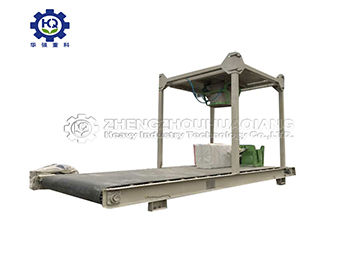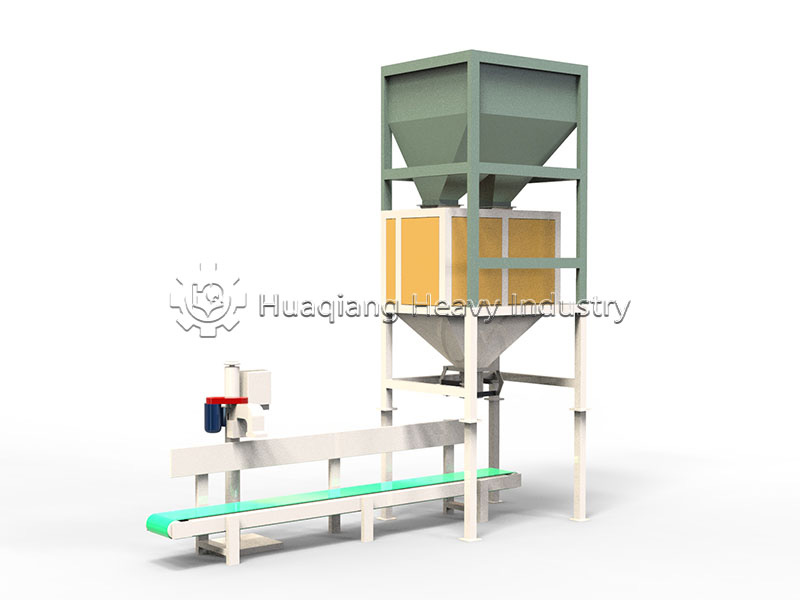
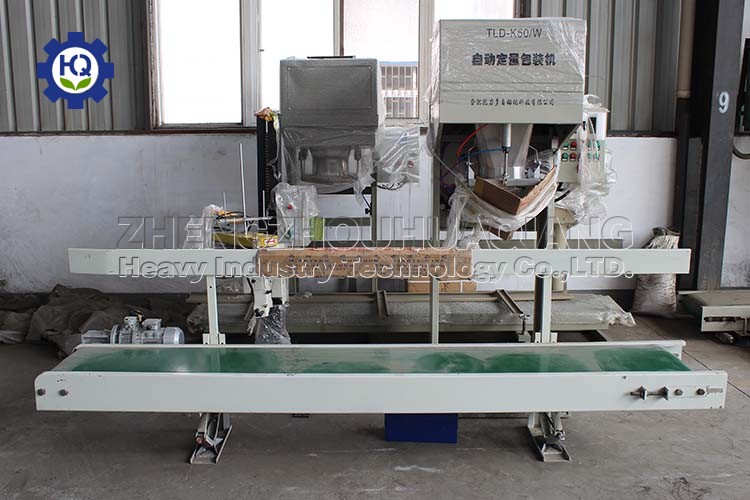
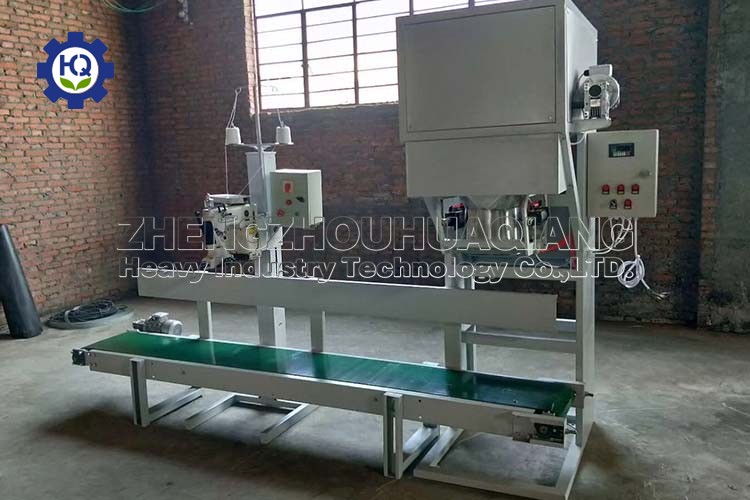
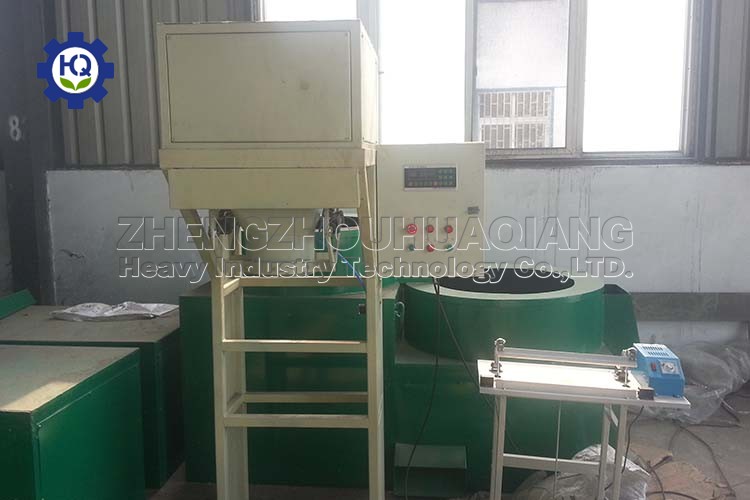
Equipment Overview
A pellet packaging machine is a specialized piece of equipment that automatically measures, fills, and seals loose granular materials according to a preset weight or volume. Based on the degree of automation, it can be divided into manual, semi-automatic, and fully automatic types; based on packaging form, it can be divided into vertical bag making, filling, and sealing integrated machines (small bags, 10 g–5 kg), open bag quantitative packaging machines (medium bags, 10–50 kg), and ton bag packaging machines (large bags, 500–2000 kg). Its core advantages lie in high measurement accuracy, fast packaging speed, good sealing performance, and minimal manual intervention, making it a key terminal equipment for achieving finished product standardization on modern industrial production lines.
Equipment Structure Composition
The entire machine is divided into five main modules: a buffer feeding unit, a weighing and metering unit, a bag clamping and conveying unit, a dust removal and sewing auxiliary machine, and a PLC electrical control system.
1. Buffer Storage Bin: The upper feed inlet connects to the elevator; the bin wall is equipped with a pneumatic vibratory arch breaker; the inner wall has an anti-stick coating; the bin is equipped with high and low level gauges, which automatically replenish material in conjunction with the front-end equipment to prevent material interruption.
2. Dual-Gate Feeding Mechanism (Core for Particles): Coarse material gate (quickly fills 85% of the weight) + fine material gate (micro-feeding for precision control), servo cylinder controlled switch; the discharge chute is equipped with a buffer baffle to reduce particle impact and breakage.
3. Net Weight Weighing Unit: Independent stainless steel weighing hopper + high-precision column-type weighing sensor; bottom discharge door; the entire machine is equipped with shock-absorbing pads to isolate production line vibrations from interfering with metering accuracy.
4. Pneumatic Bag Clamping and Conveying Assembly: Features a ring-shaped sealed dustproof skirt and pneumatically widened grippers; a belt conveyor underneath connects to the upright bag-sewing machine for automatic bag delivery.
5. Supporting Auxiliary Equipment: Pulse negative pressure dust collector, vertical bag-sewing machine, automatic bag-loading robot (optional), inkjet printer, metal detector, palletizing robot.
6. Intelligent PLC Control Cabinet: Touchscreen storage for multiple fertilizer formulas; features automatic tare, zero-point calibration, out-of-tolerance audible and visual alarms, production statistics, fault self-diagnosis, and anti-static grounding for the entire machine.
Working Principle
The core workflow of a granule packaging machine can be summarized as "metering → filling → sealing → output":
1. Metering Stage: Material enters the weighing hopper from the feeding mechanism, and the weighing sensor provides real-time weight feedback. The controller employs a two-stage feeding strategy of "coarse flow + fine flow"—first feeding rapidly to 90% of the target weight, then feeding slowly to the precise weight, balancing speed and accuracy.
2. Filling Stage: After metering, the discharge gate opens, and the material falls into the positioned packaging bag. For vertical packaging machines, the bag is first formed, then filled into the open bag.
3. Sealing Stage: After filling, a heat-sealing roller or sewing machine seals the bag opening. The heat-sealing temperature, pressure, and time parameters must match the film material (e.g., 140–160℃ is recommended for PE film).
4. Output Stage: The cutter cuts the continuous bag body, and the finished bag is conveyed out by the conveyor belt, completing one packaging cycle.
Applications and Applicable Raw Materials
The pellet packaging machine is highly adaptable and can handle a variety of granular materials with particle sizes ranging from 0.5 mm to 50 mm.
| Industry Field | Typical Materials |
|---|---|
| Fertilizer Industry | Compound fertilizer granules, organic fertilizer granules, NPK, Urea, BB fertilizer raw materials |
| Food Industry | Rice, beans, grains, candies, nuts, coffee, condiments, frozen food |
| Feed Industry | Livestock & poultry feed, aquatic feed, pet food |
| Chemical Industry | Plastic granules, resin, pigment, soda ash, catalyst |
| Pharmaceutical Industry | Chinese medicine granules, veterinary drug granules, capsule‑filling granules |
| Building Materials Industry | Cement, dry‑mixed mortar, quartz sand, ceramic granules |
For materials that are prone to moisture absorption and clumping (such as fertilizers and salts), a moisture-proof hopper, a desiccant dosing device, and stainless steel contact parts (304/316L) are required.
Application of Granule Packaging Machines in Fertilizer Production Lines
(I) Complete Process Chain: Granulator → Rotary Drum Dryer → Rotary Drum Cooler → Rotary/Vibrating Screen → Finished Product Silo → Bucket Elevator → Granule Packaging Machine → Sewing and Conveying → Palletizing and Warehousing
(II) Section Matching Logic:
1. Uniform and qualified granules after screening are uniformly sent to the packaging section to remove fine powder and large lumps, ensuring uniform particle size in each bag of fertilizer;
2. Can be used independently or paired with a ton bag packaging machine for parallel operation, simultaneously meeting retail small bag and bulk ton bag orders;
3. Dust removal and recovery of fine particles are returned to the front-end mixer, achieving a closed-loop raw material system with zero waste;
4. Can be equipped with metal detection, weight re-inspection, and coding equipment to complete the entire finished product inspection process before shipment.
Standard Operating Procedures and Full-Cycle Maintenance Methods
(I) Standard Start-up and Shutdown Procedures
Start-up
1. Check that the hopper is free of lumps, the weighing hopper is free of accumulated material, the dust collector filter is unobstructed, and the air source pressure is 0.5–0.7 MPa;
2. First, start the dust collector and the vibratory arch-breaking motor, run the gate valve unloaded for 3 minutes to confirm smooth operation;
3. Retrieve the corresponding fertilizer formula on the touchscreen, perform zero-point calibration for weighing, and only proceed with bagging production after passing the calibration.
Shutdown
1. Stop the front-end lifting and feeding, and wait for all particles in the hopper and weighing hopper to be emptied;
2. Close the gate valve, dust collector, and conveying equipment in sequence;
3. Clean the weighing hopper and sealing skirt of any remaining particles. For long-term shutdowns, loosen the bag clamping cylinder. (II) Graded Maintenance Standards
1. Daily: Clean particles from the weighing platform, calibrate the zero point every shift, and check for damage to the bag sealing skirt;
2. Weekly: Lubricate the gate cylinder and drive chain with grease, and clean dust accumulation on the surface of the dust collector filter bags;
3. Quarterly: Replace the gear oil in the reducer with brand new oil, and check the sensor wiring and the aging of the shock absorber pads;
4. Annual Overhaul: Replace worn gate bushings and aged seals, and fully calibrate the weighing system accuracy.
(III) List of Vulnerable Parts
Gate wear-resistant liner, weighing sensor, dust collector filter bag, sealing dust skirt, cylinder seal ring, sewing machine needle, V-belt.
Common Faults, Causes, and Standardized Solutions
| Fault Phenomenon | Root Cause | Professional Solutions |
|---|---|---|
| Excessive packaging weight error | Granule accumulation in weighing hopper, aging damping pad, delay of fine‑gate switch | Clean weighing platform daily, replace damping pad, fine‑tune advance closing time of fine gate |
| Poor particle discharging, material bridging in hopper | Fertilizer moisture caking, vibration arch‑breaking failure | Increase vibration frequency, install auxiliary stirring device on hopper |
| Dust overflow during filling | Damaged sealing skirt, insufficient dust collector air volume, clogged filter bag | Replace dust‑proof skirt, clean clogged filter bag, inspect induced draft fan |
| High particle breakage rate | No buffer on chute, excessive clamping force of gripper | Install buffer baffle, reduce cylinder air pressure to 0.3‑0.4MPa |
| Gate jamming, no movement | Insufficient cylinder air pressure, particles stuck in gate gap | Adjust air source pressure, stop machine and clean caked particles in gate gap |
| St skipped stitching, poor sealing | Residual particles at bag mouth, worn sewing needle, unbalanced thread tension | Blow clean bag mouth, replace sewing needle, adjust stitching thread tension |
Target Customers and Selection Recommendations
(I) Main Target Customers
1. Fertilizer Production Enterprises: Organic fertilizer plants, compound fertilizer plants, and BB fertilizer plants, for 25 kg/50 kg finished product bag packaging;
2. Food Processing Enterprises: Grain processing plants, condiment plants, and snack food plants, for small-bag quantitative packaging;
3. Feed and Veterinary Drug Enterprises: Batch packaging of livestock and poultry feed, pet food, and veterinary drug granules;
4. Chemical and Building Materials Enterprises: Open-bag/ton bag packaging of plastic granules, resin, cement, and dry-mixed mortar;
5. Pharmaceutical and Health Product Enterprises: High-precision aseptic packaging of traditional Chinese medicine granules and health product granules.
(II) Core Selection Principles
1. Selection based on packaging specifications: Small bags (<5 kg): Select vertical fully automatic packaging machines; Medium bags (10–50 kg): Select open-bag quantitative packaging machines; Large bags (>500 kg): Select ton bag packaging machines. 2. Selection based on material characteristics: Free-flowing granules can be fed by gravity; highly viscous materials prone to caking require a screw feeder with an arch-breaking device; corrosive materials should use stainless steel 304/316L contact parts.
3. Selection based on accuracy requirements: Food and pharmaceutical grades require accuracy within ±0.5 g, necessitating a high-precision electronic scale; fertilizer and feed grades only require ±0.2% to meet national standards.
4. Selection based on automation level: Semi-automatic (manual bagging) is suitable for production volumes <5 t/h; fully automatic (automatic bagging, sewing, and palletizing) is recommended for production volumes >10 t/h.
| Material | Granule |
| Weighing Range(kg) | 20-50kg |
| Weighing Speed(bag/h) | ≥500 |
| Dividing value(g) | 20 |
| Level of accuracy | 0.2 |
| Power Supply | Three-phase four-wire: AC 380V 220V 50Hz (User self-sufficiency) 50Hz (User self-sufficiency) |
| Power Consumption | 0.4~0.6Mpa 1m3/h |
| Gas Source | It is recommended to select an air compressor with a displacement of 0.25 m3/minor more. |
| Gas Consumption | 0.4~0.6Mpa 1m3/h |
| Working Environment | -20℃~+40℃ |
| Sensor | ILGC-200KG-BA (KeLi Electric) |
| Computer Control Instrument | Intelligent computer controller YH-3D YH-D8 |
| Pneumatic Components | Yadeke, Taiwan |
| Dust Removal | Reserve dust outlet |
| Manufacturing Materials | Contact with the material is made of carbon steel, good fluidity, wear resistance, corrosion resistance, easy to clean. |
| Feeding Method | Arc valve 3 feed feed |
| Installation size(mm) | 3120*1580*1350 |
| Installation Method | The scale body is directly docked to the storage bin and does not need to be added as an auxiliary steel frame. Occupied floor space is small and easy to install. |