
2026-10-29

Market acceptance is the first dividing line in deciding whether or not to use rounding. For companies primarily selling commercial fertilizers, branded products, or targeting cash crop areas, granule appearance directly impacts channel acceptance and pricing power. Unrounded extruded granules are cylindrical or "tablet-like," with poor flowability, easily clogging the feed inlet during mechanized fertilization. When paired with a rounding machine, cylindrical particles can be shaped into near-spherical forms, significantly improving roundness. Case studies from some organic fertilizer plants in Dezhou, Shandong, show that product premiums can reach 10%-20%. However, for production lines using livestock manure and straw as raw materials, primarily producing field base fertilizer or self-use fertilizer, end-users focus on nutrient content and application effectiveness. Particle shape has little impact on selling price, and cylindrical particles are perfectly acceptable. The return on investment for rounding machines is not high. In other words, rounding machines solve the "appearance" problem, not the "usability" problem.
If a rounding machine is chosen, speed and moisture content are two parameters that must be precisely controlled. The speed needs to be adjusted according to the target particle diameter: the spindle speed is generally 150-300 rpm. Small particles (φ2-4 mm) use high speed (250-300 rpm) to enhance friction, while large particles (φ5-8 mm) use medium speed (150-200 rpm) to avoid excessive crushing. If the rotation speed is too low, the centrifugal force is insufficient, and the particles simply pile up without rolling, failing to remove sharp edges. If the rotation speed is too high, the particles are thrown against the drum wall, losing their rolling ability, or are directly broken. Regarding moisture content, the rounding machine is extremely sensitive to the moisture content of the feed. The suitable moisture content window is usually between 20% and 30%. Below 20% moisture, the particles lack cohesion and are difficult to agglomerate in the drum, significantly increasing powdery return material. Above 30% moisture, the material is too sticky, easily sticking to the wall or forming large clumps. Before rounding, the particles should maintain a plastic state where they "form a clump when squeezed but crumble easily when released." Being too dry or too wet will greatly reduce the rounding effect.
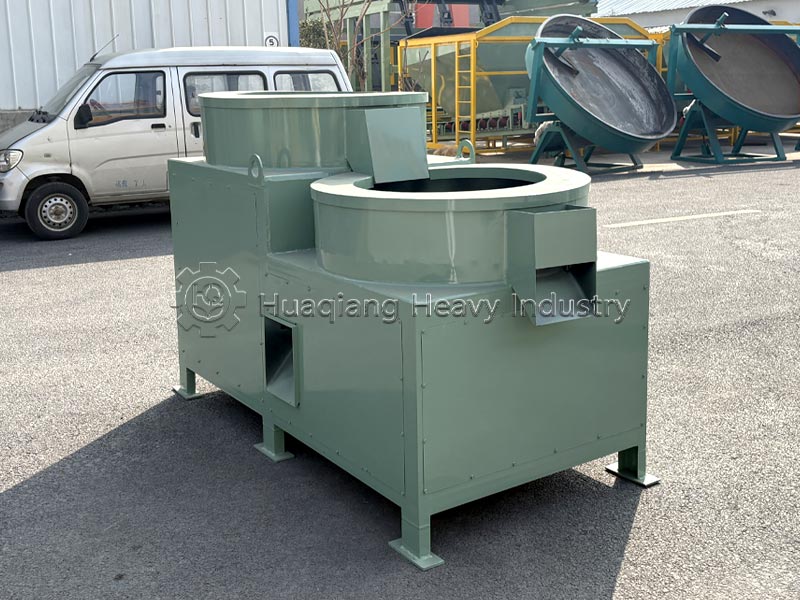
The rounding machine's impact on the return rate is bidirectional, depending on whether the initial particle state and the rounding parameters are matched. When the parameters are matched, the rounding machine's balling rate can reach over 95%, with a return rate of only about 5%. Simultaneously, particle strength increases by 15%-25%, surface burrs are smoothed, and flowability is significantly improved. However, if the feed moisture content deviates from the window or the rotation speed is improperly set, a large amount of broken particles and powder will be generated inside the polishing cylinder, increasing the return rate and increasing the load on the screening and return systems. A more hidden problem is that the polishing process itself wears away some surface material. If this fine powder directly enters the finished product, it will reduce particle uniformity; if it is screened and returned, it increases the circulation volume. Therefore, the return control of the polishing machine cannot only consider the polishing section itself, but must be calculated in conjunction with the strength of the extruded particles at the front end, the feed moisture content, and the screening efficiency, rather than managing the polishing machine as an isolated "polishing process."
Q: The strength of the extruded particles is already acceptable; will it decrease after polishing?
Under normal parameters, it will not decrease, but rather increase. While smoothing the edges during the polishing process, the continuous kneading and extrusion make the internal structure of the particles more compact, typically increasing particle strength by 15%–25%. However, this conclusion is based on the premise that the feed particles themselves possess a certain initial strength and plasticity. If the extruded granules are already loose and lack strength, or if the moisture content at the input is too low, causing the granules to become brittle and hard, the collisions and friction inside the blasting cylinder will indeed cause breakage, resulting in an increased return rate rather than an increase in strength. In this case, the problem lies not with the blasting machine itself, but with the extrusion parameters or moisture control at the front end. Blasting is a "shaping and densifying" process, not a "strength restoration" process; it can only make granules with an existing framework more compact, not magically harden loose granules.
Whether or not to use a blasting machine for extruded granules depends on the market, not the equipment itself. For commercial fertilizers, requiring premium pricing and adapting to mechanized precision fertilization, a blasting machine is an effective investment to enhance competitiveness. For field base fertilizers and self-use fertilizers, where there are no strict requirements for granule appearance, direct screening and packaging of cylindrical granules is a more economical route. After deciding to use a blasting machine, carefully controlling the rotation speed and moisture content, and accurately calculating the return rate in conjunction with the front-end processes, will transform the blasting machine from simply "adding a step" into "adding profit."