Equipment Introduction
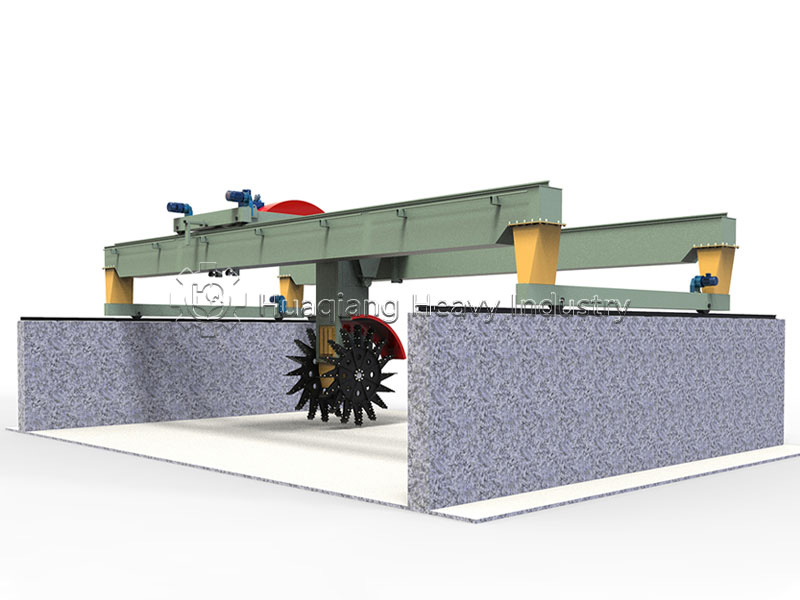
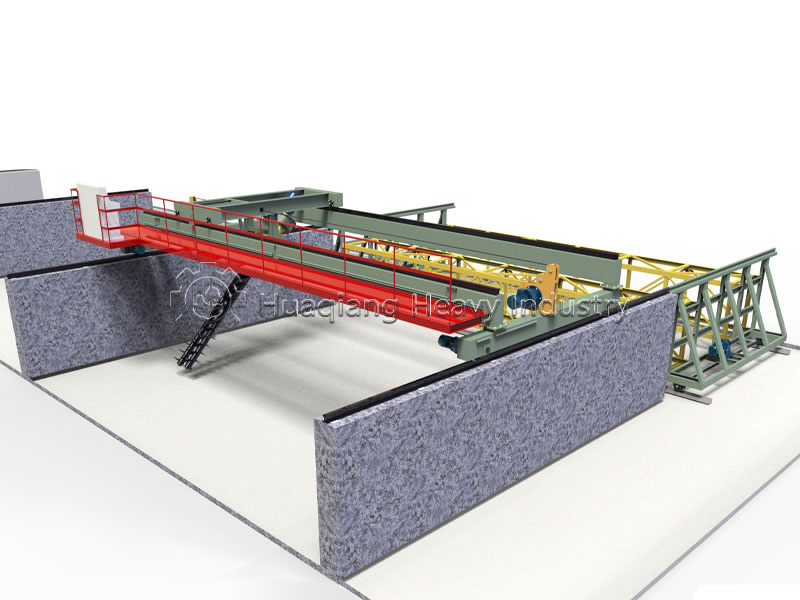
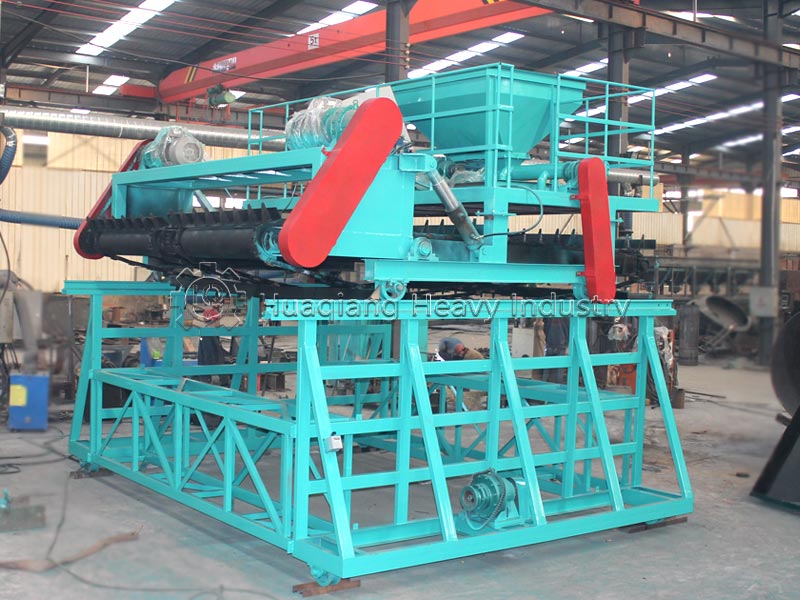
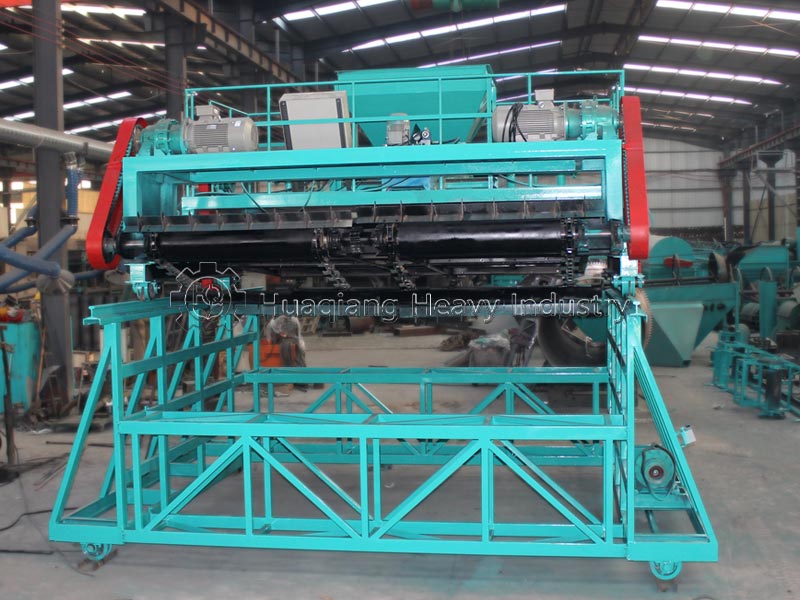
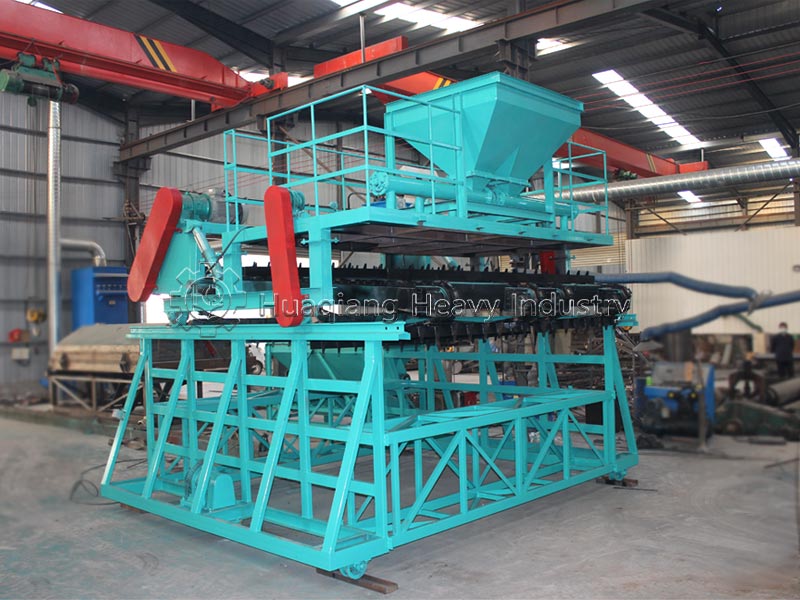
The Chain Plate Compost Turning Machine, also known as a chain plate turner or chain plate composting turner, is a core piece of equipment in organic fertilizer production and aerobic fermentation treatment of organic solid waste. It employs continuous aerobic fermentation technology in a tank (trough) manner, using a chain-driven, rolling-supported chain plate turning mechanism to throw, aerate, and mix the compost material in the fermentation tank.
The chain plate compost turner features a reasonable design, high efficiency, low energy consumption, high degree of automation, ease of use, and low cost. It can turn the compost to a depth of 1.5-2 meters, making it a highly efficient machine that is well-received by users. The machine uses a variable frequency speed control system, which adapts well to changes in workload and allows for flexible adjustment of the walking speed based on material resistance, giving the equipment greater adaptability and flexibility. Centralized control cabinet control allows for both manual and automatic control functions, and limit switches provide safety and limit functions. An optional transfer vehicle can be installed to enable the sharing of multiple tanks. If the equipment capacity allows, the production scale can be expanded simply by adding fermentation tanks, which greatly improves the value of the equipment.
Equipment Structure and Composition
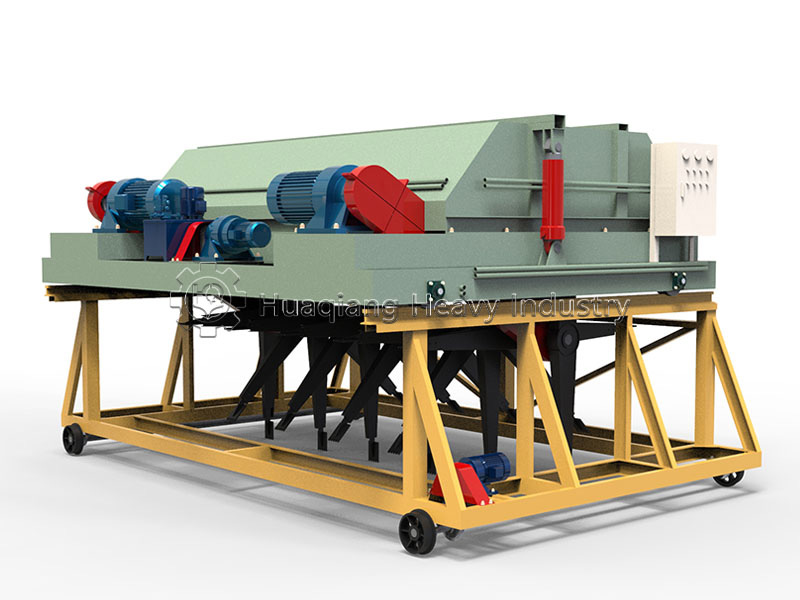
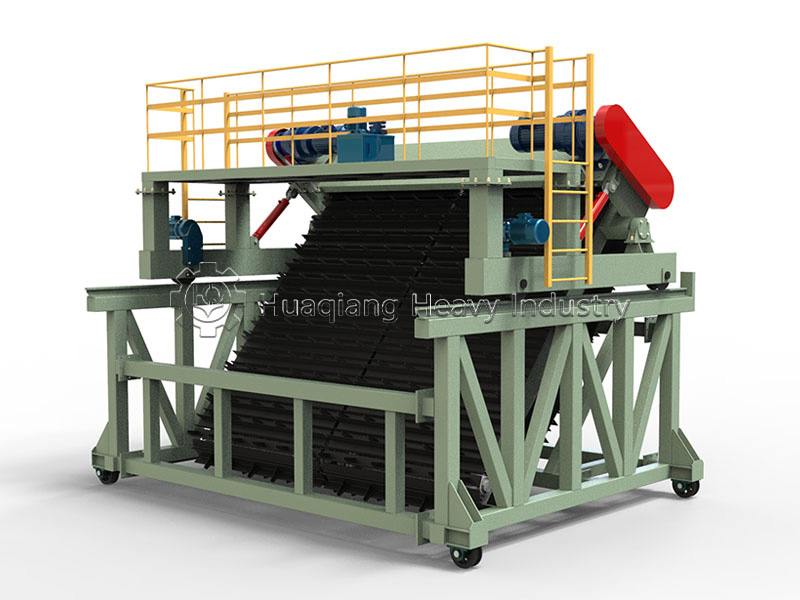
The chain plate turning machine mainly consists of the following major systems:
System Name
Main Components
Function Description
Turning Power Transmission Device
Main Motor, Reducer, Sprocket, Bearing Housing, Main Shaft
Supply power for compost turning chain plates. The motor drives the main shaft via the reducer.
Traveling Device
Travel Motor, Reducer, Transmission Shaft, Travel Wheel, Bearing
Drive the whole machine to move longitudinally along the tracks on both sides of the fermentation trough.
Hydraulic Lifting Device
Hydraulic Pump Station, Solenoid Valve Block, Hydraulic Oil Pipe, Hydraulic Cylinder, Bearing Base
Control the lifting height of compost turning chain plates to adapt to different stacking material depths.
Compost Turning Device
Support Main Beam, Motor Reducer, Main Shaft, Driven Shaft, Sprocket, Chain, Compost Turning Chain Plates
Core working component. Continuous rotation of chain plates realizes material compost turning.
Trough Transfer Cart (Mover Cart)
Travel Motor, Transmission Gear, Transmission Shaft, Travel Wheel
Serve as temporary transport tool for the compost turner to switch troughs, realizing one machine for multiple troughs.
Electrical Control System
Control Cabinet, Soft Starter, Limit Travel Switch
Centralized control system, supports manual control or automatic control mode.
Key Structural Features:
1. The electric motor directly transmits power to the reducer, driving the main shaft, which in turn drives the chain.
2. The turning chain plates, mounted on the chain, are driven by the main shaft to perform a cyclical motion.
3. The chain plates transport the material from the bottom of the trough to a higher position and scatter it down, capable of moving the material backward by 3-4 meters.
4. The chain plates have staggered manganese steel blades that can crush clumps of material.
5. The turning chain plates are made of manganese steel, making them sturdy and durable, and providing a certain degree of crushing and mixing capabilities for materials.
6. Equipped with a soft starter, resulting in low impact load during startup.
7. Limit switches provide safety and limit functions.
Applications of the Equipment
Chain plate compost turner is widely used in the following fields:
1. Livestock and poultry manure treatment: Harmless treatment and resource utilization of livestock and poultry manure such as pig manure, chicken manure, cow manure, and sheep manure.
2. Agricultural waste treatment: Crop straw, rice husks, edible mushroom residue, sugarcane bagasse, lees, sawdust, etc.
3. Sludge treatment: Sludge from urban sewage treatment plants, filter mud from sugar mills, and paper mill sludge.
4. Municipal solid waste treatment: Composting of organic municipal solid waste and kitchen waste.
5. Industrial organic waste: Food processing waste, pharmaceutical residues, brewing waste, distiller's grains, medicinal residues, and biogas residue.
6. Landscaping: Composting and fermentation of garden pruning waste and fallen leaves.
Applicable scenarios: Fermentation, composting, and moisture removal operations in organic fertilizer plants, compound fertilizer plants, sludge and waste treatment plants, horticultural farms, orchards, and button mushroom cultivation plants, etc. Suitable for aerobic fermentation and can be used in conjunction with solar fermentation chambers, fermentation tanks, and transfer vehicles. When used with a transfer cart, it can achieve the function of one machine serving multiple slots.
Raw Material Requirements for the Equipment
The chain plate turning machine can handle a wide range of raw materials, mainly including:
Raw Material Category
Specific Raw Materials
Pretreatment Requirements
Livestock & Poultry Manure
Pig manure, chicken manure, cattle manure, sheep manure, duck manure
Moisture content 50%-65%, mix with auxiliary materials
Crop Straw
Corn straw, wheat straw, rice straw, bean stalk
Crush to ≤10cm
Agricultural By-products
Rice husk, peanut shell, cottonseed hull, mushroom residue, sugar residue & meal
Used as auxiliary materials to adjust C/N ratio
Sludge
Municipal sludge, sugar mill filter sludge, paper mill sludge
Mix with dry materials to adjust moisture
Domestic Waste
Kitchen waste, fruit peels, fallen leaves
Sort and remove non-biodegradable substances
Others
Biogas residue, distiller's grains, traditional Chinese medicine residue, sawdust
Proportion according to material characteristics
Raw Material Proportioning Requirements:
1. Carbon-to-nitrogen ratio (C/N) adjusted to approximately 25:1
2. Moisture content controlled at 50%–65%
3. pH value controlled at 6–9
4. Materials pre-piled in the fermentation tank, with the pile height not exceeding the turning depth.
Working Principle of the Equipment
The chain plate compost turner adopts a combined process of "heavy-duty chain plate turning + walking conveyor":
1. Basic Working Process
The electric motor directly transmits power to the reducer, driving the main shaft. The main shaft drives the chain, and the turning chain plates mounted on the chain move in a cyclic motion under the drive of the main shaft. The equipment moves at a constant speed along the tracks laid on both sides of the fermentation tank. The wear-resistant shovels on the chain plates penetrate deep into the material layer (up to 0.8-1.5 meters).
2. Turning and Oxygen Supply Process
The chain plates transport the material at the bottom of the tank to a higher position and scatter it down, moving the material 3-4 meters backward. The chain plates have staggered manganese steel blades that can crush clumps of material. During turning, the material stays on the pallet for a long time, is scattered at a high level, and has a large contact area with air, making it easier to reduce moisture.
3. No Additional Aeration System Required
The chain plate compost turner does not require a high-pressure forced oxygen supply aeration system. Oxygen is evenly supplied to the material during the turning process, resulting in strong oxygen penetration into the material layer and uniform aerobic fermentation. The material has ample contact with oxygen in the air during the conveying and descent process, resulting in better fermentation.
4. Deep Turning Effect: Turning operations can be performed at any position within the tank through lateral and longitudinal displacement, offering great flexibility. The lifting and lowering of the turning components are controlled by a hydraulic system, allowing for a turning depth of 1.8-2.0 meters. The vertical lifting height of the material can reach 2 meters, resulting in a long residence time in the air and eliminating the need for aeration.
Equipment Operation Method
1. Start-up Procedure
Pre-start inspection → Start the turning equipment → Move the machine.
2. Pre-start Inspection
Check that all fasteners are secure and that the bearing clearances of the transmission components are appropriate—too loose will cause slippage, too tight will cause excessive rotational resistance.
Check that the reducer and all lubrication points are adequately lubricated.
Check the power supply voltage; the rated voltage is 380V, and the voltage drop should not be less than 10% (i.e., 342V) or more than 10% (i.e., 418V). Do not start the machine if it exceeds this range.
Check that the connections of the motor and electrical components are secure, and ground the motor with a wire for safety.
Check that all connections and bolts are secure; tighten or weld any loose connections.
3. No-load Test Run
First, run the turning equipment. If the rotation direction is reversed, stop immediately and change the three-phase circuit connection to change the rotation direction. While the equipment is running, listen for any abnormal noises from the reducer, check that the temperature of each bearing is within the normal range, and observe whether the rotating chain plate rubs against the ground.
4. Load Test Run
First, activate the hydraulic lifting device to lower the chain plate to the bottom of the trough, then start the main unit. Depending on the ground level, if the overall level error of the same area is less than 15 mm, the chain plate of the turner can be controlled at approximately 30-100 mm off the ground; if this level is not achieved, the chain plate should only be controlled at approximately 100 mm off the ground.
After adjusting the chain plate position off the trough, set the equipment to its working travel speed for turning. During the turning process, observe carefully. If the chain plate hits the ground, immediately raise the main frame of the turner to prevent damage to the equipment.
5. Shutdown Operation
The machine should only be stopped after all material has been discharged. In case of a sudden power outage and residual material inside the machine, manually move the V-belt to clear the material.
6. Safety Precautions
No one may pass in front of or behind the turning machine during production. Before starting the machine, the alarm bell should be sounded, and personnel should stay away from the machine to prevent accidents.
No maintenance or lubrication should be performed during production.
The machine must be moved at the specified speed during turning; exceeding the speed limit is prohibited.
No one other than the machine operator may operate the machine.
The turning shaft must not rotate if the two ends are uneven when it is being raised or lowered.
Common Equipment Problems and Solutions
| Fault Phenomenon | Fault Performance | Fault Causes | Standard Solutions |
|---|---|---|---|
| Severe deformation or foreign object winding of chain plates and shafts | Abnormal operation of chain plates, poor compost turning effect | Long-term overload operation or foreign objects stuck in chain plates | Repair chain plates or shafts, remove foreign objects |
| Difficult compost turning | Large compost turning resistance, increased equipment load | Foreign objects stuck on transmission gears or damaged transmission gears | Remove foreign objects on transmission gears or replace transmission gears |
| Unstable traveling, abnormal noise or overheating of reducer | Jitter during traveling, abnormal heating or abnormal noise of reducer | Bent transmission shaft, lack of lubricating oil, excessive wear or damage of bearings | 1. Calibrate or replace transmission shaft 2. Add lubricating oil 3. Replace excessively worn bearings |
| Difficult or failed motor startup with buzzing sound | Motor cannot start normally or difficult to start | Deformed & bent reducer shaft, excessively low or high voltage | 1. Calibrate or replace deformed reducer shaft 2. Restart after voltage returns to normal |
| Foreign objects on traveling wheels or tracks | Travel jamming and deviation | Debris on tracks or damaged traveling wheels | Remove foreign objects on traveling wheels or tracks |
| Insufficient compost turning force | Shallow compost turning depth, insufficient material crushing | Abnormal hydraulic system pressure or worn chain plates | Check whether hydraulic system pressure is normal, inspect chain plate wear; replace severely worn chain plates or blades if necessary |
| Chain wear or breakage | Abnormal chain noise, gear jumping or even breakage during operation | Insufficient lubrication, over-tight or over-loose chain | 1. Check chain temperature daily; touch the middle part of chain after shutdown. Hot surface (>60°C) indicates excessive friction 2. Wipe chain plates with white cloth to check oil film; ideal lubrication leaves transparent oil film 3. Adjust chain timely if tightness is improper |
Equipment Application in the Production Line
1. Position in the Organic Fertilizer Production Line
The chain plate turner is the core equipment in the fermentation section of the organic fertilizer production line. It undertakes the core process of material composting and fermentation, directly determining the fermentation quality, production efficiency, and finished product quality of the organic fertilizer. It plays a crucial role in the entire production line, acting as a bridge between upstream and downstream processes. The equipment adopts a deep-layer fermentation process using a ground-level tank, receiving materials from the upstream batching and feeding process, completing the turning, oxygenation, mixing, and composting operations, providing qualified composted raw materials for downstream deep processing.
The complete organic fertilizer production process embedded with the equipment is as follows: Raw material pretreatment → Batching and mixing → Fermentation tank feeding → Chain plate turner turning and fermentation → Discharge → Crushing → Screening → Granulation → Drying → Cooling → Secondary screening → Finished product packaging. In the entire process, turning and fermentation is the core link in the harmless and resource-based treatment of raw materials, and a key process to ensure that organic fertilizer meets production standards.
2. Production Line Supporting Equipment and Functions The chain plate compost turner needs to be used in conjunction with a complete set of organic fertilizer production equipment. Each supporting device has a clearly defined function, working together to automate the entire organic fertilizer production process from raw material processing to finished product packaging. Specific supporting equipment and functions are as follows:
Loader/Loader Loader: Primarily used for transferring and stacking raw materials, and feeding materials into fermentation tanks, continuously supplying materials to the fermentation section to ensure the continuous and stable operation of the production line.
Ingredient Mixing System: Precisely proportions main ingredients and various auxiliary materials according to organic fertilizer production process standards, adjusting core parameters such as carbon-nitrogen ratio and moisture content to provide excellent basic conditions for efficient fermentation.
Transfer Cart/Tanker Cart: Used in conjunction with the chain plate compost turner, enabling a single turner to operate across multiple fermentation tanks, completing the turning and composting of materials in multiple tanks, achieving a multi-tank production mode.
Crusher: Used for fine crushing of the fermented and composted materials. The chain plate compost turner has a built-in material crushing function, effectively breaking up lumpy materials, simplifying subsequent crushing processes, and reducing the crusher's workload.
Screening machine: Screens and sieves the fermented and pulverized materials, effectively removing large pieces of incompletely fermented material and impurities, ensuring uniform particle size to meet the production requirements of subsequent granulation processes.
Pelletizer: Processes the screened, well-rotted powdered organic fertilizer into regular granular fertilizer, improving the ease of application, fertility stability, and product appearance of the organic fertilizer.
Fermentation Process of the Equipment
The chain plate turner is the core equipment for achieving aerobic composting fermentation:
1. Aerobic Fermentation Principle
It adopts continuous aerobic fermentation technology in a pool, utilizing beneficial microorganisms to promote the rapid maturation of organic waste such as livestock and poultry manure. Through chain plate turning, the organic waste is rapidly maturated, dehydrated, sterilized, and deodorized, achieving the goals of harmlessness, resource recovery, and volume reduction.
2. Intelligent Fermentation Control
The intelligent automatic control of the turning process of the fermentation materials causes a certain displacement of the fermentation materials within the pool. The materials move backward in a regular and continuous manner within the pool, thus forming a continuous aerobic fermentation process.
3. Oxygen Supply and Moisture Control
During the turning process, the materials remain on the pallets for a long time and are scattered at a high level, ensuring sufficient contact with air and easy moisture reduction. There is no need to configure a high-pressure forced oxygen supply aeration system; oxygen is evenly supplied to the materials during the turning process, and the oxygen penetration of the material layer is strong.
4. Fermentation Effect
Through deep turning and turning, the materials in the pile are fully replaced, and the oxygen-deficient materials at the bottom are brought to the surface.
The pile temperature is stably maintained at 55-65℃, and complete decomposition is achieved in 7-15 days.
Insect eggs, pathogens, and weed seeds in the materials are thoroughly killed.
The fermentation cycle is short (7-8 days), far superior to traditional processes.
5. Fermentation Tank Configuration
Construct two fermentation tanks, 1.5-1.8 meters high, 60-80 meters long, and 3-10 meters apart, with lightweight tracks installed on the walls. The tanks are as low as 2 meters above the ground, reaching up to 12 meters, resulting in a shorter fermentation cycle and higher daily and annual production capacity. Fixed copper sliding angle cables can be installed on the sides of the fermentation tanks, ensuring safety, reliability, durability, and easy maintenance.
Summary of Equipment Advantages and Features
1) Advantages Compared to Other Types of Compost Turners
Comparison Item
Chain Plate Compost Turner
Trough Compost Turner (Drum Type)
Wheel Disc Compost Turner
Turning Depth
1.5-2m
0.6-1.5m
1.5-3m
Turning Mechanism
Reciprocating movement of chain plates, high-position throwing
Drum rotary cutting
Rotary conveying by wheel disc
Material Mixing Uniformity
High (hard to stratify)
Medium
Medium
Energy Consumption
Low (small counter-throwing resistance)
Medium
Medium
Crushing Capacity
Strong (manganese steel cutters)
Medium
Strong
Deep Trough Operation
Suitable
General
Suitable
Automation Level
High
High
High
Manufacturing Cost
Low
Low
Medium
2) Core Competitive Advantages
1. Large Turning Depth: Up to 1.5–2 meters, suitable for deep trench operations
2. Low Back-Throwing Resistance: Adopts a chain drive and rolling support chain plate mechanism, saving energy
3. Uniform Material Mixing: Main and auxiliary materials are kept in a uniform mixing state, and the material is not prone to stratification
4. High-Level Spreading: The material stays on the pallet for a long time, and the high-level spreading ensures sufficient contact with air, making it easy to reduce moisture
5. Strong Crushing Capacity: The manganese steel blades distributed in a staggered manner on the chain plate can crush agglomerated materials
6. No High-Pressure Aeration Required: Oxygen is uniformly supplied to the material without dead corners during the turning process
7. Variable Frequency Speed Regulation: The walking system adopts variable frequency speed regulation, which has good adaptability to different materials
8. Hydraulic Control: The lifting and lowering of the turning and turning working parts are controlled by a hydraulic system, which allows for flexible operation, safety and speed
9. Remote Control Operation: Forward, turning, lifting and reversing operations can be remotely controlled from a distance, improving the operating environment
10. 11. Multi-trough operation: Equipped with a trough-shifting cart, one turning machine can operate in multiple troughs, saving investment.
12. Rational structure: Rational design, reliable performance, beautiful appearance, and convenient operation and maintenance.
13. Low cost: Easy to use, low cost, and widely applicable.
As a core piece of equipment in the fermentation section of medium-to-large-scale organic fertilizer production lines, the chain plate compost turner has become one of the preferred fermentation equipment for organic fertilizer plants, compound fertilizer plants, sludge and waste treatment plants, and button mushroom cultivation plants due to its technological advantages such as deep-trough operation, low resistance during back-throwing, uniform material mixing, sufficient oxygen supply from high-level spreading, and strong crushing capacity. Its ground-trough aerobic fermentation technology can convert organic raw materials such as livestock and poultry manure and agricultural waste into high-quality organic fertilizer within 15-25 days, achieving the dual goals of resource utilization and environmental protection.
The chain plate compost turner adopts a chain-driven and rolling support chain plate mechanism, resulting in low resistance during back-throwing, energy saving, and suitability for deep-trough operation. During back-throwing, the material stays on the pallet for a long time, is spread at a high level, and has sufficient contact with air, making it easy to reduce moisture. The chain plate has staggered manganese steel blades that can crush clumps of material. This equipment does not require high-pressure aeration equipment; it provides oxygen to the material evenly and without dead zones during the turning process, ensuring strong aeration penetration into the material layer and uniform aerobic fermentation.
During the selection and use of this machine, users should choose the appropriate model based on the actual fermentation tank size, raw material quantity, site conditions, and budget. They must strictly adhere to operating procedures and maintenance requirements to ensure safe, efficient, and long-term stable operation of the equipment. This machine features a reasonable design, high efficiency, low energy consumption, high degree of automation, ease of use, low cost, and wide application, making it a highly efficient model that is well-received by users.
Whether you need a fermentation compost turning machine or plan an entire fertilizer production line—from fermentation turning and crushing to granulation, drying, cooling, screening, and packaging—we can provide you with a one-stop solution.