
2026-10-23
The root cause of jamming in high-fiber raw material granulation is usually not the granulator itself, but rather the failure to properly pre-treat the fiber length. When the fiber content of the material exceeds approximately 15%, the rolling ball-forming mode of disc or drum granulation is easily entangled and agglomerated by long fibers. The material "rolls" without dispersing within the disc or drum, resulting in a sharp drop in ball-forming rate or even machine blockage and shutdown. Pre-shearing to cut the fibers to below 5mm is a crucial step in restoring material flowability and allowing the granulator to resume normal operation.

Different granulation processes have significantly different tolerances for fiber content. The red line for fiber content in disc and drum granulation is approximately 15%: exceeding this proportion, long fibers, such as straw, become entangled during rolling, forming fiber clumps that hinder normal particle bonding, significantly increasing the risk of blockage. When the fiber content is in the critical range of 15%-25%, the material exhibits both viscosity and toughness. Even if it manages to form pellets, the internal structure of the particles is easily loose and porous due to the fiber skeleton. The fiber content threshold for toothed granulation also falls around 15%: below 15%, pelletizing is smooth; between 15% and 25%, a reinforced equipment and finer crushing are required; above 25%, toothed granulators are not recommended, and a flat die pelleting machine or double roller pressing route should be adopted. The pelleting rate of pure straw and mushroom residue materials may even be lower than 60% because their inherent viscosity is too poor, and simply adding water and rolling cannot achieve tight agglomeration. In other words, the fiber content itself is not the problem; the problem lies in whether the process route matches the fiber length.
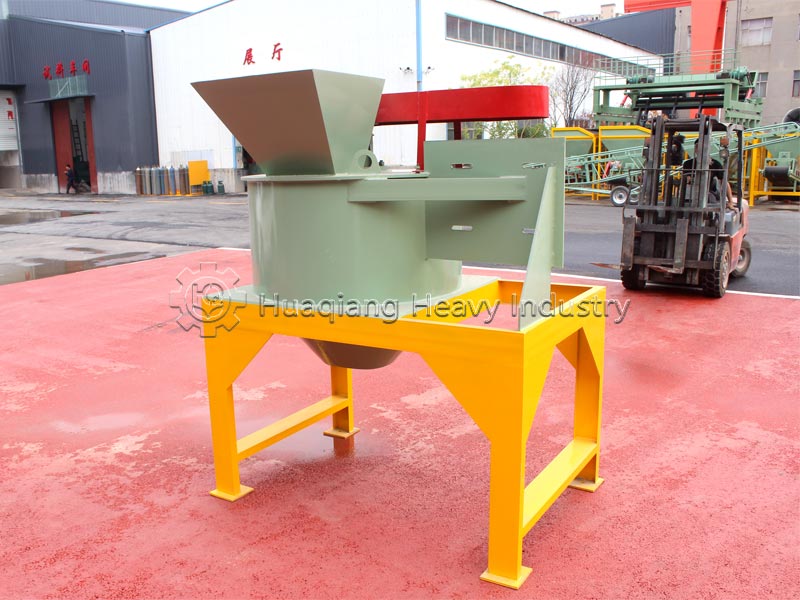
The core logic of pre-processing equipment for high-fiber materials is "cutting" rather than "crushing." Traditional hammer mills rely on high-speed impact to crush materials, which easily leads to screen clogging and shaft winding when dealing with high-moisture fibers. The proportion of fine powder is also difficult to control, which exacerbates the risk of material blockage during subsequent granulation. A more suitable option is a rotor or blade assembly with shearing function: A semi-wet material crusher uses a screenless dual-rotor structure, processing high-moisture fibrous materials with a moisture content of 25%-55% through shearing and impact, providing good cutting effect for long fibers and preventing screen clogging; a vertical blade crusher uses alloy blades with staggered cutting, specializing in coarse fibrous organic raw materials, suitable for both dry and wet applications, and provides thorough cutting, reducing fiber entanglement at the source. If the fiber content is high and the material is tough, a pre-shearing process can be added before the main crushing to coarsely cut long straw and forage to a few centimeters before entering the fine crushing stage, avoiding overload caused by feeding all at once. When selecting a model, priority should be given to confirming whether the blade assembly is primarily for shearing and whether it is suitable for the actual moisture content of the material, rather than just looking at the nominal capacity.
The influence of fiber length on particle strength is two-sided; it is not necessarily "the shorter the better." If fibers are too short (e.g., all ground into fine powder), the granules lack internal skeletal support, resulting in decreased strength. If fibers are too long, they tangle and create large pores within the granules, also compromising strength. The practical balance is that cutting fibers to below 5 mm restores flowability and pelletizing properties, but excessive ultra-fine grinding is unnecessary. For straw fibers, some sources suggest that controlling the raw material's pulverized length to below 3 mm yields the highest particle density and pelletizing rate. Finer fibers are more evenly distributed in the granules, resulting in more contact points after compaction and increased compressive strength; however, if the fibers are so fine that they lose their skeletal function, the granules are prone to brittleness after drying. A reasonable approach is graded control: coarse fibers are first cut to below 5 mm to prevent tangling, then excessively long fibers are further refined through sieving or secondary grinding, retaining an appropriate amount of short fibers as the internal skeletal structure, balancing flowability and strength.
Q: Can straw-based raw materials be directly fed into a disc pelletizer without pretreatment?
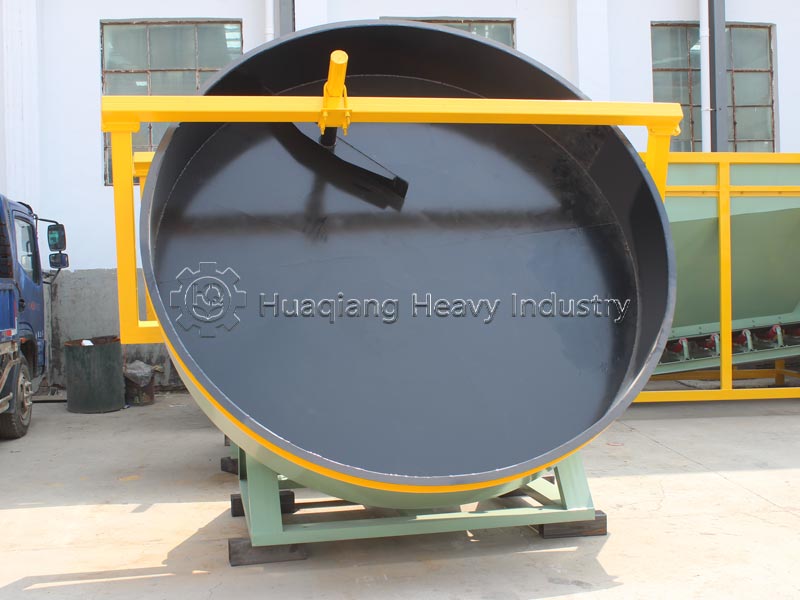
No. Straw, being a high-coarse-fiber raw material, is prone to entanglement and jamming when directly fed into pelletizing equipment, a typical cause of disc and drum clogging. Disc pelletizing relies on rolling to form pellets; however, long fibers cannot be effectively dispersed within the disc, instead becoming increasingly compacted and clump-like, preventing proper particle bonding and significantly reducing the pelleting rate. The correct pretreatment method is to first crush or shear the straw to below 5 mm, then mix it with sticky materials such as livestock manure in a specific ratio. The binding properties of the manure compensate for the straw's lack of viscosity; if necessary, a small amount of bentonite or humic acid can be added to aid pelleting. If the straw content is very high, exceeding 25% fiber, the disc method is unsuitable; flat die extrusion or roller pressing should be considered instead of "bluntly" pelletizing on the disc.
The solution to material jamming in high-fiber raw material pelletizing lies not inside the pelletizer, but before feeding. By accurately measuring the fiber content, cutting long fibers to below 5 mm, changing the shearing equipment from "hammering" to "shearing," and selecting a matching granulation process based on the fiber ratio, the material jamming problem can be eliminated at its source.