
2026-06-01
What is a 5-10 ton/hour fertilizer production line?
This refers to a medium-sized production system that stably produces 5 to 10 tons of finished compound fertilizer or organic fertilizer per hour. This is currently the investment scale range most favored by regional fertilizer companies, large planting cooperatives, and agricultural service companies. Compared to micro-production lines, it possesses industrial-grade process stability; compared to hundred-ton-level industrial lines, its investment threshold and payback period are more suitable for medium-sized operators.
I. The Watershed Moment in Granulation Machine Selection
The first major variable in cost comes from the choice of granulation method. For a production capacity target of 5-7 tons/hour, disc granulators are an economical solution due to their lower main unit purchase cost and simple installation requirements, but their granulation uniformity depends on operational experience. When the target increases to 8-10 tons/hour, drum granulators with steam regulation systems become the industry standard configuration—by injecting saturated steam to stabilize the material temperature in the 60-70 degree Celsius range, the granulation pelletizing rate can be increased from 65% to over 85%. This main unit upgrade will increase the cost of the core equipment for the entire production line by about 40%, but it will also significantly reduce the energy consumption of the return material cycle.
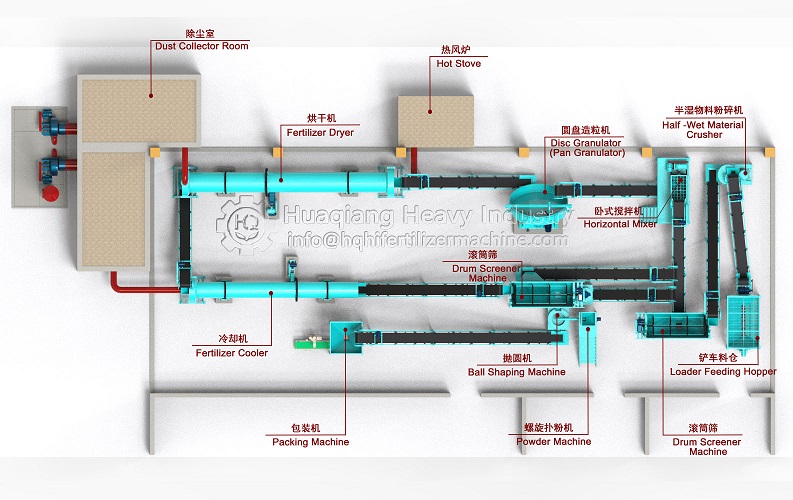
II. Matching of Heat Source and Size in the Drying System The moisture content of freshly granulated fertilizer is typically between 12% and 15%, and must be reduced to below 3% before it can enter the packaging stage. A 5-ton/hour production line is suitable for a rotary dryer with a diameter of 1.5 meters and a length of 12 meters, using biomass pellets or a coal-fired hot air furnace as the heat source; while a 10-ton/hour production line requires a drying drum with a diameter of 2.0 meters and a length of more than 15 meters, and it is recommended to configure a natural gas combustion system to achieve a precise temperature control curve. The overall cost of the drying and cooling unit almost doubles in this range, but the heat consumption per unit product can be reduced by 15%-18%. In the long run, the savings in fuel costs will gradually offset the difference in initial investment.
III. Marginal Advantages of the Automated Batching System In the leap in capacity from 5 tons to 10 tons, the cost of the PLC-controlled automated batching system does not increase proportionally. A system comprising 4 to 6 raw material silos, dynamic weighing sensors, and variable frequency screw feeders has a hardware cost difference of less than 30% between two production lines. This is because the core control logic and host computer software are completely reused; the main difference lies in the physical specifications of the feeders. This means that the investment percentage for automation systems in a 10-ton/hour production line is actually lower, while reducing manual material handling positions by two to three per shift, resulting in a shorter payback period in a market environment with high labor costs.
Comprehensive Cost Range and Investment Recommendations
Based on the above analysis of physical dimensions, the approximate range for equipment procurement costs (excluding plant, foundation, and environmental approvals) for a complete production line from raw material crushing to finished product packaging is as follows: $90,000 to $140,000 for a 5-ton/hour line, approximately $120,000 to $180,000 for a 7-ton/hour line, and approximately $190,000 to $260,000 for a 10-ton/hour line. It is recommended to allocate an additional 10% to 15% of the budget for auxiliary equipment such as bucket elevators, belt conveyors, and dust collection systems—these "hidden costs" often have the longest commissioning periods but are indispensable rigid expenditures.
.jpg)
The granulation unit determines the production capacity benchmark, the drying system affects long-term energy consumption, and the level of automation balances labor costs—these three factors together constitute a complete evaluation framework for investment decisions in 5-10 tonnes/hour fertilizer production lines.
The 5–10 ton/hour capacity band represents a critical inflection point where granulation platform selection decisively shapes both capital outlay and long-term operating economics. Within the organic fertilizer granulator series, a disc granulator machine offers the lowest entry threshold for 5–7 ton/hour operations, rewarding skilled operators with spherical pellets at modest equipment cost. As throughput targets approach 8–10 tons/hour, a rotary drum granulator with steam injection becomes the industry-standard anchor of a robust npk fertilizer production line, boosting pelletizing rates from 65% to over 85% while reducing recycle energy penalties. For producers seeking to bypass thermal drying entirely, fertilizer granules compaction through a high-pressure fertilizer compactor delivers dense, durable pellets directly from low-moisture feedstock, eliminating the fuel-intensive drying-cooling train. Regardless of whether the chosen fertilizer granulator machine relies on steam agglomeration or mechanical extrusion, the decisive investment criterion remains the three-way balance among granulation capacity benchmark, drying system energy profile, and automation level—ensuring that every dollar of capital aligns with the operator's raw material constraints, labor cost environment, and market price sensitivity.
Our company can customize full-specification fertilizer production lines of 5-10 tonnes/hour to meet your needs, providing a one-stop solution with complete equipment and implementation plans to help customers achieve efficient production and revenue generation.