
2026-05-08
In fertilizer production, traditional granulation processes often require a lengthy process of "adding water—drying—re-screening." This not only consumes a large amount of energy but also increases equipment investment and dust emissions. Is there a simpler method? Fertilizer granule compactors provide a definite answer.
Working Principle: High-Pressure Compaction, Room-Temperature Forming
The core of a granule compactor (also known as a double roller press granulator) is a pair of horizontally mounted, relatively rotating high-precision rollers. The surfaces of the two rollers are evenly distributed with hemispherical, rod-shaped, or rhomboid grooves. When dry powder material is forcibly fed from above into the wedge-shaped gap between the two rollers, it is subjected to enormous linear pressure (typically reaching 30-50 tons/cm).
Under this pressure, the originally loose powder particles are rearranged, compressed, and deformed, shortening the distance between adjacent particles to a level where intermolecular forces are sufficient to create a strong bond. The material is compressed into continuous sheets or strips, which naturally fracture after leaving the rollers. After passing through a granulator and screening machine, regular granules are obtained.
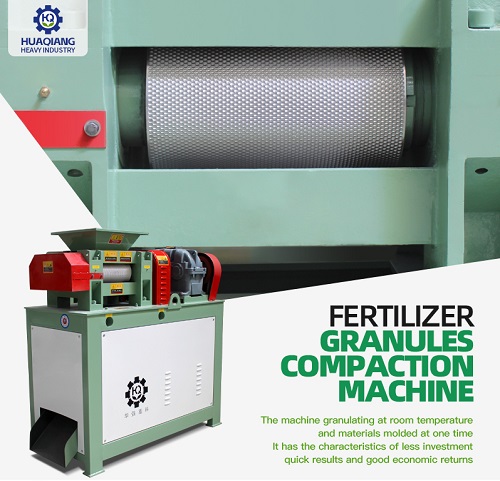
The entire process is carried out at room temperature, requiring no added water or steam, and eliminating the need for subsequent hot air drying.
Core Advantages: Low energy consumption, short process, and less environmental pressure.
Compared to the traditional rotary drum granulation + drying process, the granulator compaction route has significant advantages:
1. Significantly reduced energy consumption. The rotary drum process consumes approximately 40-60 kg of standard coal per ton of product (including electricity for the hot air furnace and coal/gas).
The compaction process only consumes electricity for the motor driving the rollers, requiring only 25-35 kWh per ton of product, equivalent to approximately 10-14 kg of standard coal. Energy savings reach 60%-70%.
2. Significantly Shortened Production Process
Traditional Process: Batching → Mixing → Granulation → Drying → Cooling → Screening (6 steps)
Compaction Process: Batching → Mixing → Compaction → Crushing → Screening (5 steps, eliminating the need for two large drying and cooling equipment sets)
A complete compaction production line occupies approximately 30% less floor space than a rotary drum line, reducing equipment investment by approximately 20%-25%.
3. No Wastewater, Low Dust
No water addition is required, therefore no process wastewater is generated.
The equipment adopts a fully enclosed design, with dust collection pipes connected to the inlet and outlet, allowing for centralized dust collection and return to the system for regranulation, achieving a material utilization rate of nearly 100%. Applicable Raw Materials and Precautions
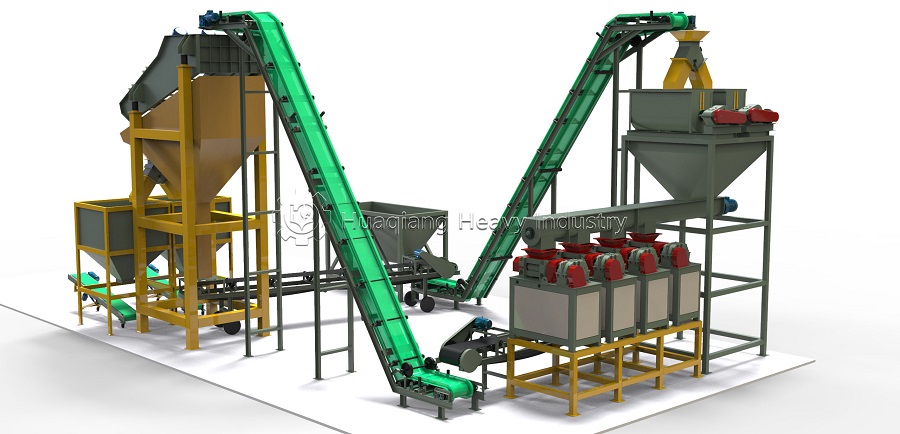
The compactor has a wide range of adaptable raw materials, but there are some specific requirements:
Ideal Raw Materials:
Compound Fertilizer Powder: Potassium chloride, potassium sulfate, ammonium sulfate, diammonium phosphate (used alone or in mixtures)
Organic Fertilizer Powder: Pure organic materials with a post-fermentation moisture content ≤12% and a particle size ≤0.5mm
Organic-Inorganic Compound: Premixed materials in a specific ratio
Situations to Avoid:
Raw material moisture content exceeding 15%: Moisture acts as a lubricant, causing the rollers to slip and preventing sufficient pressure from being built up.
Contains coarse fibers or hard particles: Such as uncrushed straw segments or small stones, which can get stuck in the roller grooves and damage the roller surface.
High urea formulation (exceeding 30%): Urea is viscoelastic and easily adheres to the roller surface, leading to poor demolding. A small amount of clay or talcum powder can be added to alleviate this.
When selecting a pellet compactor, focus on three parameters:
Roller Material: For compound fertilizer, use alloy steel with a welded wear-resistant layer; for organic fertilizer, use 304 stainless steel with an anti-stick coating.
Feeding method: Materials with good flowability should be fed by gravity; materials with high viscosity and easy bridging (such as humic acid powder) must be equipped with a forced screw feeder.
Pelletizing system: The matching crusher and grading screen should be able to handle the extruded flakes. A double-rotor hammer crusher is recommended, with the screen aperture selected at 80% of the target particle size.
The fertilizer granule compactor (double roller press granulator) achieves fertilizer granules compaction through high-pressure, room-temperature forming. It is a key fertilizer compactor in dry granulation technology. Compared to a rotary drum granulator (wet process) used in traditional npk fertilizer production lines, the compactor offers significant advantages: energy savings (60%-70%, 25-35 kWh/ton vs. 40-60 kg coal/ton), shortened process (5 steps vs. 6, eliminating drying/cooling), reduced footprint (30% less), lower equipment investment (20%-25% less), zero wastewater, and low dust (enclosed design). In the npk fertilizer production process, the compactor eliminates the need for a dryer and cooler. For organic fertilizer production granulation, a flat die pelleting machine is another dry compaction option, but the roller compactor is preferred for higher capacity. The compactor is a member of the organic fertilizer granulator series for organic-inorganic blends. Suitable raw materials: compound fertilizer powder (potassium chloride, potassium sulfate, DAP), organic fertilizer powder (moisture ≤12%, particle size ≤0.5mm), and organic-inorganic blends. Avoid moisture >15%, coarse fibers, hard particles, and high urea formulations (>30% urea may stick). This fertilizer compaction technology is ideal for producers seeking energy efficiency, lower emissions, and a simpler process. Small-scale tests to verify granulation properties are recommended before customizing equipment parameters. Understanding the distinct roles of fertilizer compactor vs. rotary drum granulator is key to selecting the optimal fertilizer compaction technology for your raw materials and production goals.