
2026-03-24
In fertilizer production equipment procurement, the selection of granulators often presents a dilemma for enterprise decision-makers. While both rotary drum granulators and disc granulators are core equipment in wet granulation, their working principles and performance differ, making them suitable for completely different production scenarios. Choosing the wrong model can result in efficiency losses of up to half or even complete line shutdown. This article will clarify the selection logic for overseas fertilizer companies from three dimensions: core principles, advantages and disadvantages, and suitable scenarios.
Core Principle Differences: Centrifugal Force vs. Gravity Classification
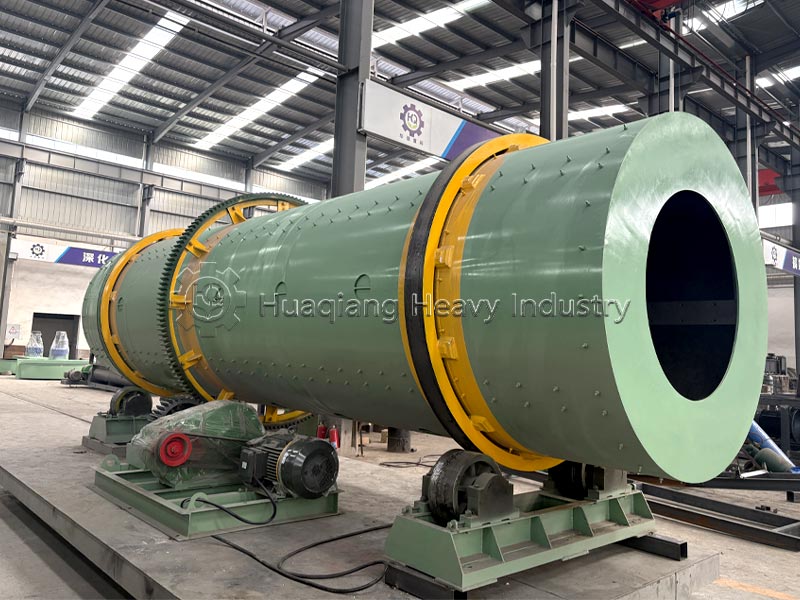
A rotary drum granulator is a tilted, rotating cylinder. Material rises along the cylinder wall inside, then falls in a waterfall-like manner after reaching a certain height. Humidified by steam or water atomization, the powder agglomerates into spheres during rolling, while simultaneously, under centrifugal force, smaller particles gradually roll towards the discharge end. Its core principle is "continuous rolling and dynamic spherical formation," making it suitable for large-scale continuous production.
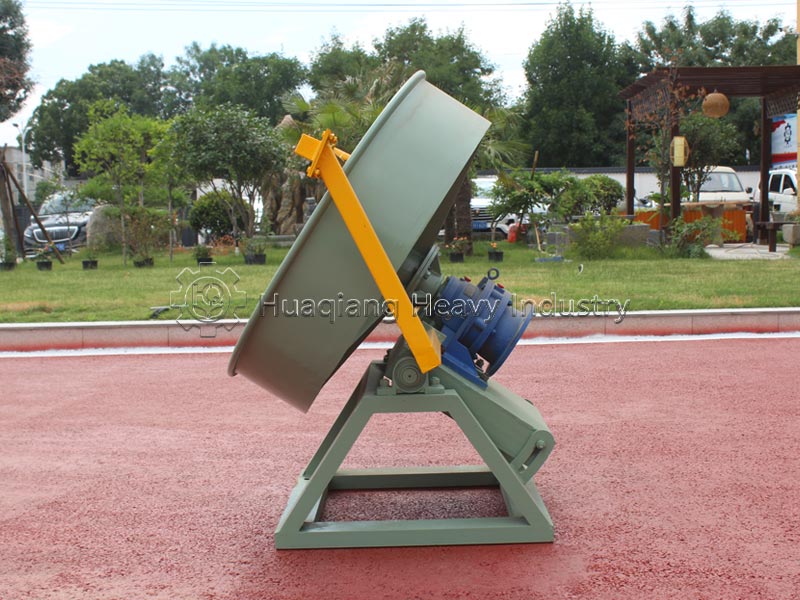
A disc granulator machine is an inclined disc on which materials move in a circular motion. Due to gravity, larger particles float to the top and smaller particles sink to the bottom, achieving automatic particle classification and discharge through "gravity grading." Operators can precisely control the particle size by adjusting the tilt angle and rotation speed.
Advantages and Disadvantages Comparison: Efficiency vs. Precision
The core advantage of a rotary drum granulator lies in its "high efficiency and continuous operation." A single machine can achieve a capacity of 10-20 tons/hour, operate 24 hours a day without interruption, and seamlessly integrate with upstream and downstream equipment, making it a standard feature of large-scale compound fertilizer production lines. However, its control precision is relatively limited—the particle size distribution is relatively wide (2-5mm), requiring a screening system to recover returned material. Simultaneously, the steam conditioning system is complex, resulting in a higher operational threshold.
Disc granulators, on the other hand, excel in "precision and flexibility." With stepless adjustment of tilt angle (35°-55°) and rotation speed (10-20 r/min), the particle size can be precisely controlled within the range of 1-5 mm, achieving a particle uniformity of up to 95%. The equipment has a simple structure, low investment, and a relatively small single-machine processing capacity (0.5-3 tons/hour). Operation is intuitive, requiring only one person to operate. The disadvantages are weak continuous production capacity and limited batch processing efficiency.
Suitable Scenarios: Scale Determines Machine Type
Drum granulators are the ideal choice for large-scale compound fertilizer production. Whether it's a pure NPK production line with an annual output of over 100,000 tons or a large-scale blended fertilizer base, drum granulators maximize overall line efficiency due to their continuous and high-capacity characteristics. Especially when integrated with automatic batching and DCS control systems, 24-hour unattended operation can be achieved.
Disc granulators are more suitable for refined, small- to medium-scale production. For organic fertilizer plants and organic-inorganic compound fertilizer production lines with an annual output of 10,000-30,000 tons, or scenarios requiring frequent formula switching (such as alternating production of high-nitrogen and high-phosphorus types), the flexibility and precise control advantages of disc granulators are prominent. Furthermore, they have a wide adaptability range for material moisture content (15%-25%), making them particularly suitable for processing fermented organic materials.
Selection Recommendations and Equipment Recommendations
For customers planning to build large-scale compound fertilizer plants with an annual output of over 100,000 tons, rotary drum granulators are the core choice. We recommend our R-series rotary drum granulators, which employ variable frequency speed regulation and an intelligent temperature control system, improving particle uniformity to over 92% and reducing steam consumption per ton by 18%.
For small- to medium-scale organic fertilizer or organic-inorganic compound fertilizer production, disc granulators are more suitable. Our D-series disc granulators are equipped with spiral guide plates and an atomizing humidification system, achieving a stable forming rate of 90%-95%, and particle roundness meeting the requirements of the high-end market.
From prioritizing efficiency to prioritizing precision, rotary drums and disc drums each have their own approach. Only by basing decisions on actual production capacity and product positioning can the optimal choice be made.
The comparison between rotary drum and disc granulators highlights a fundamental choice in fertilizer production machine technology. While both are wet granulation methods, their operational scales and precision differ. However, it's important to consider these alongside other granulation technologies. For dry compaction, a double roller press granulator within a roller press granulator production line achieves fertilizer granules compaction without heat or binders, offering an energy-efficient alternative. For producing premium spherical granules in smaller volumes, a disc granulator machine excels. For very small-scale or specialty applications requiring simple cylindrical pellets, a flat die pelleting machine provides a low-cost, flexible entry point. The choice is therefore not simply between a rotary drum granulator and a disc granulator machine, but about selecting the optimal technology from the entire spectrum of fertilizer production machine technology. A large-scale NPK plant will naturally gravitate towards the high capacity of a rotary drum granulator. A smaller organic fertilizer producer will find the precision and low investment of a disc granulator machine ideal. For a producer focused on dry, moisture-sensitive formulations, a double roller press granulator might be the best path. Matching the technology to the specific raw material, scale, and product goal is the key to an optimal investment.