
2026-03-14
In the large-scale production of NPK compound fertilizer, achieving continuous and efficient granulation while ensuring particle strength has always been a key technological challenge. Rotary drum granulators, with their steam-assisted compaction process, combine "rolling agglomeration" with "thermodynamic plasticization," becoming core equipment in large-scale compound fertilizer production lines. This article will delve into its technical principles and core advantages.
Core Mechanism of Steam-Assisted Compaction
The steam-assisted compaction process in rotary drum granulators essentially optimizes the physical forming conditions of particles through thermodynamic means. The material propels forward within the rotating drum while saturated steam at 0.3-0.5 MPa is introduced. The steam's effect is manifested in three aspects: increasing the material temperature to 60-80℃, softening the particle surface and enhancing plasticity; increasing the liquid phase ratio, promoting capillary forces between particles; and releasing latent heat through partial steam condensation, providing energy for chemical bonding between materials. Under this synergistic thermodynamic effect, the particles gradually compact during rolling, increasing the forming rate to over 90%.
Integrated Compaction and Granulation Process
The rotary drum granulator integrates compaction and granulation into a continuous workflow. Material is precisely proportioned by an automatic batching system and then enters the drum via a belt conveyor. The drum rotates at 15-25 r/min, and the material rises along the drum wall to a certain height before cascading down in a waterfall-like manner, forming a dense material curtain. Steam nozzles are positioned at the feed end of the drum, ensuring full contact between the steam and the material, wetting and softening the powder surface. Through repeated rolling and impact, small particles gradually agglomerate and grow, eventually forming uniform granules of 2-4 mm. The discharged granules go directly into a dryer, where they are dried at low temperature, screened, and packaged. Unqualified granules are returned for reuse.

Key Parameter Control: Precision Determines Quality
The effectiveness of steam-assisted compaction highly depends on the precise control of key parameters. Steam pressure is the core parameter—too low a pressure results in insufficient plasticization of the material and loose granules; too high a pressure causes the material to become too wet and sticky, leading to blockages. During operation, the pressure should be maintained within the range of 0.3-0.5 MPa, and fine-tuned according to the characteristics of the raw materials. The drum speed affects the particle residence time and rolling intensity; an adjustment range of 15-25 r/min can meet the granulation requirements of different formulations. The inclination angle is usually set at 2°-4° to control the material's propulsion speed within the drum, ensuring sufficient time for particle rolling and forming.
Advantages Compared to Traditional Compaction Processes
Compared to dry compaction in roller extrusion granulation, steam-assisted compaction in rotary drum granulation exhibits differentiated advantages. In terms of energy consumption, although a steam boiler is required, the single-unit capacity can reach 10-20 tons/hour, and the energy consumption per unit product is lower than that of multiple small machines operating in parallel. In terms of efficiency, continuous operation increases the overall production line efficiency by more than 40%, making it particularly suitable for large-scale production bases with an annual output of over 100,000 tons. In terms of particle quality, steam-assisted forming results in higher particle roundness and a smoother surface, with a finished product yield of up to 95% after screening.
Technological Upgrades and Equipment Highlights
Modern rotary drum granulators are continuously upgraded based on steam-assisted processes. The rotary drum granulator employs a rubber or acid-resistant stainless steel lining for automatic scar and nodule removal, eliminating the need for traditional scraper devices and reducing maintenance frequency. A variable frequency speed control system automatically adjusts the rotation speed according to the load, providing energy on demand. An intelligent control system monitors temperature, pressure, and current parameters in real time, automatically adjusting the steam addition and feeding speed to ensure stable granule quality. For enterprises pursuing large-scale, continuous, and high-quality compound fertilizer production, the steam-assisted compaction process of the rotary drum granulator is a core technological support for achieving breakthroughs in production capacity and quality upgrades.
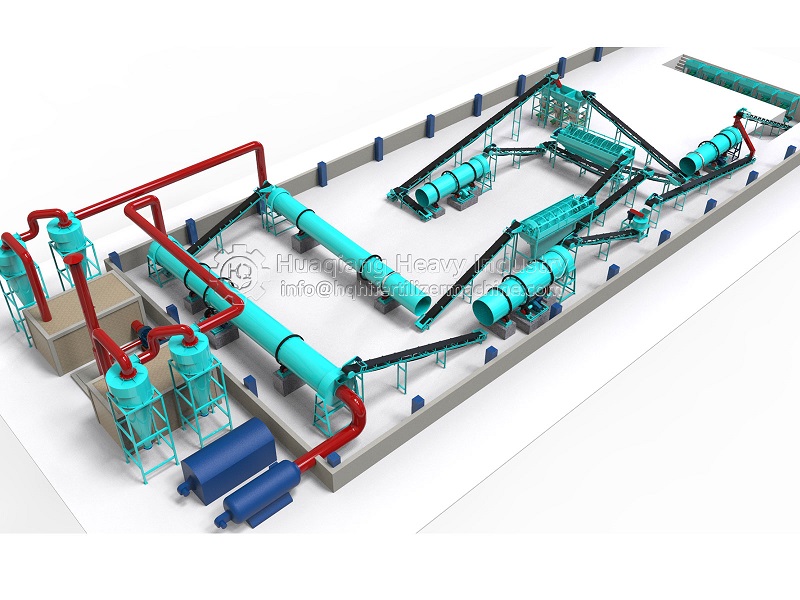
Steam-Assisted Compaction in Rotary Drum Granulators
The steam-assisted compaction process of the rotary drum granulator represents a sophisticated form of fertilizer granules compaction, leveraging heat and moisture to enhance particle formation. This contrasts significantly with purely mechanical dry compaction methods. A double roller press granulator, for instance, achieves fertilizer granules compaction solely through immense pressure, creating dense, hard granules without any thermal energy. This makes it ideal for moisture-sensitive materials but produces granules with a different physical structure. A flat die pelleting machine also uses mechanical pressure, extruding material through a die to create simple cylindrical pellets, a form of compaction suited for smaller-scale or specialty applications. In contrast, a disc granulator machine relies on a tumbling, agglomeration process with added liquid, producing spherical granules but without the densifying effect of pressure. The rotary drum granulator's steam-assisted method occupies a unique middle ground. It combines the agglomeration of a tumbling bed with the thermodynamic softening and binding action of steam, resulting in granules that are both round and dense. This synergy makes it the preferred technology for large-scale production of high-quality compound fertilizers, where the combination of high throughput, excellent particle characteristics, and efficient continuous operation is paramount.