
2026-01-21
Granulation is a critical process in fertilizer manufacturing that transforms fine powder raw materials into granular forms, enhancing handling, storage, and application efficiency. There are two primary types of granulation techniques in this industry: Dry Granulation and Wet Granulation. The fundamental distinction between the two lies in whether a liquid solution or binder is employed during the granulation process. Each method boasts unique processes, applicable scenarios, equipment requirements, and advantages and disadvantages, making them suitable for different production needs and fertilizer formulations.
Dry Granulation, also known as extrusion granulation, relies solely on mechanical pressure to bond powder particles, without the addition of water or any liquid binders. The process starts with raw materials that have low moisture content, typically below 10%. These dry powders are fed into a double roller extrusion granulator, where they are squeezed between two counter-rotating rollers under high pressure. This intense mechanical force compacts the powder into dense sheets or "slugs." Subsequently, these slugs are crushed into smaller particles and screened to obtain granules of the desired size. This method is particularly well-suited for moisture-sensitive or heat-sensitive fertilizers, as the absence of liquid and heat prevents nutrient degradation. It is also an ideal choice for small-to-medium-scale production operations.
The key advantage of Dry Granulation is its high energy efficiency. Since no liquid is added, it eliminates the need for subsequent drying and cooling processes, which are energy-intensive steps in other granulation methods. However, this technique has inherent limitations. The granules produced are usually irregularly shaped or oblate (flat), which is less visually appealing compared to the spherical granules from wet methods. Additionally, Dry Granulation typically has lower production rates than wet granulation, making it less suitable for large-scale commercial production demands.
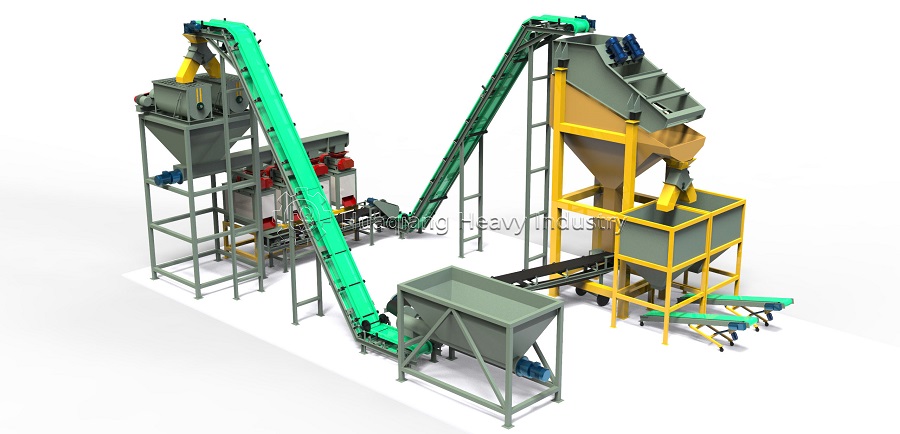
Wet Granulation, or agglomeration, is the most common industrial granulation method. It utilizes a liquid binder—such as water, steam, or chemical slurries—to facilitate the bonding of powder particles. The process involves agitating the fertilizer powder in a rotating device, while the liquid binder is uniformly sprayed onto the powder. The tumbling action of the rotating equipment causes the powder particles to stick together, either growing into spherical granules through agglomeration or forming layered "onion-skin" structures via accretion. This method is optimal for large-scale commercial production, especially for compound fertilizers like NPK. It is also preferred for formulations that require high-strength, spherical granules, which offer better flowability and uniformity during application.
The main equipment used in Wet Granulation includes rotary drum granulators, disc (pan) granulators, and spray/high-tower granulation systems. The primary advantage of this method is the production of uniform, high-quality, and aesthetically pleasing spherical granules that meet the strict requirements of large-scale agricultural applications. However, Wet Granulation is more energy-intensive and costly. The added liquid binder means the finished granules must undergo extensive drying and cooling processes to remove excess moisture, which consumes significant energy and increases production costs.
In conclusion, Dry Granulation and Wet Granulation are the two core techniques in fertilizer manufacturing, differentiated by the use of liquid binders. Dry Granulation excels in energy efficiency and suitability for sensitive materials and small-scale production, while Wet Granulation is favored for large-scale commercial operations and high-quality spherical granules. Understanding the characteristics of each method allows fertilizer manufacturers to select the most appropriate granulation technique based on their production scale, fertilizer type, and quality requirements, ultimately optimizing production efficiency and product performance.
Strategic Integration of Granulation within Production Systems
The choice between dry and wet granulation is a fundamental decision in designing an organic fertilizer manufacturing system or an npk fertilizer manufacturing process. Dry granulation, specifically fertilizer granules compaction via a roller press granulator production line, is a core fertilizer production machine technology. This method uses a high-pressure fertilizer compactor and is ideal for moisture-sensitive materials, avoiding the need for drying. In contrast, the wet npk manufacturing process typically employs rotary drum granulation to produce spherical pellets.
For organic systems, the production chain often begins with aerobic decomposition using a windrow composting machine. The cured compost is then granulated, and the choice of fertilizer production machine depends on the material's properties. Dry fertilizer compaction can be effective for powdery, low-moisture organic blends, while wet pan or drum granulators are better for materials that can accept a binder. Thus, the granulation technology is not selected in isolation but is integrally linked to the characteristics of the feedstock and the overall system design.
Ultimately, the selection of granulation equipment dictates the energy profile, product characteristics, and scalability of the entire production line. A sophisticated manufacturing system seamlessly integrates the chosen granulation method with upstream and downstream processes to optimize both economic and agronomic outcomes.