
2026-11-13
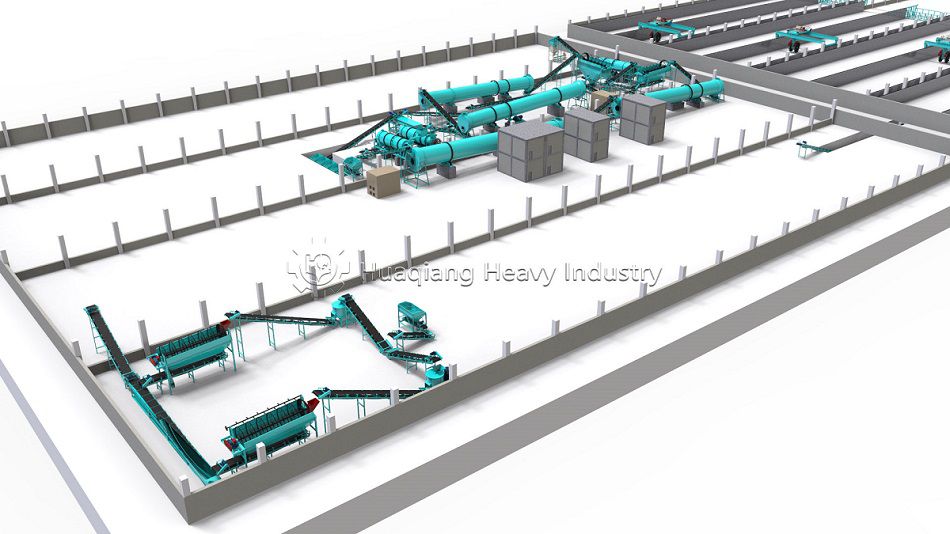
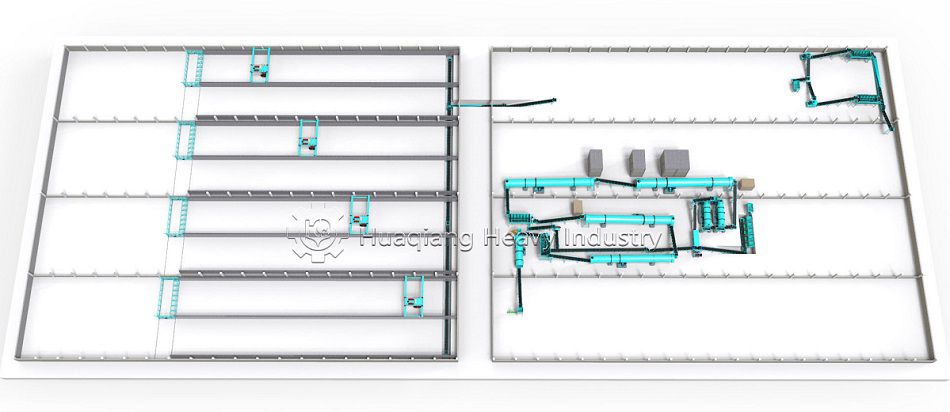
In organic fertilizer production lines, the processing capacity of the fermentation section determines the overall production capacity ceiling. Traditional trough-type compost turners are limited by span and single-unit processing capacity, often requiring multiple units in parallel in projects with a capacity of tens of thousands of tons or more. The structural difference of the large-disc compost turner lies in replacing multiple sets of small-diameter turning shafts with a single large-diameter disc, significantly increasing the lateral width and depth of coverage in a single rotation.
According to the structural parameters given on the official product page, the core working component of the large-disc compost turner is a hollow disc welded from high-strength steel, with a diameter of 5-10 m and wear-resistant alloy steel turning teeth arranged spirally or radially at 30-60 cm on the edge. During operation, the disc rotates at 10-20 rpm, using centrifugal force and the cutting action of the teeth to lift, scatter, and re-staple the material. The transmission system employs a fully enclosed gear set for direct drive, providing strong resistance to impact loads. The walking device moves longitudinally along the tracks on both sides of the trough at a speed of 1-15 m/min. Combined with hydraulic lifting and lateral movement mechanisms, it achieves real-time adjustment of the turning depth and "no dead angle" coverage.
These structural features result in clear production capacity indicators: a turning depth of 1.5-3 m, a maximum turning width of 30 m, and energy consumption reduced by approximately 70% compared to traditional turning equipment for the same workload. With the support of a fully automatic electronic control system, unattended continuous operation is possible. For the granulation section requiring continuous feeding at the downstream end, the ability of the turning machine to stably and evenly discharge material at the designated pace is more important than the depth at which a single machine turns the material.
Moisture conditions to be aware of: The official organic fertilizer process article points out that the feed moisture window for wet disc/drum granulation is typically around 25%-35%, while the large disc turning machine is suitable for fermentation raw materials with a moisture content of around 55%. There is an aging/moisture reduction stage between the two processes, which must be reserved in the production line configuration. The output from the turning machine cannot be directly fed into the granulator.
In wet granulation, drums and discs are not interchangeable, but rather two stages on the same line with different process objectives. The official website's selection comparison article clearly explains this division of labor: Drum granulators use a horizontal drum with axial tumbling, relying on lifting plates and repeated collisions to agglomerate materials. Single-machine capacity is 5-50 t/h, suitable for large-scale continuous production, but the sphericity of the pellets is usually 75%-85%, requiring screening to ensure qualified pellets. Disc granulators use a spiral rolling ball mechanism within an inclined disc, with a capacity of 0.5-5 t/h. Particle size can be precisely controlled through adjustments to the tilt angle, rotation speed, and water spray volume, achieving a sphericity of over 90% and higher appearance quality. However, the single-machine scale is not suitable for supporting a continuous production line of tens of thousands of tons.
The logic of the series process thus becomes clear: the drum is responsible for "quantity" and "initial pelletizing," continuously and stably converting the tumbled and aged material into wet granules with a basic particle shape; the disc is responsible for "shape" and "receiving," handling the portion of the drum discharge that requires improved roundness and particle size control, bringing the sphericity and appearance to the finished product standard. The drum discharge doesn't all go into the disc; instead, after screening, it's divided according to particle size — qualified particles go directly to drying, while smaller and larger particles are sent to the disc for shaping or returned. This division of labor is also documented in the process patent for organic-inorganic compound fertilizers: the material first enters the rotary drum granulator, then the discharge enters the disc granulator for further granulation, followed by a second stage of drying.
The bottom line for capacity matching: If the rear disc only handles a portion of the drum discharge, the disc's capacity should be selected based on the amount requiring shaping after screening, not on the total drum discharge. If the goal is to achieve roundness of all granules through disc reshaping, the disc capacity needs to be aligned with the drum capacity. In this case, the "drum + disc" configuration effectively becomes a two-stage series granulation process, requiring a corresponding increase in the number or size of the discs.
| Process Section & Equipment | Key Parameters | Downstream Connection Requirements |
|---|---|---|
| Compost Turning: Large Disc Turner | Disc diameter: 5–10 m; turning depth: 1.5–3 m; max span: 30 m; rotating speed: 10–20 rpm | Discharge moisture approx. 55%; need curing / auxiliary material adjustment to reach the wet process window of 25%–35% |
| Curing & Moisture Reduction: Curing Silo / Re-mixing Section | Target moisture: 25%–35% | Feed into granulation only after moisture meets the window for rotary drum / disc granulation |
| Continuous Balling: Rotary Drum Granulator | Capacity: 5–50 t/h; sphericity: 75%–85% | Discharged material is separated by screening: qualified pellets go to drying; pellets needing shaping go to disc for fine rounding |
| Fine Rounding: Disc Granulator | Capacity: 0.5–5 t/h; roundness ≥90%; adjustable inclination angle | Disc discharge mixes with qualified undersize pellets from drum screen and then enters drying |
| Drying & Cooling: Rotary Dryer + Cooler | Inlet moisture of wet pellets: 20%–35%; dried to safe storage moisture | Drying load shall match the total wet material flow from drum and disc granulators |
How to use this table: First, determine the turning depth and span of the large disc reshaping machine to deduce the daily processing capacity of the fermentation tank/winding stack; then, based on the range to which the moisture content can be stably compressed in the aging section, determine the specifications of the drum granulator; finally, determine the number or model of the disc granulator according to the "proportion requiring disc shaping after screening." Skipping the connection conditions and directly selecting a single machine at any step will lead to moisture mismatch or capacity mismatch in the granulation section.
Q1: The moisture content of the material output from the large disc reshaping machine is around 55%. Can it be directly fed into the drum granulator?
No. The wet granulation window for drum and disc granulators is typically 25%-35%. Fermentation output of 55% is far above this range, and direct feeding into the drum can cause material to stick to the drum walls and shrunk uncontrollably. An aging and moisture reduction stage needs to be set between the turner and the granulator. By extending the aging period, turning, or remixing dry auxiliary materials, the moisture content is reduced to the granulation window before entering the drum.
Q2: The sphericity of drum granulators is only 75%-85%. How much can adding disc granulators improve it?
Disc granulators can achieve sphericity of over 90%, but they can only process the portion of material entering the disc. To improve the overall sphericity of the finished product, the oversized or undersized particles from the drum output need to be fed into the disc, rather than expecting the disc to "remodel" the entire drum output. The disc granulator's capacity of 0.5-5 t/h also means it typically handles diversion shaping rather than full-line series shaping; the number of units should be calculated based on the diversion ratio when configuring the granulator.
Q3: How to choose between this line and the "all-disc" or "all-drum" route?
The all-disc line is suitable for small to medium-sized projects with an annual capacity of 10,000-30,000 tons, focusing on the appearance of retail pellets as a key selling point. It has low investment and good roundness, but the scale of a single machine cannot support large-scale production. The all-drum line is suitable for large-scale continuous lines with a capacity of over 50,000 tons, where the requirements for sphericity are not extreme. It has high capacity, but the roundness depends on the return material from screening to ensure it. The drum + disc combination is positioned between the two: the drum solves the problems of scale and continuity, while the disc solves some of the roundness and appearance problems of the materials. If the product is aimed at the high-end retail market and the scale is large, this combination has one more disc shaping step than the all-drum line and one more drum main line than the all-disc line, which is a configuration that balances capacity and appearance.