
2026-09-08
Why Can't a Large Flow of Water Be Used for Direct Spraying in a Disc Granulator? The Correct Operation Method for Atomized Spraying
The water spraying process in a disc granulator is crucial for determining pellet quality, but it must never be done by directly spraying a large flow of water onto the disc surface. This crude practice will severely damage the granulation process and pellet quality, directly leading to production failures.
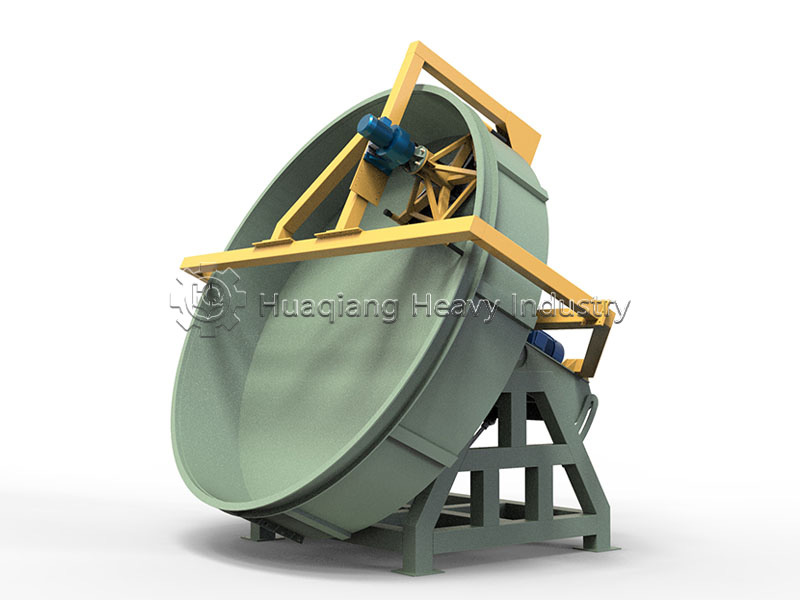
I. Why is Direct Spraying a Large Flow of Water a Major Taboo?
1. Disrupts the Pelletizing Mechanism, Leading to Uncontrolled Particle Size
The essence of disc granulation is that the powder gradually grows into a "snowball" as it rolls. Direct spraying a large flow of water will cause localized areas to become instantly over-wetted, forming large clumps of mud. These clumps rapidly bind with surrounding fine powder during rolling, quickly forming oversized particles (>8mm). Simultaneously, a large amount of fine powder cannot form pellets due to lack of water, resulting in a polarized particle size distribution – "the large ones are too big, and the small ones are too small," significantly reducing the pelletizing rate.
2. Poor Particle Strength and Rough Appearance: The water film distribution caused by direct water jetting is extremely uneven. In overly wet areas, the internal moisture content of the particles is too high, leaving numerous pores after drying, resulting in loose and brittle particles. In overly dry areas, effective adhesion cannot be formed, resulting in rough particle surfaces and severe powder shedding.
3. Severe Adhesion to the Walls and Frequent Shutdowns: Direct water jetting causes a large amount of wet material to splash and adhere to the disc surface and edges, forming a thick layer of wet material. If not cleaned promptly, the adhered layer continues to thicken, changing the effective diameter and tilt angle of the disc surface, disrupting the granulation process, and in severe cases, even causing motor overload and tripping.

II. Correct Operation Method of Atomizing Spraying
1. Use Dedicated Atomizing Nozzles: Fan-shaped or cone-shaped atomizing nozzles should be used to disperse water into a fine water mist with a diameter of 50–200 micrometers. The water mist evenly covers the material surface, forming a thin and uniform water film on the surface of each particle, ensuring a gentle and controllable granulation process.
2. Control the Spray Position
The nozzle should be installed above the annular area between the center and edge of the spray pan—this is the area with the most active material flow and the most vigorous powder tumbling, allowing the water mist to mix quickly with the material. Avoid spraying directly onto the pan surface, edge, or areas with large, already formed particles.
3. Follow the "Small Amounts, Frequent Application" Principle
Use intermittent spraying, pausing for a few seconds after each spray to observe the balling state of the material before deciding whether to add more water. Adhere to the principle of "adding small amounts frequently," erring on the side of adding more water multiple times rather than adding too much at once.
4. Master the "Hand-Grab Cushion" Judgment Criterion
The most practical rule of thumb is: grab a handful of material from the pan; if it can be formed into a ball when squeezed in your hand and easily disperses upon light touch, this indicates the ideal moisture state. If water is squeezed out after forming a ball, it means too much water has been sprayed; stop adding water immediately and add dry powder to adjust the material.
III. Comprehensive Recommendations
The correct spraying operation is "using water where it's most needed"—using the least amount of water, the finest mist, and the most precise positioning to maximize the balling effect. It is recommended to set initial spray parameters based on the characteristics of the raw materials before production, and to have skilled operators monitor the entire production process, making real-time adjustments based on the pellet formation. After adopting standardized atomized spraying, the pellet formation rate can be stabilized at 85%–95%, and both the appearance and strength of the pellets are significantly improved.