
2026-07-09
Answer: Saline-alkali soils have high pH, high salt content, low organic matter content, and poor physicochemical properties. Fertilizing such soils, if the fertilizer selection or application method is inappropriate, can exacerbate crop damage through a chain reaction of "salt accumulation - intensified alkalization - nutrient inactivation." Fertilization in saline-alkali land should strictly adhere to the following principles:
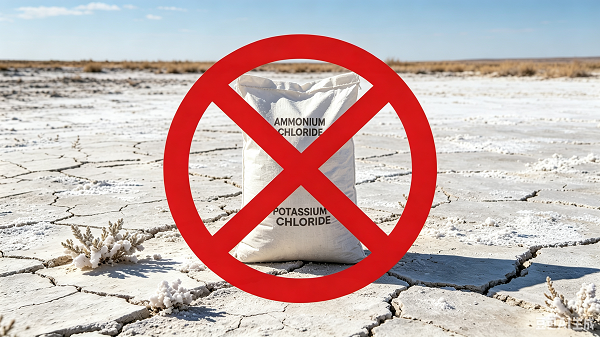
1. Avoid applying chloride-containing fertilizers to prevent cumulative salt damage. The chloride ion content in saline-alkali soils is already high. After applying chloride-containing fertilizers such as ammonium chloride and potassium chloride, chloride ions will accumulate, further increasing the salt concentration in the soil solution and aggravating salt damage. Applying chloride-containing fertilizers to saline-alkali land will lead to reduced crop yields and income. Therefore, chloride-containing fertilizers should be prohibited in saline-alkali land.
2. Choose acidic or physiologically acidic fertilizers to neutralize the alkali. Alkaline fertilizers (such as ammonia water, ammonium bicarbonate, calcium cyanamide, calcium magnesium phosphate, etc.) should be avoided in saline-alkali land. Neutral and acidic fertilizers should be prioritized. Superphosphate and ammonium sulfate, being acidic or physiologically acidic fertilizers, are suitable choices for saline-alkali land. After the ammonium in ammonium sulfate is absorbed by crops, the residual sulfate ions can reduce soil alkalinity. Superphosphate can significantly lower the soil pH.
III. Increase the application of organic fertilizers to achieve both buffering and soil improvement effects. The general principle of fertilization for saline-alkali land is to primarily apply organic fertilizers while appropriately controlling the application of chemical fertilizers. Organic fertilizers contain a large amount of organic matter, which, after microbial decomposition and transformation into humus, can improve the soil's buffering capacity against harmful anions and cations. It can also react with sodium carbonate to form sodium humate, reducing soil alkalinity. Humus can also promote the formation of soil aggregates, enhance permeability, and facilitate salt leaching. Simultaneously, the decomposition of organic fertilizers produces a large amount of organic acids, which can neutralize soil alkalinity and accelerate nutrient decomposition and transformation. It is recommended to apply 3-4 cubic meters of organic fertilizer per acre of saline-alkali land.

IV. Other Key Considerations High-concentration fertilizers should be used due to their high effective nutrient content and low negative ion content. The amount applied each time should not be excessive to avoid exacerbating secondary soil salinization. Irrigation should be combined with fertilization to reduce soil solution concentration. Multiple small applications are recommended. Fertilizer should be kept away from seeds to prevent increasing soil solution concentration and affecting germination and seedling emergence. For the common phosphorus deficiency problem in saline-alkali land, phosphate fertilizer should be applied more frequently and deeply as a base fertilizer. Ammonium nitrogen fertilizers are prone to ammonia volatilization when applied to saline-alkali land and must be applied deeply and covered with soil.
The core of fertilization in saline-alkali land lies in "avoiding chlorine, selecting acidic fertilizers, and increasing organic fertilizers"—avoiding chlorine-containing fertilizers to prevent cumulative salt damage, using acidic fertilizers to neutralize soil alkalinity, and increasing the application of organic fertilizers to achieve both buffering and improvement effects. If you encounter difficulties in the formulation design or granulation process of fertilizers specifically for saline-alkali land during production, our technical team can provide you with a complete optimization solution from raw material analysis to equipment selection.
If you have any questions about fertilizer production equipment and processes or would like to learn more about customized solutions, please contact us immediately. Whether it's equipment selection and pricing, installation, commissioning and operation training, or later maintenance and process upgrades, we can provide you with professional and timely answers and support to help your project be implemented efficiently.