
2026-09-29
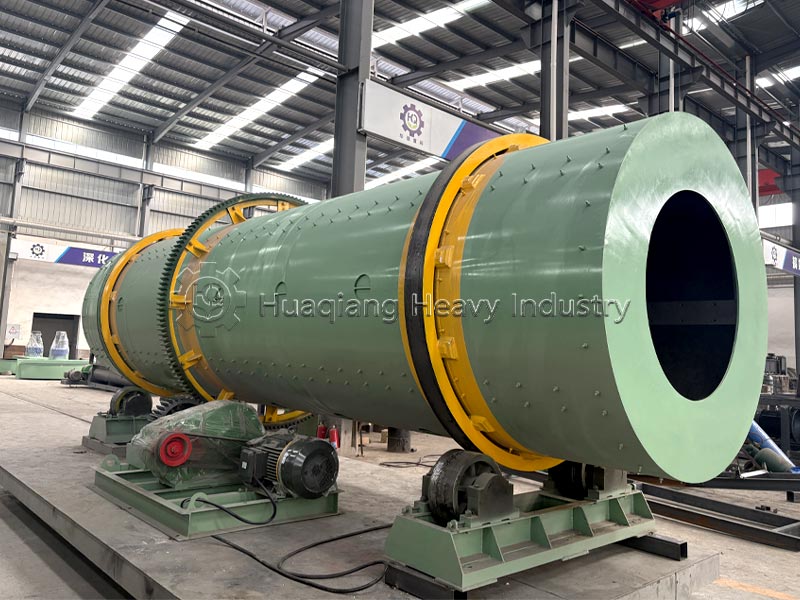
What should the tilt angle of a drum granulator be? 3.5° is a common benchmark value. In compound fertilizer, organic fertilizer, and NPK granulation production lines, the installation tilt angle of the drum granulator is usually controlled between 2° and 5°, with 3.5° considered the industry benchmark for general materials. This angle ensures that the material has sufficient residence time in the drum to complete pelleting, while avoiding excessively large particles or clumping due to excessive residence time.
I. Why is 3.5° the benchmark?
Drum granulators rely on the rotation of the drum to tumble and agglomerate the material. The tilt angle determines the axial movement speed of the material in the drum. The smaller the tilt angle, the longer the material residence time, and the more opportunities for the particles to roll into pellets, but the output decreases, and large lumps are more likely to form; the larger the tilt angle, the faster the material moves forward, increasing the output, but the pelleting time is insufficient, resulting in loose particles and more fine powder. 3.5° represents a balance between output and pelleting rate, suitable for most organic and compound fertilizer materials with a moisture content of 25%–35%.

II. Specific Effects of Inclination Angle on Granulation Effect
When the inclination angle is adjusted from 3.5° to 2°, the material residence time increases by approximately 20%, the average particle size increases, and the pelleting rate improves. However, the material layer inside the cylinder thickens, the motor load increases, and the risk of sticking to the wall increases. When the inclination angle is adjusted from 3.5° to 5°, the material passes through quickly, and the output can increase by 10%–15%, but the particle strength decreases, the amount of returned material increases, and the finished product qualification rate decreases. Therefore, inclination angle adjustment must be coordinated with rotational speed, moisture content, and steam volume.
III. How to Determine the Optimal Inclination Angle?
Determining the optimal inclination angle should follow the principle of "baseline first, then fine-tuning." Initially set at 3.5°, then adjust according to the trial run results. If the particles are too small and the pelleting rate is low, the tilt angle can be decreased by 0.5°–1°; if the particles are too large and agglomeration is severe, the tilt angle can be increased by 0.5°–1°. Adjustments should be made in 0.5° increments, and observation should be conducted for 2–4 hours after each adjustment until the operating conditions stabilize before further evaluation. During adjustment, the drum rotation speed and material moisture content must be checked simultaneously to avoid masking the true problem by changing only one parameter.
IV. Supporting Parameters Cannot Be Ignored
The tilt angle is not an isolated parameter. The rotation speed of a rotary drum granulator is typically 10–15 r/min, and the filling rate is controlled at 15%–25%. When the moisture content is too high, the tilt angle should be appropriately increased to accelerate material flow and prevent sticking to the wall; when the moisture content is too low, the tilt angle can be decreased to prolong the residence time and promote pelleting. For high-fiber organic fertilizer, the tilt angle should be smaller; for high-nitrogen compound fertilizer, the tilt angle should be larger. In winter, when the ambient temperature is low and material pelleting is slow, the tilt angle can also be appropriately decreased.
V. Summary
What should the tilt angle of a rotary drum granulator be set at? 3.5° is a common benchmark value. This angle represents a balance between output, pelletizing rate, and granule quality, but it is not fixed. During production, it should be dynamically adjusted based on raw material characteristics, moisture content, and rotation speed, gradually optimizing in 0.5° increments. Understanding the synergistic relationship between the tilt angle, rotation speed, and moisture content is crucial to ensuring the rotary drum granulator performs optimally, achieving high pelletizing rate, low return material, and stable output.