
2026-11-03
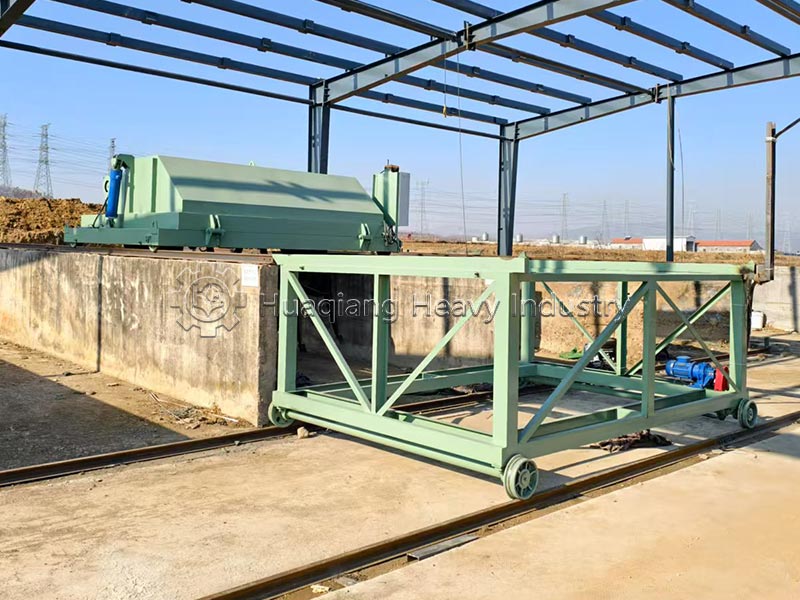
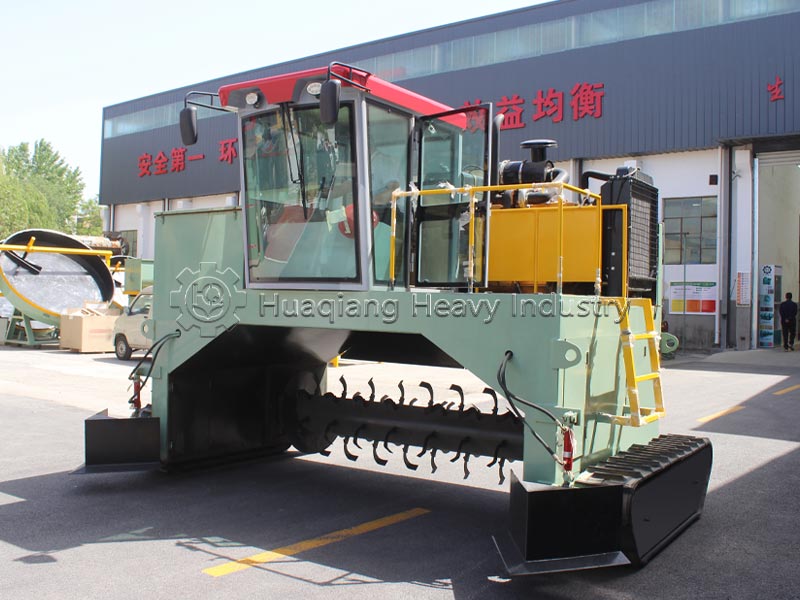
In terms of turning depth, trench-type equipment operates along a track within a fixed fermentation tank, typically with a turning depth of 1.8-2.5 meters. A single tank can hold hundreds or thousands of cubic meters of material, making it suitable for continuous, large-scale production. Tracked turners typically have a turning depth of 0.8-2 meters, with a single unit processing capacity of 10-30 tons/hour. However, due to limitations in track load-bearing capacity and cutter shaft lifting height, excessively high piles may not allow for proper turning of the bottom layer of material, potentially leading to localized anaerobic digestion.
Land and civil engineering costs are the second major dividing line. Trough-type turners require concrete fermentation tanks and tracks, and civil engineering costs are often underestimated—the need for tank construction is often only discovered after equipment purchase, a common budget overrun during selection. However, trough-type turners offer a larger material capacity per unit area; multi-layered deep trough designs can accommodate more material within the same footprint and can be equipped with canopies and deodorization systems, making them suitable for land-constrained plants. Tracked turners require no civil engineering; operation can begin after site hardening. Equipment investment is approximately 50,000-100,000 RMB, but the width and height of the windrows are limited, resulting in a lower total material capacity for the same area, making them more suitable for smaller-scale operations with a daily output of 5-20 tons.
In terms of automation, trough-type turners use tracked movement and PLC-timed turning, requiring minimal human intervention; tracked turners require manual operation for relocation and alignment, sacrificing flexibility for manpower.
Turning width is the most easily obscured bottleneck in the production capacity of tracked conveyor systems, often hidden by specifications alone. When the effective turning width is less than 2 meters, the width of the windrows is forced to compress, preventing the formation of sufficient material layer thickness and length, thus reducing the material throughput per operation. More importantly, insufficient width leads to missed turning on both sides: material at the edges of the pile remains in a turning blind zone for extended periods, resulting in poor aeration, low temperature, and disrupted fermentation uniformity. The cost of rework and extended cycles ultimately translates into a further reduction in effective processing capacity.
Specifically, for small tracked conveyors with a width of 1.8-2.2 meters, a windrow width of only 2.0-2.5 meters and a height of 0.8-1.2 meters is recommended, with a single windrow material volume of 15-30 cubic meters. If the actual pile width exceeds the turning width, missed turning on both sides is inevitable, increasing energy consumption per unit area by more than 30%, and uneven stress on both sides of the track also increases the risk of tipping over. Therefore, a width of 2 meters is a watershed: below this value, tracked equipment is suitable for small-batch, multi-batch, and dispersed sites; if a continuous and stable daily processing capacity is required, compressing the pile width to "make up" for the width will only result in wasted processing capacity due to missed turning and rework.
Environmental protection has become a veto factor in the selection process. Tank-type fermentation tanks are inherently leak-proof and rainproof, allowing for fully enclosed workshops. Odors are collected and centrally treated through pipelines, resulting in the highest environmental impact assessment approval rate. This is currently the mainstream solution for formal organic fertilizer plants and manure resource utilization projects. In a closed workshop using tank-type turning, ammonia concentration can be controlled below 5 ppm, while in open-air operations with tracked equipment, ammonia concentration often exceeds 20 ppm.
Tracked systems are not incapable of being environmentally friendly, but they require additional costs: the work area needs to be designated as a fixed turning zone, and simple sealed sheds or fences need to be erected to control the spread of odors; after odor collection, activated carbon, biological filters, or spray towers are still required for treatment to ensure that hydrogen sulfide ≤0.3 mg/m³ and ammonia ≤1.0 mg/m³. For projects near urban areas, villages, or those applying for formal environmental impact assessments, purely open-air tracked windrow systems are unlikely to pass acceptance in most areas; trough-type or closed fermentation tanks are the compliant path.
Q: With a limited initial budget, is it feasible to buy tracked systems first and then convert to trough-type systems once production capacity increases?
Yes, it is feasible, but the cost of the conversion depends on whether the initial civil engineering was planned in advance. The tracked equipment itself will not be scrapped due to the conversion to trough-type systems—after the trough fermentation tank is built, the tracked turning machine can still be used for auxiliary operations in windrow pretreatment or as backup equipment. The real cost risk lies in civil engineering: the concrete foundation of the fermentation tanks, the impermeable layer, the pre-embedded tracks, and the drainage slope. If these are not planned in the early stages of construction, the cost of excavating and rebuilding on the hardened ground later will be far higher than the cost of a one-time construction. A pragmatic approach is to use tracked machines to validate the market and accumulate cash flow in the initial phase, but to reserve space for fermentation tank locations and drainage routes according to the future tank layout during site planning, and to leave cuttable joints when hardening the ground. Once production capacity stabilizes and environmental impact assessment requirements upgrade, only the tank structure and track installation should be carried out, without complete demolition. If the focus is clearly on commercial organic fertilizer and formal environmental impact assessment from the beginning, using tank machines directly will save on overall costs, avoiding paying for civil engineering costs twice for a "transition."
The choice between tank-type and tracked compost turners is essentially a trade-off between "fixed tank continuous production" and "mobile stack flexible operation." Depth determines whether thorough turning is possible, land occupation and investment determine the initial entry barrier, width determines the actual production capacity limit of tracked machines, and environmental protection determines whether the project can operate legally in the long term. First, clearly list your production capacity, site conditions, and environmental impact assessment requirements, then compare them against these four boundaries. The answer will be much more reliable than looking at the quotation.