
2026-03-12
In the production of compound fertilizers and bio-organic fertilizers, adjusting process parameters in the granulation stage has long relied on the "feel" of experienced operators—the tilt angle, rotation speed, and moisture control were often determined by experience. However, with labor shortages and increasingly stringent quality control requirements, this traditional model is being completely reshaped by the wave of intelligent technology. AI-powered automatic parameter adjustment, digital twin simulation, and IoT real-time monitoring are transforming granulators from "machines that turn" into "intelligent agents that think."
The limitations of manual operation are obvious. Fluctuations in the moisture content of raw materials from different batches and changes in environmental temperature and humidity require operators to frequently adjust granulator parameters. However, the human eye cannot easily capture changes within the material, and experience-based judgment is often lagging, resulting in high return rates and granule qualification rates that frequently hover between 85% and 90%. Even more problematic is the difficulty in detecting early signs of equipment failure, with sudden shutdowns often causing losses of tens of thousands of yuan.
The core of intelligent upgrading lies in enabling equipment to possess a closed-loop capability of "perception-decision-execution." The new generation of granulators is equipped with a multi-parameter sensor array to collect key data such as torque, melt pressure, and temperature in real time. The built-in AI control system uses machine learning algorithms to automatically analyze the matching degree between material characteristics and equipment status, adjusting feeding speed, roller pressure, and rotation speed within milliseconds to ensure that the granules are always within the optimal forming range. Practical applications show that AI automatic parameter adjustment can stabilize the granule qualification rate at over 98%, and control the particle size deviation within ±3.5% of the MFI coefficient of variation, far exceeding the level of manual operation.
Every "breath" of the equipment is precisely recorded by the IoT system. When the torque sensor detects abnormal fluctuations, the system immediately warns of potential blockage risks; when melt pressure data deviates from the normal curve, the edge computing module automatically diagnoses the bearing wear and pushes maintenance suggestions. Operators can remotely view the equipment status via a mobile app, achieving unattended operation. After introducing intelligent monitoring of the roller granulator, one company reduced downtime by 60% and maintenance costs by 35%.
Cutting-edge digital twin technology is equipping granulators with a "parallel world." Engineers build models in a virtual environment that perfectly match the physical equipment, importing different raw material characteristics and process parameters to simulate particle movement trajectories and the forming process. Using thermal image data generated by computer vision, the digital twin system can predict equipment performance under different operating conditions, pre-optimizing blade configuration and spray angles, reducing process development cycles from months to weeks. One chemical company, using digital twin technology, shortened reaction cycles by 12% and reduced costs by 30%.
Looking to the future, the intelligentization of granulators will move towards a closed-loop digital twin system encompassing materials, equipment, and processes. AI will not only adjust parameters but also optimize raw material ratios based on finished product testing data; the Internet of Things will not only monitor but also link the entire process of batching, drying, and packaging, achieving integrated control of the entire production line. When granulators possess self-evolution capabilities, compound fertilizer production will truly achieve high-efficiency, stable, and green high-quality development.
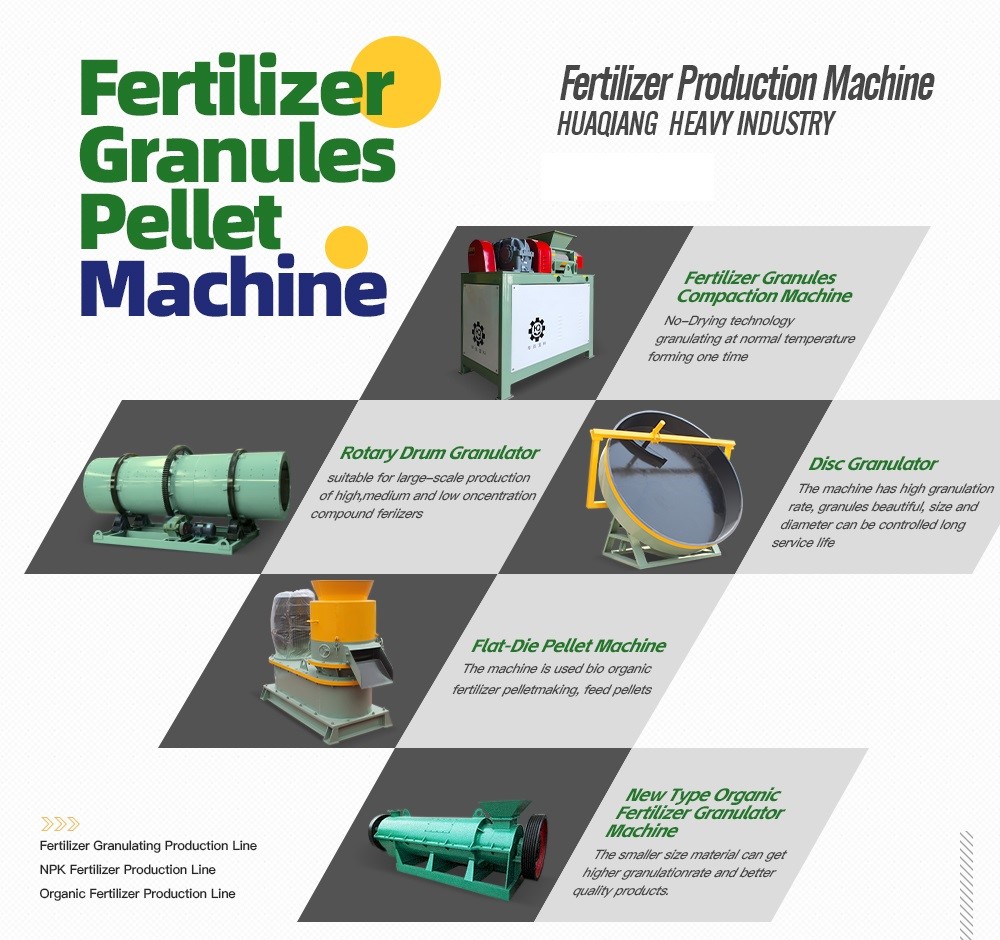
The intelligent upgrade described—with its sensors, AI control, and digital twins—is revolutionizing all types of fertilizer granulation technology. For a rotary drum granulator, AI can optimize the complex interplay of steam pressure, drum speed, and angle to maintain consistent fertilizer granules compaction and sphericity despite varying raw material moisture. In a roller press granulator production line, the double roller press granulator benefits immensely from AI's ability to preemptively adjust roller pressure and feed rate based on real-time torque data, preventing blockages and ensuring uniform granule density. Even a simpler disc granulator machine can be transformed; AI can analyze video of the tumbling bed to fine-tune disc angle and rotation speed, maintaining the optimal rolling action for perfectly spherical pellets. For small-scale or specialty applications, a flat die pelleting machine can be equipped with sensors to monitor die temperature and motor load, with an AI system adjusting the feed rate to prevent jamming and prolong die life. Ultimately, whether it's a massive rotary drum granulator or a compact flat die pelleting machine, the integration of AI and IoT moves each machine from a passive tool to an active, self-optimizing "intelligent agent," ensuring peak efficiency, consistent product quality, and predictive maintenance across the entire production line.