
2026-04-10
In fertilizer production, granule quality directly determines the market competitiveness of the product. Compound fertilizers require uniform nutrient distribution and high granule strength; phosphate fertilizers need to overcome challenges like high raw material viscosity and difficult formation; potash fertilizers have stringent requirements for granule compressive strength and anti-caking performance. With its precise pressure control and dry granulation process, the hydraulic roller granulator is becoming the core equipment for the fertilizer industry to meet these challenges.
Core Requirements for Fertilizer Industry Granulation
The quality of fertilizer granules is measured by three key indicators: Granule compressive strength needs to reach 10-30N to ensure resistance to crumbling during storage and transport; Nutrient uniformity coefficient of variation should be ≤5% to avoid nutrient imbalance in application areas; Granule size is concentrated in the 2-4mm range, suitable for mechanized precision fertilization. Additionally, large-scale production requires equipment with strong continuous operation capability, low energy consumption, and no wastewater discharge.
Process Adaptability of Hydraulic Roller Granulator in Compound Fertilizer Granulation
Compound fertilizers involve many raw material types and complex ratios, demanding high raw material adaptability from the granulation equipment. The hydraulic roller granulator uses a dry extrusion process and can handle various materials like potassium chloride, ammonium sulfate, monoammonium phosphate (MAP), and diammonium phosphate (DAP). Its core advantages lie in: No binder required – it compacts materials using adjustable pressure of 5-30MPa, increasing granule density by 1.5-3 times; Precise pressure control via the hydraulic system automatically compensates for raw material hardness fluctuations, ensuring consistent granule strength; Ambient temperature forming avoids nitrogen loss caused by high temperatures, making it especially suitable for high-nitrogen formulas containing urea.
In one example of a 100,000 t/year compound fertilizer project, after adopting a hydraulic roller granulator, the forming rate stabilized above 95%, the return fines rate was controlled within 15%, and granule compressive strength reached 20-25N, reducing energy consumption by 40% compared to traditional drum granulation processes.
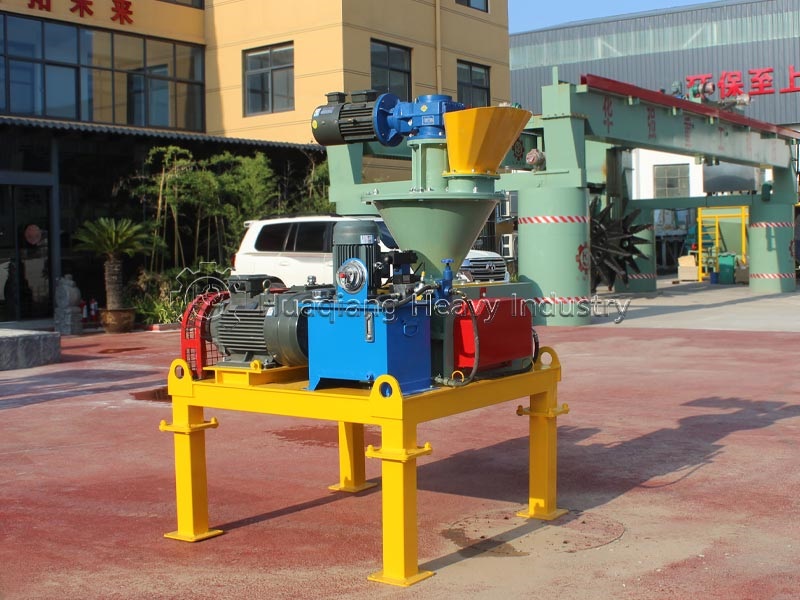
High-Pressure Adaptability for Phosphate Fertilizer Granulation
Phosphate raw materials such as phosphate rock powder and dicalcium phosphate are characterized by high viscosity and poor plasticity, requiring high granulation pressure. The hydraulic roller granulator, through independent dual-roll hydraulic control, can apply pressure up to 30MPa, causing phosphate rock particles to undergo plastic deformation under high pressure. The intermolecular distance decreases, and van der Waals forces and crystal bridge action bond the particles tightly. The roller surface uses high-chromium wear-resistant alloy with tungsten carbide overlay coating, effectively resisting abrasion from phosphate rock, with a service life exceeding 8000 hours.
For materials like single superphosphate (SSP) and triple superphosphate (TSP), the equipment can be equipped with an optional forced feeding system, using a variable frequency drive screw and agitator to solve bridging and arching problems, ensuring uniform material supply.
Parameter Optimization for Potash Fertilizer Granulation
Potash raw materials like potassium chloride, potassium sulfate, and potassium nitrate are highly crystalline and prone to moisture absorption, imposing special requirements on the granulation process. The hydraulic roller granulator achieves efficient forming of potash granules through precise matching of pressure and speed: roller speed controlled at 10-15 r/min prolongs the material's compression time in the roller gap; pressure adjusted to 15-25MPa compacts the potassium salt particles into dense granules. The discharge granule compressive strength can reach over 30N. When combined with subsequent coating treatment, it effectively prevents caking during storage.
.jpg)
Practical Application Case
A fertilizer plant in Southeast Asia originally used a drum granulation process for potassium chloride granules. Due to the raw material's high hygroscopicity, the granules after drying were prone to crumbling and caking. After introducing our hydraulic roller granulator using a dry extrusion process (roller pressure 22MPa, speed 12 r/min), the discharge granule compressive strength reached 28N, with a forming rate of 97%. The production line eliminated the drying step, reducing energy consumption per ton of product by 35%, with a payback period of less than 1.5 years.
Customized Design of Website Equipment for the Fertilizer Industry
Our hydraulic roller granulator incorporates several customized designs for the specific needs of the fertilizer industry: Corrosion-resistant rollers use tungsten carbide overlay with an epoxy coating to withstand chloride corrosion; Anti-caking feeding system for raw materials is equipped with a vibrating hopper and anti-bridge agitator to solve bridging issues with potash salts and phosphate rock; Hydraulic system standard with forced air cooling ensures continuous operation oil temperature ≤55°C even in tropical regions. The equipment supports both 380V/50Hz and 460V/60Hz dual voltage configurations, adapting to global power grid standards.
From precise proportioning for compound fertilizers to high-pressure forming for phosphates, from moisture-proof granulation for potash to low-temperature protection for nitrogen fertilizers, the hydraulic roller granulator, with its process flexibility, is becoming a core piece of equipment for granule quality upgrades in the fertilizer industry. Contact us to get a customized granulation solution tailored to your raw material characteristics.
The hydraulic roller granulator represents a pinnacle of fertilizer production machine technology, specifically designed to achieve superior fertilizer granules compaction. As a sophisticated fertilizer compactor, it is the core of a roller press granulator production line. This technology offers a distinct alternative to the traditional rotary drum granulator, which is the workhorse of a conventional rotary drum granulation production line. For a complete npk fertilizer production line, the choice is strategic. A rotary drum granulator excels in high-volume, continuous production of spherical granules using a wet process. However, for applications demanding high-density, high-strength granules, or for processing heat-sensitive or moisture-prone materials like potash, the hydraulic roller granulator is superior. Its dry compaction method eliminates the need for drying, significantly reducing energy consumption and simplifying the process flow. Furthermore, for the production of specialized fertilizers, this fertilizer compactor is a key member of the organic fertilizer granulator series when blending organic materials with mineral nutrients. The precision and flexibility of the hydraulic system make it the preferred choice for manufacturers seeking to upgrade product quality and optimize energy efficiency in their granulation operations.