
2026-04-11
In the field of high-end powder granulation, the hydraulic roller granulator, with its precise pressure control and stable particle quality, has become a technological benchmark in the chemical and fertilizer industries. The equipment's superior performance stems from its precise mechanical structure and the collaborative design between its components. This article will deeply dissect the six core systems of the hydraulic roller granulator, analyzing its functional logic and design highlights.
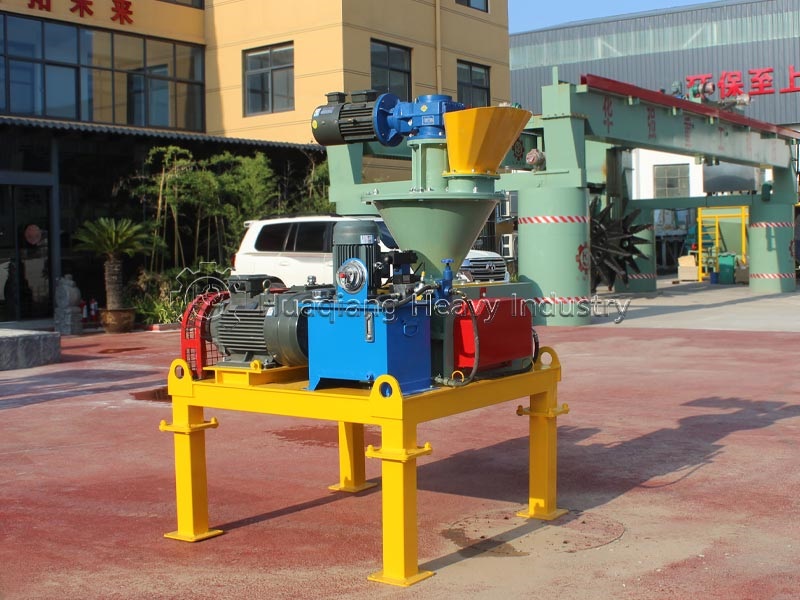
The hydraulic roller granulator consists of a roller assembly, a hydraulic system, a feeding system, a control system, a frame support, and an optional crushing and screening system. These six systems are organically integrated to form a continuous closed-loop operation from raw material input to particle output.
The roller assembly is the "heart" of the granulator. A pair of rollers rotate in opposite directions, with the fixed roller remaining in a fixed position, while the floating roller is driven by the hydraulic system. The roller surface is covered with precisely engraved grooves, allowing for customization of mold shapes such as spherical, pillow-shaped, and flat spherical shapes according to product requirements. The core design highlight lies in its high-wear-resistant coating technology—the roller surface is overlaid with tungsten carbide or high-chromium alloy, and then vacuum-quenched, achieving a hardness of HRC60 or higher, extending its lifespan by 3-5 times compared to ordinary rollers. The roller's internal circulating water cooling structure effectively controls the temperature rise during extrusion, preventing material overheating and deformation.

The hydraulic system is the core differentiator between hydraulic roller granulators and ordinary roller presses. The system consists of a hydraulic station, cylinders, proportional valves, and accumulators. During operation, the hydraulic station precisely controls the oil pressure through proportional valves, applying it to the cylinders at both ends of the floating roller to maintain a constant pressure. When material hardness fluctuates or foreign objects enter, the accumulator instantly absorbs the impact, preventing equipment damage. Our equipment uses dual-cylinder synchronous control technology to ensure that the pressure deviation at both ends of the floating roller is ≤0.5MPa, increasing particle density uniformity to over 98%.
The forced feeding system consists of a hopper, a variable frequency speed-regulating screw, and a stirring device. After the material enters the hopper, the agitator prevents bridging and arching, and the variable frequency screw automatically adjusts the feeding rate according to the roller speed, ensuring continuous and uniform filling of the roller gaps. A key design feature is the sealing structure—a labyrinth seal is used at the junction of the screw and the hopper to prevent dust leakage and ensure a clean working environment.
The control system integrates a PLC, touchscreen, and sensor network. Operators can set parameters such as pressure, speed, and feeding rate via the touchscreen, and the system automatically executes and monitors the operating status in real time. A core highlight is the pressure closed-loop control—pressure sensors monitor the actual roller pressure in real time, compare it with the set value, and automatically adjust the proportional valve opening with a millisecond-level response time, ensuring constant pressure.
The frame is welded from heavy-duty H-beams and undergoes aging treatment to eliminate internal stress, ensuring the equipment does not deform during long-term operation. The key bearing housing adopts a split design for easy maintenance; vibration damping pads absorb operating vibrations, reducing noise and transmission to the foundation.
For fertilizer and chemical production with high particle quality requirements, an integrated crushing and screening machine can be configured. After being discharged from the rollers, the flaky material directly enters the crushing chamber, where it is broken up by rotating blades and then classified by a vibrating screen. Qualified granules are packaged, while fine powder and oversized particles are automatically returned to the feeding system for re-extrusion, forming a closed-loop production process. This design increases the yield to over 95%, with a particle size deviation of ≤±0.2mm.
After the equipment starts, the control system activates the hydraulic station to pressurize to the target value according to preset parameters. The feeding system then feeds material evenly, and the material is extruded into flakes between the rollers. The flakes fall into an optional crushing and screening machine, where qualified granules are output. The returned material is then returned to the feeding system through a closed pipeline. The entire process achieves continuous and automated operation of "feeding-granulation-discharge".
Our hydraulic roller granulator continuously innovates in its core structure: the detachable roller design allows for mold replacement without disassembling the entire machine, completing the changeover in just 2 hours; the intelligent lubrication system automatically adds grease at regular intervals, extending bearing life by 30%; and the remote monitoring module supports real-time viewing of operating parameters via a mobile app, with automatic fault warnings. The equipment undergoes pre-assembly and no-load testing before leaving the factory, allowing overseas customers to quickly install and put it into production upon receipt.
The sophisticated six-system design of the hydraulic roller granulator positions it as a premier fertilizer compactor, central to a modern roller press granulator production line. Its precise control over pressure, enabled by the hydraulic system and wear-resistant rollers, allows it to achieve superior fertilizer granules compaction. This technology offers a distinct alternative to the traditional rotary drum granulator, which is the workhorse of a conventional npk fertilizer production line. For the npk fertilizer production process, the choice is strategic. A rotary drum granulator excels in high-volume, continuous production of spherical granules using a wet process. However, for applications demanding high-density, high-strength granules, or for processing heat-sensitive or moisture-prone materials, the hydraulic roller granulator is superior. Its dry compaction method eliminates the need for drying, significantly reducing energy consumption and simplifying the process flow. The precision of its hydraulic system ensures uniform particle density and strength, making it the preferred choice for manufacturers seeking to upgrade product quality and optimize energy efficiency in their npk fertilizer production process.
From the wear-resistant roller surface to the intelligent hydraulic system, from forced feeding to closed-loop control, every structural design of the hydraulic roller granulator serves the granulation goal of "precise pressure control and stable, efficient production." Please contact us for detailed technical parameters and customized solutions.