2026-06-30
Granulation is the core process in fertilizer production, transforming powdered raw materials into granular finished products. Currently, the mainstream models on the market can be divided into four main categories: disc, drum, extrusion, and agitator granulators. Each type has its own focus in terms of principle, capacity, granule shape, and applicable scenarios. The following outlines the core features and selection logic of each model based on actual production needs.
I. Disc Granulator: A Cost-Effective Choice for Small to Medium Capacity Production
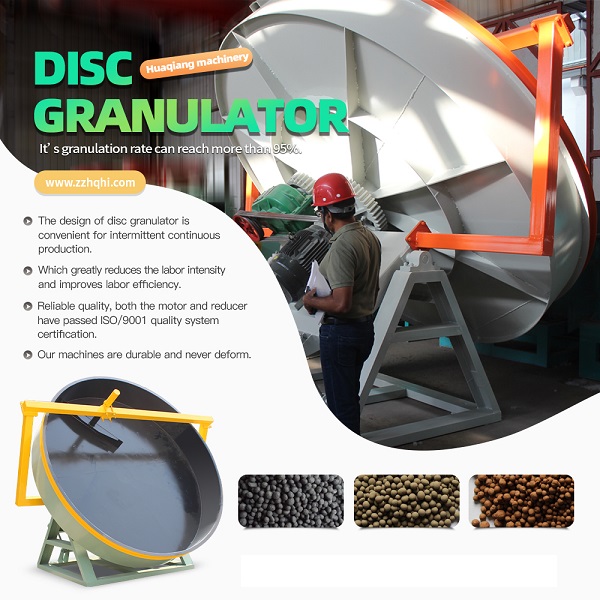
Disc granulators utilize the rotation of an inclined disc, employing centrifugal force and friction to continuously roll and agglomerate materials, gradually forming spherical granules. This process is similar to a "snowball effect"—small granules gradually absorb powder and grow larger during rolling, eventually overflowing from the edge of the disc.
Core Advantages: Simple structure, low unit cost (10,000-50,000 RMB), small footprint (approximately 5㎡), and low operating threshold. High granule roundness (≥90%) and good finished product appearance. Particle size can be flexibly controlled by adjusting the disc angle, rotation speed, and water spray volume.
Suitable Scenarios: Small-scale production lines with a capacity of 0.3-1.5 tons per hour, suitable for raw materials with moderate viscosity, such as livestock manure and humus. Particularly suitable for small-scale manufacturers with limited budgets.
Precautions: Sensitive to raw material moisture content (ideally controlled between 25%-35%). Excessive moisture content leads to sticking to the granulation tray, while insufficient moisture makes granulation difficult. Limited single-unit capacity makes it unsuitable for large-scale mass production.
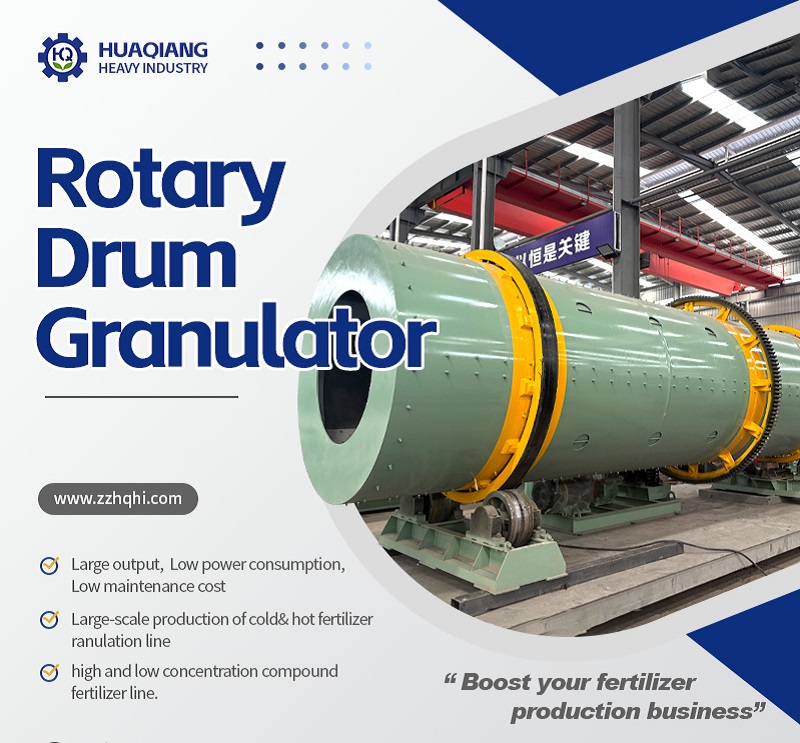
II. Rotary Drum Granulator: The "Efficiency Champion" for Large-Scale Production The rotary drum granulator uses a wet granulation process. A long cylindrical drum rotates at low speed (10-20 r/min). Raw materials are lifted and scattered within the drum by lifting plates, while simultaneously sprayed with water or steam. Through repeated collisions, the raw materials agglomerate into granules. Steam granulation also increases material temperature, reduces granulation moisture, and decreases the subsequent drying load.
Core Advantages: High capacity (5-30 tons per hour), capable of 24-hour continuous operation; high granule strength (compressive strength ≥20N), resistant to storage and transportation; strong adaptability to materials, capable of handling various formulations. The inner lining of the rollers with rubber or stainless steel plates enables automatic scar removal.
Applicable Scenarios: Medium to large-scale production lines with an hourly output of 2-10 tons, widely used in large-scale compound fertilizer and organic fertilizer plants. It is the mainstream choice for large-scale, formal fertilizer plants with an annual output of over 50,000 tons.
Precautions: The equipment is large (5-10m long), requiring sufficient installation space; the investment per unit is high, and a hot air drying system is required.
III. Extrusion Granulator: The "Dry Process Expert" for Low-Moisture Materials
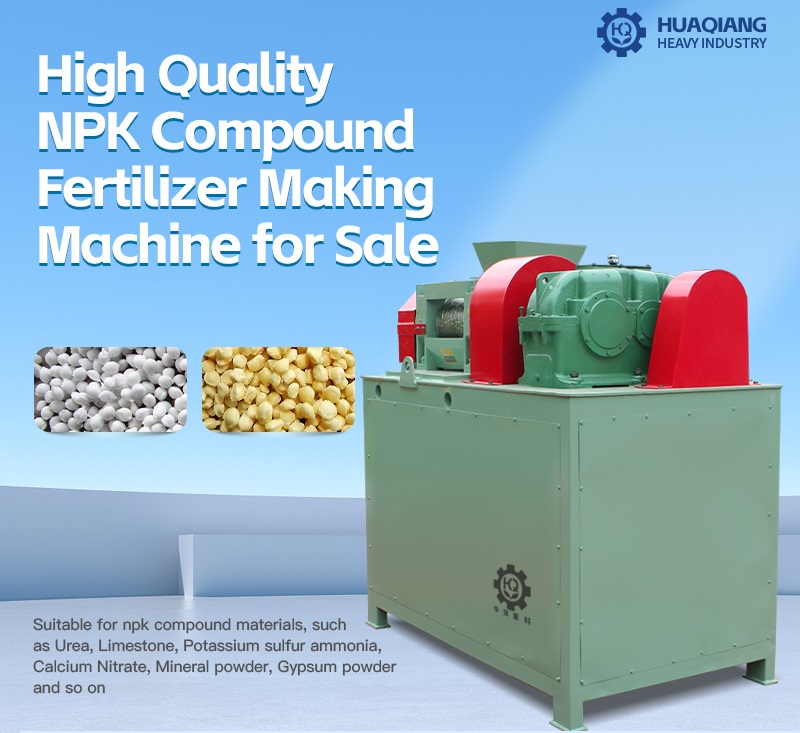
Extrusion granulation uses mechanical pressure (double-roller extrusion or screw extrusion) to force dry powder or semi-wet materials through die holes, forming columnar or flat round granules. The entire process requires no water or steam, belonging to dry granulation.
Core Advantages: No drying process required, saving energy costs; high particle density and strength, not easily absorbing moisture; strong raw material adaptability, suitable for heat-sensitive materials (such as high urea content compound fertilizer). In the fertilizer field, it is particularly suitable for potassium chloride granulation—the granular potassium chloride required for BB fertilizers is basically produced by extrusion.
Applicable Scenarios: With a capacity of 0.2-2 tons per hour, suitable for processing relatively dry raw materials such as distiller's grains and medicinal herb residues, or for scenarios requiring the production of "non-dried granular fertilizer." Also suitable for fertilizers requiring high granule hardness and long-distance transportation.
Precautions: Granules are mostly cylindrical or irregular in shape, with an appearance slightly inferior to disc granulators; the molds are prone to wear and generally need replacement every 3-6 months.

IV. Stirring Tooth Granulator: A "Breakthrough Tool" for High-Moisture Organic Raw Materials
The stirring tooth granulator (also known as an internal rotating stirring tooth granulator or wet granulator) utilizes high-speed rotating stirring teeth (500-800 r/min) to generate strong mechanical stirring force and aerodynamics, allowing fine powder materials to continuously complete mixing, granulation, pelletizing, and densification processes within the machine. It can directly process high-moisture materials without the need for additional binders.
Core Advantages: High organic content, enabling pure organic granulation; high granulation rate (80%-90% or more), with higher particle strength than disc and drum granulators; particularly suitable for direct granulation after organic fertilizer fermentation, saving the drying process.
Applicable Scenarios: 0.5-2 tons per hour, suitable for organic fermentation raw materials such as poultry and livestock manure and municipal waste. The stirring tooth granulator has unique advantages for treating high-moisture, high-viscosity organic waste.
Precautions: Granulation requires the use of a grading screen; the equipment has high requirements for material quality and processing precision.
Selection Decision Tree:
1. Consider Raw Materials: High-moisture organic materials (30%-45% water content) → Stirring tooth granulator; Medium-moisture (25%-35%) → Disc or drum granulator; Low-moisture dry powder (10%-20%) → Extrusion granulator.
2. Consider Capacity: <1.5 tons per hour → Disc or extrusion granulator; 1.5-10 tons per hour → Drum granulator; >10 tons per hour → Drum granulator. Three considerations for granulation: For spherical, rounded granules: disc or agitator granulators; for high strength and durability during storage and transportation: drum or extrusion granulators; for energy-saving, no-drying requirements: extrusion granulators.
Four considerations for budget: Limited investment: disc or small extrusion granulators; sufficient investment for large-scale production: drum granulators.
We specialize in the R&D and manufacturing of fertilizer granulation equipment, covering four major series: disc, drum, extrusion, and agitator granulators. From raw material analysis to trial runs, our professional team provides precise selection to ensure the perfect balance of capacity, quality, and return on investment.
FAQ
Q: What should I choose for a small organic fertilizer plant starting up?
A: Disc granulators are the first choice—low investment, simple operation, and rounded granules make them the most economical entry-level option.
Q: What should I use for direct granulation of high-moisture manure?
A: Agitator granulators can directly process wet materials with a moisture content of 30%-45% without pre-drying.
Q: How are potassium fertilizer granules made for BB fertilizer production?
A: Extrusion granulation is the only option—granular potassium chloride is primarily produced using extrusion.
Q: What should I choose for large-scale compound fertilizer production? A: The rotary drum granulator is the industry standard configuration, with large capacity, good continuity, and high particle strength.
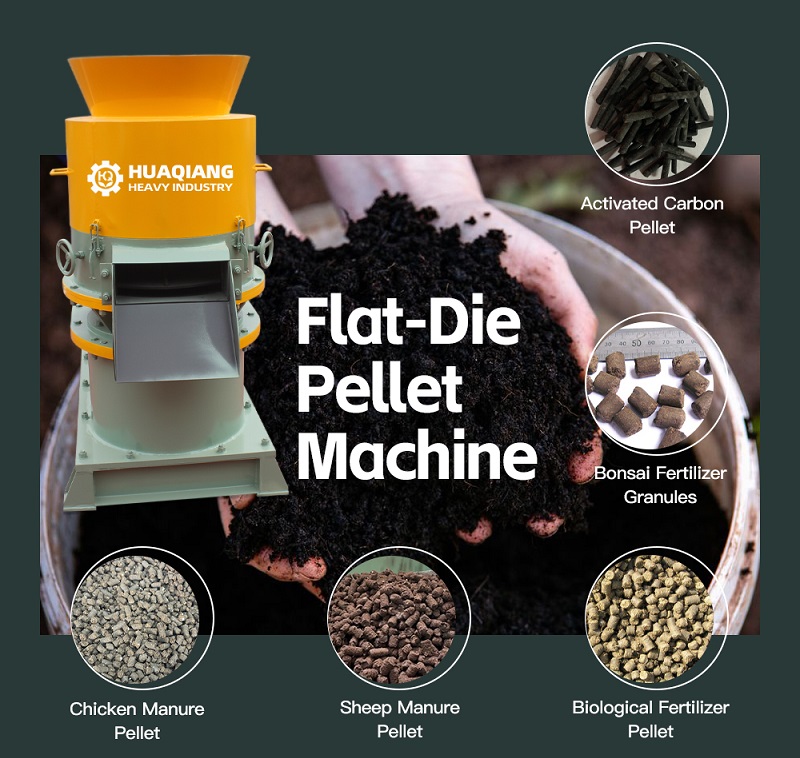
Choosing the right granulator is not a one‑size‑fits‑all decision—it requires a systematic evaluation of your raw material properties, target capacity, product quality requirements, and investment budget. The four main types—disc granulator machine, rotary drum granulator, extrusion granulator (serving as a fertilizer compactor for dry compaction), and stirring tooth granulator—each excel in different domains. For spherical, low‑cost granules, the disc granulator remains the entry‑level champion; for large‑scale continuous production with high fertilizer granules compaction, the rotary drum granulator is the industry workhorse; for dry, heat‑sensitive materials demanding high density, the extrusion compactor delivers unmatched strength; and for high‑moisture organic wastes, the new type stirring tooth‑drum granulator (an evolution of the new type organic fertilizer granulator) offers breakthrough performance without pre‑drying. Together, these machines form the complete organic fertilizer granulator series, which also includes the fertilizer flat die pellet machine for columnar organic pellets—a versatile option for small‑to‑medium producers. By aligning your specific needs with the strengths of each technology—considering moisture content, throughput, granule shape, and energy cost—you can achieve optimal granulation efficiency, product consistency, and return on investment. Ultimately, the best granulator is the one that integrates seamlessly into your entire production line, from mixing to drying and screening, ensuring that every granule meets the quality standards of modern agriculture.