
2026-06-23
Ammonium chloride, an important ammonium nitrogen fertilizer, is traditionally granulated using disc or drum processes, requiring the addition of water and steam, followed by drying, resulting in high energy consumption and a long process. The double roller extrusion granulator, with its unique advantages in dry granulation, provides a completely new solution for the granulation production of ammonium chloride.
I. Core Advantages: Six Highlights
No Drying Required, One-Step Forming: The double roller extrusion granulator uses a dry-free, room-temperature process. Powdered ammonium chloride is directly granulated after high-pressure extrusion by two rollers, without the need for water or any binders. The material is forcibly compressed under mechanical pressure, ensuring complete preservation of product purity. This completely solves the lengthy chain of traditional "granulation-drying-cooling" processes, significantly reducing production costs.
High Granulation Rate, Uniform Granules: The equipment can directly produce uniform granules of 0.3-10mm from powder raw materials. Actual production data shows that the pelletizing rate of ammonium chloride using roller granulation reaches over 95%, with finished granules concentrated in the 2-4mm particle size range, fully meeting the particle size standards for agricultural ammonium chloride.
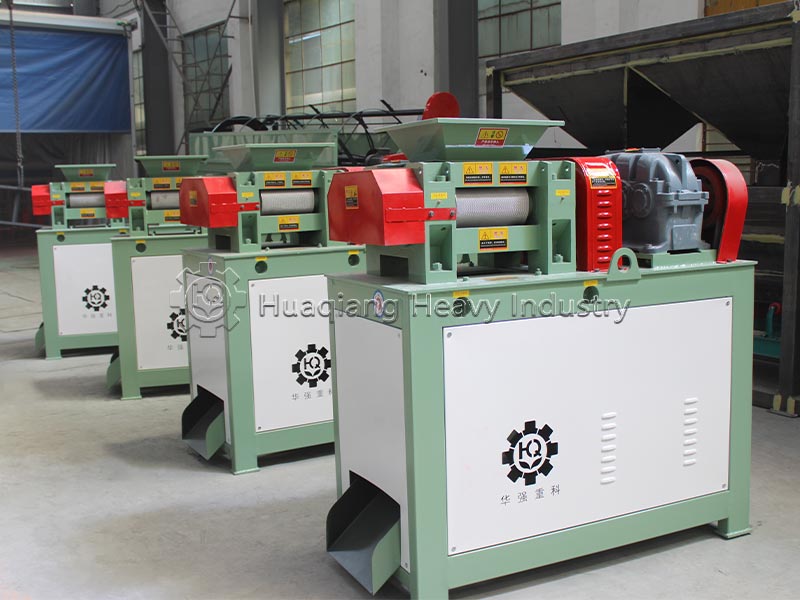
The granules have high strength and are resistant to storage and transportation. During the roller pressing process, the actual density of the material can increase by 1.5-3 times. The finished granules have a compressive strength exceeding 15N, are not easily pulverized, and fully meet the needs of storage and long-distance transportation.
Energy saving and consumption reduction, with significant cost advantages. Compared with steam granulation, extrusion granulation is carried out at room temperature, eliminating the need for drying measures such as fuel oil or natural gas. This process can reduce subsequent drying costs by 30%-50%, and the overall energy consumption is far lower than that of traditional wet granulation.
Circular operation, continuous production. Undersized powder can be automatically returned to the granulation system for reuse, forming a closed-loop cycle and achieving continuous and mechanized production.
Strong raw material adaptability. The equipment is widely applicable to various single-element fertilizers and compound fertilizers such as ammonium chloride, ammonium sulfate, ammonium bicarbonate, potassium chloride, and monoammonium phosphate, offering multiple uses and a quick return on investment.
II. Pressure Control Technology Details The core of roller extrusion granulation lies in the synergistic effect of mechanical high pressure and physical agglomeration. Powdered ammonium chloride is evenly fed into the gap between the two rollers via a frequency conversion feeding system. The rollers rotate in opposite directions under hydraulic or mechanical pressure, forcing the material into the roller gap. As extrusion proceeds, air between the particles is forcibly expelled, shortening the particle spacing to the microscopic level where intermolecular forces occur.
Precise pressure control directly determines the quality of the finished product: insufficient pressure results in loose particles with insufficient strength; excessive pressure exacerbates roller wear. Modern equipment uses a hydraulic system to adjust the extrusion pressure, offering high operational flexibility and allowing for flexible adjustment based on material characteristics and target strength. The roller spacing can also be precisely adjusted to ensure the finished particle size remains stable within the standard range of 2-10mm.
Furthermore, moisture content control is equally crucial. One of the core conditions for ammonium chloride extrusion molding is the material moisture content—the raw material moisture content needs to be controlled at a dry powder state of 2%-5%, typically adjusted to around 5% in trial runs. Slightly higher moisture content can lead to roller sticking, incomplete forming, or screen clogging.
In summary, the double-roller extrusion granulator demonstrates irreplaceable value in ammonium chloride dry powder granulation due to its three core advantages: no drying required, high granulation rate, and strong granules. For ammonium chloride processing enterprises seeking low cost, high purity, and energy conservation, this is a process route worth prioritizing. We specialize in the R&D and manufacturing of double-roller extrusion granulators, providing complete dry granulation solutions for single-element fertilizers such as ammonium chloride, ammonium sulfate, and potassium chloride, as well as compound fertilizers—no drying required, high granulation rate, strong granules, low investment, and quick returns, helping you seize the initiative in low-cost, high-quality fertilizer production.
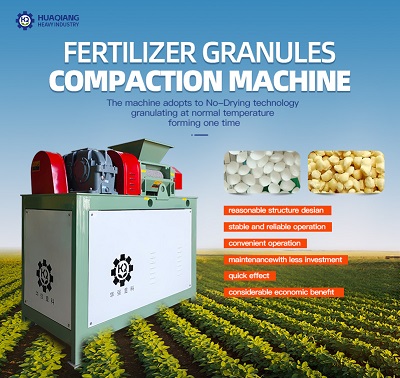
The double roller extrusion granulator represents a paradigm shift in ammonium chloride granulation, delivering exceptional fertilizer granules compaction through a dry, room‑temperature process that eliminates the need for drying and binders. As the core of a complete roller press granulator production line, this fertilizer compactor (or fertilizer compaction machine) achieves a granulation rate exceeding 95% and produces granules with compressive strength over 15N, far surpassing conventional disc or drum products. The fertilizer compaction mechanism – high‑pressure interparticle bonding – not only ensures excellent particle integrity during storage and transport but also enables closed‑loop recycling of undersized powder, making the process highly efficient and sustainable. Beyond ammonium chloride, the same technology is readily applied to other single‑element and compound fertilizers, demonstrating its versatility and value in modern npk fertilizer manufacturing technology. When integrated into a full production line, this fertilizer granulator machine significantly reduces energy consumption (by 30‑50%) and capital investment, as it requires no boiler, dryer, or cooler – making it an ideal choice for producers seeking low‑cost, high‑purity granulation. With precise hydraulic pressure control and adjustable roll gap, the system consistently produces uniform, high‑strength granules that meet the most demanding quality standards, offering a rapid return on investment and a competitive edge in the fertilizer market.
III. FAQ
Q: What materials are suitable for double-roller extrusion granulators?
A: Particularly suitable for single-element fertilizers such as ammonium chloride, ammonium sulfate, ammonium bicarbonate, potassium chloride, and monoammonium phosphate, as well as multi-element compound fertilizers based on these materials.
Q: What is the granule strength that can be achieved?
A: The compressive strength of ammonium chloride granules can exceed 15N, and some equipment can reach 10-25N, far exceeding that of ordinary disc granulation products.
Q: What are the requirements for the moisture content of the raw materials?
A: The dry powder content must be controlled at 2%-5%. Moisture-absorbing materials such as ammonium chloride require strict moisture control, otherwise it will affect the particle strength.
Q: What is the equipment investment?
A: Roller extrusion granulators require less investment and yield quick results. They do not require large-scale thermal equipment such as boilers and dryers, and the overall investment is far lower than that of rotary drum granulation production lines.