
2026-07-06
Rotary dryers are the core energy consumers in organic fertilizer and compound fertilizer production lines—their heat consumption typically accounts for 60%–70% of the total energy consumption of the entire production line, while their thermal efficiency generally hovers between 40% and 55%. A large amount of heat energy is directly emitted as waste gas, not only increasing production costs but also bringing additional carbon emission burdens. This article proposes a systematic energy efficiency improvement scheme from three dimensions: hot blast stove improvement, material lifting plate structure optimization, and frequency conversion control strategy.
I. Hot Blast Stove Improvement: Combustion Efficiency and Cascaded Heat Utilization
Traditional fixed grate hot blast stoves suffer from incomplete combustion and a high excess air coefficient (often exceeding 1.5), leading to severe heat loss. The improvements are as follows: Replacing the fixed grate with a chain grate or reciprocating grate ensures a more uniform fuel layer, increasing combustion efficiency by 10%–15%. Adding a secondary air system, using high-speed jets to disrupt the airflow within the furnace, ensures complete combustion of volatiles, reducing exhaust gas temperature from 280℃ to below 220℃. A more crucial improvement is the addition of an air preheater—using high-temperature flue gas to preheat the combustion air can raise the combustion air temperature from ambient to 150℃–200℃, directly increasing the theoretical combustion temperature of the furnace and reducing coal consumption per unit product by 12%–18%. For coal-fired hot blast stoves, it is recommended to equip them with a two-stage dust collector consisting of a cyclone separator and a bag filter to ensure that the dust concentration in the flue gas is below 30 mg/Nm³, meeting environmental protection requirements while reducing the impact of ash accumulation on heat exchange efficiency.
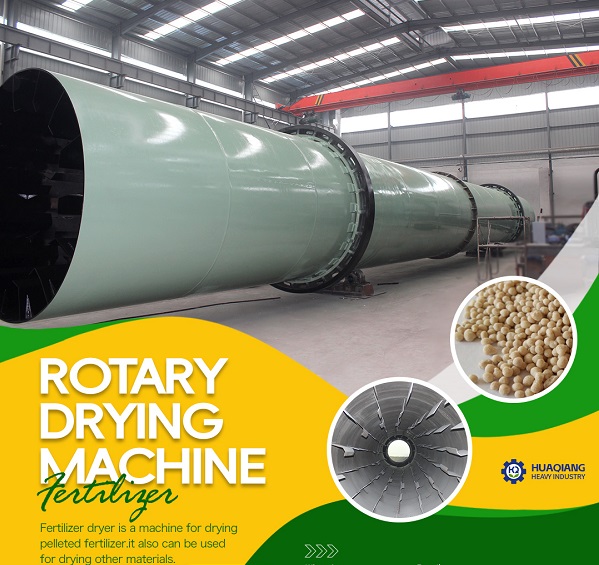
II. Internal Lifting Plate Design: Enhancing Gas-Solid Heat Exchange
The lifting plate is the core heat exchange element inside the dryer, and its structure determines the degree of material dispersion across the cylinder cross-section. Traditional straight-plate lifting plates have limited lifting height, leading to material accumulation in crescent-shaped zones. Hot air often passes through these gaps via short-circuit systems, resulting in extremely low heat exchange efficiency. The optimized solution recommends a combined lifting plate system. A spiral guide plate in the feeding section guides the material rapidly to the high-temperature zone. In the middle section, alternating bent and curved plates create a reciprocating motion of "lifting-scattering-lifting," evenly distributing the material across the entire cylinder cross-section and significantly increasing the contact area and time between the material and hot air. Actual measurement data shows that the improved cylinder cross-section material filling rate can be increased from 12%–18% to 22%–28%, the volumetric heat transfer coefficient can be increased by 30%–40%, and the moisture content fluctuation of the discharged material can be narrowed from ±2.5% to ±1.0%. A smooth section without lifting plates, approximately 15%–20% of the total cylinder length, should be installed at the discharge end as a buffer zone for material settling and discharge.
III. Variable Frequency Speed Control: Intelligent Matching of Heat Load and Material Flow Rate The thermal system of a dryer exhibits typical characteristics of high inertia and pure time lag. Traditional constant speed operation cannot adapt to fluctuations in feed moisture content or output adjustments, often resulting in "over-drying" or "under-drying." A control scheme centered on a frequency converter can adjust the drum speed and blower frequency in real time based on the dryer's tail gas temperature (set value 110℃~130℃), thereby changing the material residence time and hot air flow rate. When the tail temperature rises, the speed is automatically increased to shorten the residence time or reduce the hot air volume; when the tail temperature decreases, the opposite adjustment is made. Furthermore, cascade control can be introduced—using the online detection signal of the discharge moisture content as the primary adjustment parameter and the tail temperature as the secondary adjustment parameter to achieve dual closed-loop control. Practice shows that after frequency conversion modification, the dryer can linearly adjust within a load range of 40%~100%, reducing unit product heat consumption by 8%~12%, and avoiding frequent under-burning or scorching accidents caused by manual adjustment based on experience.
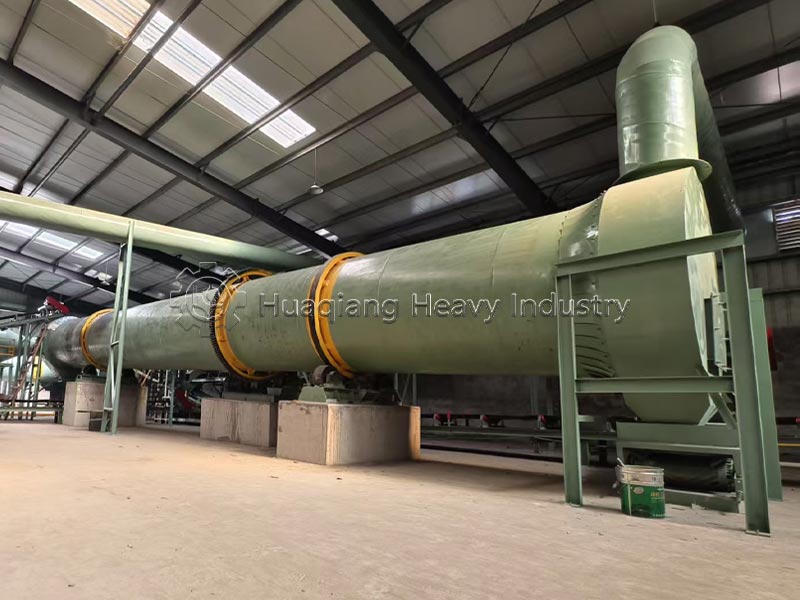
In summary, the three optimizations are not isolated measures—the improved hot air furnace provides a higher-quality heat source, the lifting plate design ensures that heat can be effectively absorbed by the materials, and the frequency converter control enables the entire system to dynamically match production fluctuations. The recommended implementation sequence is to first upgrade the hot air furnace and lifting plate (hardware investment), then configure the frequency converter and automatic control system (software upgrade), gradually achieving deep energy savings in the drying section.
Optimizing the rotary drum dryer is not merely an isolated energy‑saving measure—it directly enhances the performance and economics of the entire production chain. A dryer with improved combustion efficiency, advanced lifting plates, and intelligent frequency control delivers uniformly dried granules with optimal moisture content, which is the foundation for achieving high fertilizer granules compaction in downstream equipment. Whether the preceding granulation is done by a rotary drum granulator for large‑scale NPK production, a fertilizer compactor for dry extrusion, or any unit in the organic fertilizer granulator series, the quality of the dried feed determines final particle strength and resistance to caking. In a complete npk fertilizer production line, the dryer’s thermal efficiency directly affects the overall energy cost per ton—and when integrated with the broader npk fertilizer manufacturing process, these improvements reduce coal consumption by 12‑18% and cut heat loss by over 20%, while narrowing moisture deviation to ±1.0%. Moreover, the same optimization principles apply to organic fertilizer lines, where gentle drying preserves biological activity and prevents scorching. Ultimately, treating the dryer as a system—not a standalone machine—and implementing these three upgrades in sequence (furnace, lifters, VFD) delivers a rapid payback, typically within 12‑18 months, while significantly lowering the carbon footprint of fertilizer production. In short, energy efficiency in drying is the hidden lever that unlocks sustainable, cost‑competitive manufacturing across the fertilizer industry.