
2026-02-24
The granulation process is a core technological node connecting the formula to the finished product, directly impacting product quality, production efficiency, and energy consumption. With technological advancements, rotary drum granulation and extrusion granulation have become the two main technological routes. For manufacturing companies, choosing the right high-efficiency granulation equipment is not only crucial for current production capacity but also affects long-term market competitiveness. Today, we will delve into the differences and applications of these two technologies.
I. Process Principles: A Duel of "Chemical Reaction" and "Physical Forming"
Understanding the fundamental differences between the two technologies requires starting with their core process principles.
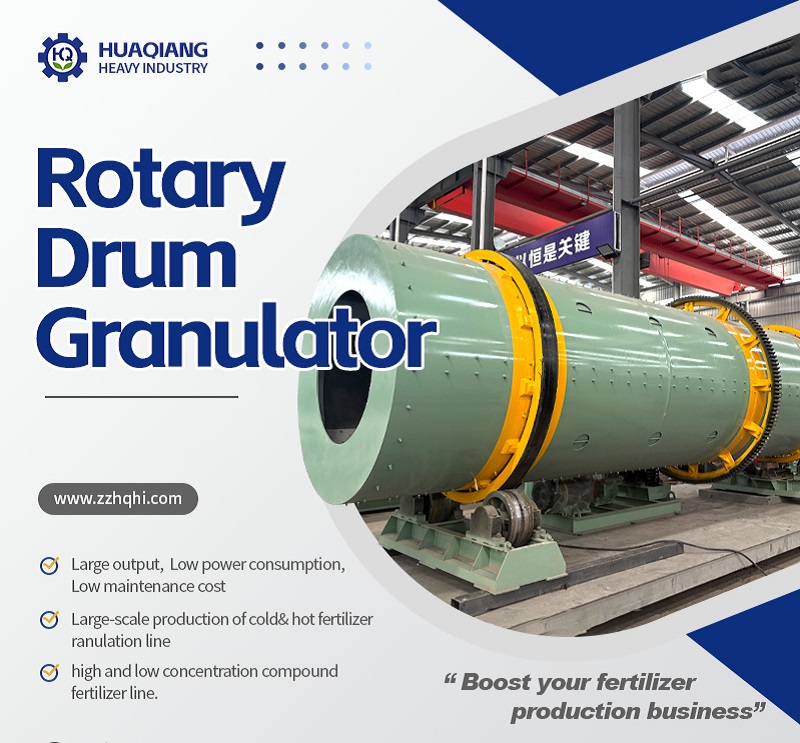
Rotary drum granulation, especially steam rotary drum granulation, is a typical "chemical reaction and thermal forming" process. Powdered raw materials and an appropriate amount of steam or liquid binder are mixed in a long rotating cylinder. During rotation, the "liquid phase" (slurry) produced by the chemical reaction acts as a binder, causing the fine powder to gradually agglomerate into spheres. This process requires precise control of temperature, humidity, and cylinder rotation speed, allowing the particles to grow through a "snowballing" effect. The resulting particles are mostly spherical with moderate strength.
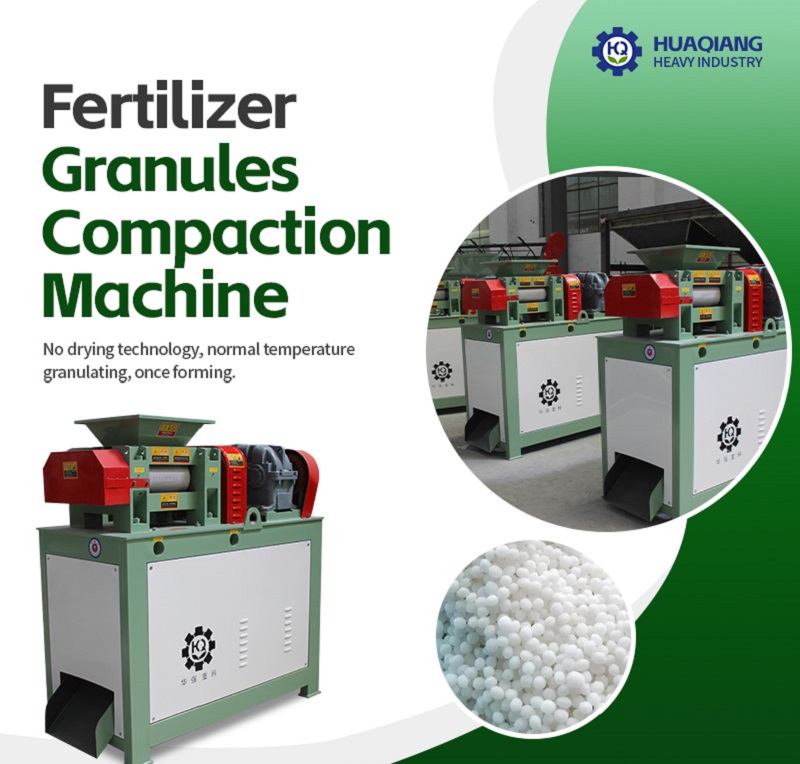
Extrusion granulation, on the other hand, is purely a "mechanical physical forming" process. It involves feeding dry or low-moisture powdered raw materials directly between a pair of precisely designed pressure rollers. Under powerful mechanical pressure of tens to hundreds of tons, the material is forced through the die holes on the rollers, being extruded into dense cylindrical or flattened spherical particles. This process does not require the introduction of water or heat, relying entirely on mechanical force to "lock" the materials together.
II. Energy Consumption and Efficiency: The Dividing Line of Core Competitiveness
From the perspective of energy saving and efficiency, the two technologies exhibit distinctly different characteristics.
Extrusion granulation has a significant advantage in energy consumption, making it a "pioneer in energy saving." This is because it completely eliminates the drying step, which is essential in traditional granulation processes, directly reducing fuel consumption by approximately 30%-50%. The entire production process generates almost no waste gas, resulting in less environmental pressure. However, its "efficiency ceiling" is relatively obvious: the equipment is a purely mechanical structure, and the capacity increase of a single unit and single line mainly depends on increasing the size of the pressure rollers and increasing the rotation speed. However, limited by mechanical design and material strength, large-scale expansion usually requires increasing the number of equipment units running in parallel, rather than unlimited expansion of a single line.
Drum granulation, on the other hand, is a "master of scale and flexibility." For large-scale compound fertilizer production lines, a single large drum granulation system can achieve a daily capacity of several thousand tons, demonstrating significant economies of scale. With proper control, its granulation rate can be maintained at a high level. However, its high capacity comes at the cost of high energy consumption. It not only requires steam consumption, but also requires a large drying and cooling system to remove moisture from the granules and reduce their temperature. The entire system has very high thermal energy consumption. At the same time, the emitted drying exhaust gas contains dust and possible gaseous pollutants, requiring complex environmental protection equipment for treatment.
III. Product Characteristics and Applicable Scenarios: Each with its own strengths and applications
Technology selection ultimately serves product positioning and the market.
Fertilizer granules produced using extrusion granulation technology have extremely high hardness and dissolve slowly, exhibiting certain slow-release characteristics. It is especially suitable for producing heat-sensitive fertilizers (such as certain special fertilizers with added biological agents or vitamins), as well as organic-inorganic compound fertilizers. Due to its simple process and relatively low investment threshold, it is also favored by small and medium-sized fertilizer enterprises.
Drum granulation technology, due to its round granules, appropriate strength, and controllable dissolution rate, has become the absolute mainstream for producing high-concentration compound fertilizers, nitro-compound fertilizers, and other bulk products. Its products have good commercial appearance and are more accepted by traditional channels and farmers. However, this technology requires a certain level of chemical reactivity of the raw materials, and the flexibility of formula adjustment is relatively limited.
Choosing between drum granulation and extrusion granulation is not about which is absolutely "better," but rather which is "more suitable."
If your core goal is large-scale, low-cost production of mainstream compound fertilizers, and you have a stable steam source and the ability to handle environmental protection investments, then the mature process and powerful scale capacity of drum granulation are your first choice.
If you are focused on producing differentiated special fertilizers, prioritizing energy saving and consumption reduction, or if you are a startup company with limited investment, then extrusion granulation, with its drying-free energy-saving advantages, simple process, and unique product characteristics, is undoubtedly a wiser direction. Modern, advanced fertilizer companies often don't rely on a single technology. More and more production lines are adopting a "combination of technologies," for example, using extrusion granulation to produce specialized product lines and rotary drum granulation to ensure a stable supply of basic products. This diversified approach to fertilizer granulation technology, based on market segmentation, represents the future trend of the industry towards efficiency, energy saving, and precision.
In addition to the two primary methods, a complete understanding of granulation technology includes several other specialized options. A disc granulator machine offers a flexible, low-cost solution for producing high-quality spherical granules, often used in smaller-scale or organic fertilizer lines. For specific applications requiring very small-scale production or unique cylindrical shapes, a flat die pelleting machine provides a simple and effective granulation method. The choice of technology, whether it's the large-scale rotary drum granulator, the energy-efficient double roller press granulator (central to a roller press granulator production line), or these other options, all converge on the same principle: transforming powder into granules. The goal is to achieve fertilizer granules compaction or agglomeration, enhancing the physical properties of the fertilizer for easier handling, storage, and application. By understanding the full spectrum of available technologies, manufacturers can select the precise method that best aligns with their raw materials, target product characteristics, and production scale, ensuring optimal efficiency and market competitiveness.