
2026-04-02
Livestock and poultry manure is the primary raw material in organic fertilizer production. However, chicken manure, cow manure, and pig manure have significantly different physicochemical properties, posing different requirements for granulation processes. Chicken manure has a high nitrogen content and is prone to moisture absorption and clumping; cow manure has coarse and long fibers and requires fine crushing; pig manure is highly viscous and easily sticks to equipment. Mastering granulation technologies for different types of manure is crucial for ensuring pellet quality and improving production efficiency.
Chicken Manure Granulation: Anti-Clumping Strategies for High-Nitrogen Raw Materials
Chicken manure has a high nitrogen content (approximately 1.6%-2.0%) and a high proportion of urea nitrogen, making it extremely prone to moisture absorption and clumping during granulation and storage. The core of its granulation lies in "carbon-nitrogen balance + low-temperature process." During the batching stage, high-carbon auxiliary materials such as rice husks and straw need to be added to adjust the C/N ratio to 25-30:1, which both dilutes the nitrogen concentration and increases particle porosity. For granulation, a disc granulator is recommended. The material moisture content should be controlled at 20%-25%, with precise humidification via atomized spraying to prevent excessive moisture and sticking. The drying temperature should be strictly ≤60℃ to prevent nitrogen volatilization loss. It is recommended to spray the granules with 2%-3% anti-caking agent and line the packaging with a moisture-proof film; this can prevent caking for up to 6 months during storage.
Cow Dung Granulation: Refining of Coarse Fiber Raw Materials Cow dung often contains a large amount of coarse fiber (approximately 30%-40%) due to incomplete digestion. Direct granulation can easily result in loose and cracked granules. The key to the process lies in the pretreatment stage: fermented and decomposed cow dung is first processed by a high-moisture material crusher to a particle size ≤5mm, cutting long fibers into short filaments. If the fibers are still too long, a chain crusher can be added for secondary fine crushing. During granulation, a roller extrusion granulator is ideal, as high pressure binds the fibers and fine powder together, resulting in granules with a compressive strength of 15-20N. For applications requiring the production of round pellets, a polishing machine can be added after extrusion to achieve a smooth pellet surface.
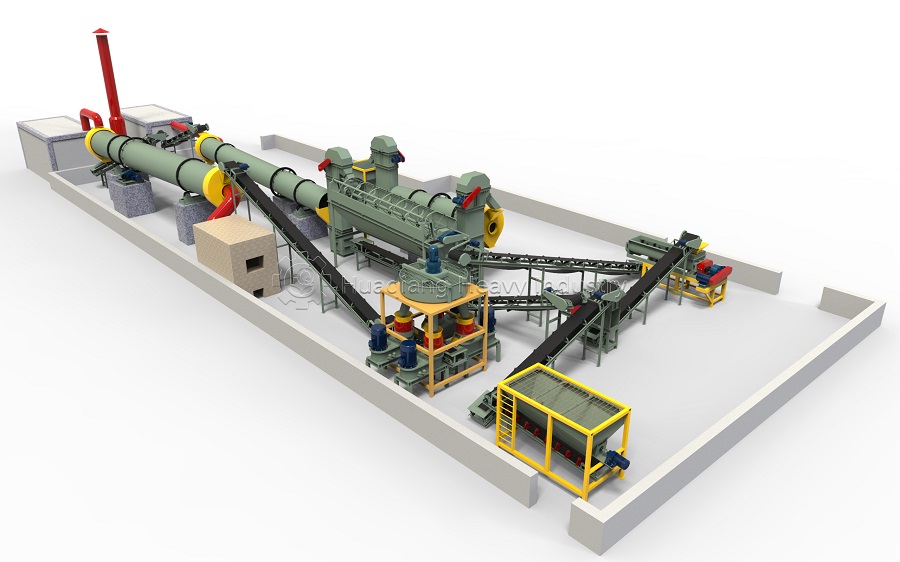
Pig Manure Granulation: Anti-Adhesion Measures for Sticky Materials
Pig manure has a high protein content and high viscosity, easily adhering to the inner wall of the equipment during granulation, leading to blockages and irregular pellets. Solutions include: adding 20%-30% loosening materials such as straw and sawdust during fermentation to reduce overall stickiness; precisely controlling the material moisture content to 18%-22% before granulation (too wet makes it sticky, too dry makes it difficult to form); equipping the equipment with an automatic scraper device to clean the inner wall of the drum or disc in real time to prevent material accumulation; and using a forced feeding system in a hydraulic roller granulator to effectively push sticky materials into the roller gap for stable forming.
Three Key Points for Granulation Quality Control
Regardless of the type of manure raw material, granulation quality must control three core indicators: Particle size—2-4mm for disc granulation, 3-6mm for roller extrusion, with a pass rate ≥90%; Particle hardness—8-12N for pure organic fertilizer, 12-18N for organic-inorganic compound fertilizer, avoiding excessively hard particles that are difficult to break down or excessively soft particles that are easily pulverized; Porosity—suitable 25%-35%, ensuring aerobic microbial activity and nutrient release rate.
Fragile granules are often due to overly dry raw materials or insufficient binder. Water can be sprayed to adjust the moisture content to the appropriate range, or 3%-5% bentonite can be added to enhance binding strength. Granule clumping is due to insufficient drying or cooling. The finished product moisture content should be controlled to ≤12%, and the granules should be cooled to ambient temperature before packaging. If the granule surface is rough and cracked, it is often due to insufficient grinding fineness; the crusher screen should be adjusted to below 5mm.
The specific granulation challenges posed by different manures highlight the importance of selecting the right technology from the organic fertilizer granulator series. Each type of manure requires a tailored approach to achieve optimal fertilizer granules compaction. For high-nitrogen chicken manure, a disc granulator with a low-temperature drying process is often ideal. For the fibrous nature of cow manure, a fertilizer compactor, such as a double roller press granulator, excels at binding fibers and powder into dense, strong granules. For sticky pig manure, a robust fertilizer compactor with a forced feeding system is the most effective solution. This specialized machinery, a form of advanced fertilizer production machine technology, can be integrated into a larger npk fertilizer production line when the organic base is to be combined with mineral nutrients. For very small-scale or specialty applications, a flat die pelleting machine offers a simple, low-cost entry point for manure granulation. The choice is not about finding a single "best" machine, but about matching the specific granulation mechanism—whether the rolling action of a rotary drum granulator or the high-pressure compaction of a fertilizer compactor—to the unique physical and chemical properties of the manure. This targeted approach ensures that the final product meets the required standards for strength, uniformity, and storage stability, transforming a waste management challenge into a source of high-value fertilizer.