
2026-04-27
Hard fertilizer particles, such as monoammonium, diammonium, and urea, are common challenges in organic and compound fertilizer production. A high-quality cage crusher is essential to crush these hard materials into uniform powder, ensuring smooth subsequent granulation and improving overall production efficiency. However, selecting the right cage crusher for hard fertilizer particles requires considering multiple factors, as not all models are designed to handle high-hardness materials. This guide will help you make an informed choice for your fertilizer plant.
First, prioritize the crushing capacity and hardness tolerance. Cage crushers vary in capacity, ranging from small models suitable for 500kg/h to large ones for 5T/h or more. For small-scale plants, a medium-sized horizontal cage crusher is sufficient, while large-scale production requires higher-capacity models. Most importantly, ensure the crusher can handle materials with moisture content below 6%—a key feature of quality cage crushers, as high moisture can cause blockages and reduce crushing efficiency. Huaqiang’s cage crusher is specifically designed to tackle hard particles, with strong wear resistance and stable performance.
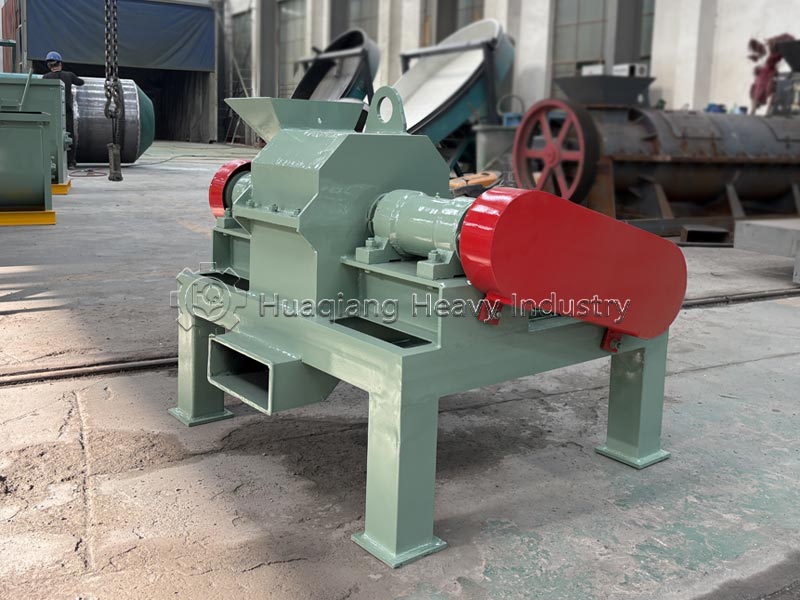

Next, consider the machine structure and maintenance convenience. A good cage crusher should have a simple and compact structure, occupying less space in your plant. Look for models with easy-to-disassemble parts, as this simplifies cleaning and maintenance—critical for long-term operation. The cage crusher’s rotor and hammer parts should be made of high-wear-resistant steel to withstand the impact of hard particles, reducing the frequency of part replacement and lowering operational costs.
Another key factor is the crushing effect and particle size adjustability. For organic fertilizer production, the crushed powder needs to be uniform to ensure better granulation. Choose a cage crusher with adjustable gap between the rotor and screen, allowing you to control the particle size according to your specific needs. A high crushing ratio (the ratio of raw material size to finished product size) is also important, as it reduces the need for secondary crushing and saves energy.
The proper selection of a cage crusher is crucial for preparing hard materials like MAP, DAP, and urea for the granulation stage. This machine is a key component of fertilizer granulation technology, ensuring a uniform fine powder for subsequent processes. After crushing, the material is ready for fertilizer granules compaction using a fertilizer compactor, such as a double roller press granulator, or for wet agglomeration in a rotary drum granulator as part of a complete npk fertilizer production line. The cage crusher is also a member of the organic fertilizer granulator series when processing organic-based blends. For columnar fertilizer granulation technology, a flat die pelleting machine is used. The key to selecting a cage crusher for hard particles is its ability to handle materials with moisture below 6% without clogging. Its high wear resistance and adjustable gap allow for precise particle size control, while a high crushing ratio reduces the need for secondary crushing. Simple maintenance, easy-to-disassemble parts, and robust after-sales support are also critical. A well-chosen cage crusher ensures a consistent, fine powder, which is the foundation for high-quality fertilizer granules compaction in any fertilizer granulation technology process. Whether for an npk fertilizer production line or an organic line, this machine is an essential investment for reliable and efficient production.
Finally, consider the manufacturer’s after-sales support. A reliable manufacturer like Huaqiang provides professional installation, commissioning, and 24/7 technical support, ensuring your cage crusher operates smoothly. Avoid low-quality models that may have frequent breakdowns, as they can disrupt production and increase costs. By focusing on these factors, you can select a suitable cage crusher that effectively handles hard fertilizer particles and boosts your production efficiency.