
2026-03-30
Granulation is a crucial step in organic fertilizer production, directly impacting product appearance, quality, and production costs. Currently, the mainstream processes are divided into dry granulation and wet granulation, each with its own advantages and disadvantages, suitable for different raw materials and production capacity requirements. This article will provide a detailed comparison to help you choose the most suitable granulation solution for your needs.
Wet Granulation: High Capacity, Round Particles
Wet granulation is the traditional mainstream process, represented by rotary drum granulators and disc granulators. Its core principle is to add water or steam to the material, wetting the surface and causing it to agglomerate and form granules during rolling and stirring.
The biggest advantage of wet granulation is its round and aesthetically pleasing granule appearance, with a granulation rate exceeding 90%, suitable for markets with high requirements for product appearance. Rotary drum granulators can achieve a single-machine hourly output of 15-30 tons, making them the first choice for large-scale continuous production lines. Disc granulators, on the other hand, require less investment and are simpler to operate, suitable for small and medium-sized production lines.
However, wet granulation also has significant drawbacks. First, it has high energy consumption—the moisture content of the granulated particles is relatively high (30%-40%), requiring a drying system to reduce the moisture content to a safe level. The drying process consumes a significant amount of heat and electricity. Second, it requires substantial equipment investment—in addition to the granulator, it also requires a dryer, cooler, hot air furnace, dust removal system, etc., resulting in a high overall investment threshold. Third, for bio-organic fertilizers with added functional bacteria, the high temperature during the drying process may affect the survival rate of the bacteria.

Dry Granulation: Energy-Saving, Environmentally Friendly, and Protects Live Bacteria
Dry granulation is a rapidly developing new process in recent years, with the roller extrusion granulator as a representative model. Its core principle is to forcibly extrude powdery materials with low moisture content (usually ≤25%) into blocks or flakes through two opposing rotating rollers, and then crush and granulate them to obtain granules.
The biggest advantage of dry granulation is energy saving—no drying process is required, and the overall energy consumption is reduced by 30%-40% compared to wet granulation. This is particularly attractive in areas with high energy costs. The dry process produces no wastewater discharge, dust is easy to collect, and environmental pressure is lower. For companies producing bio-organic fertilizers, dry granulation avoids damage to functional bacteria from high temperatures, significantly improving the survival rate of live bacteria. Furthermore, extrusion granulation produces high-density, high-compressive-strength particles that are less prone to breakage and pulverization during transportation and storage.
The limitations of dry granulation lie in the irregular appearance of the particles, which are mostly flaky or cylindrical, unlike the rounded particles produced by wet granulation. It requires a higher fineness of material (above 100 mesh), and the rollers are consumable parts that need regular replacement.
From a production capacity perspective, wet granulation is more suitable for large-scale continuous production (over 50,000 tons per year), while dry granulation has a clear advantage in the low-to-medium capacity range (10,000-50,000 tons per year). From a raw material perspective, high-moisture materials (not dried after fermentation) can only be granulated using wet granulation; low-moisture materials or raw materials requiring the retention of functional bacteria are better suited for dry granulation. From an investment perspective, dry granulation production lines have a lower investment threshold, as they do not require a drying system; wet granulation requires a larger initial investment, but the cost per ton decreases as the scale of production increases. From a product positioning perspective, for ordinary organic fertilizers targeting the mass market, a rounded appearance is more popular; for bio-organic fertilizers targeting the high-end market, the content of live bacteria and functionality are more important than appearance.


Organic Fertilizer Granulation: Wet vs. Dry Processes
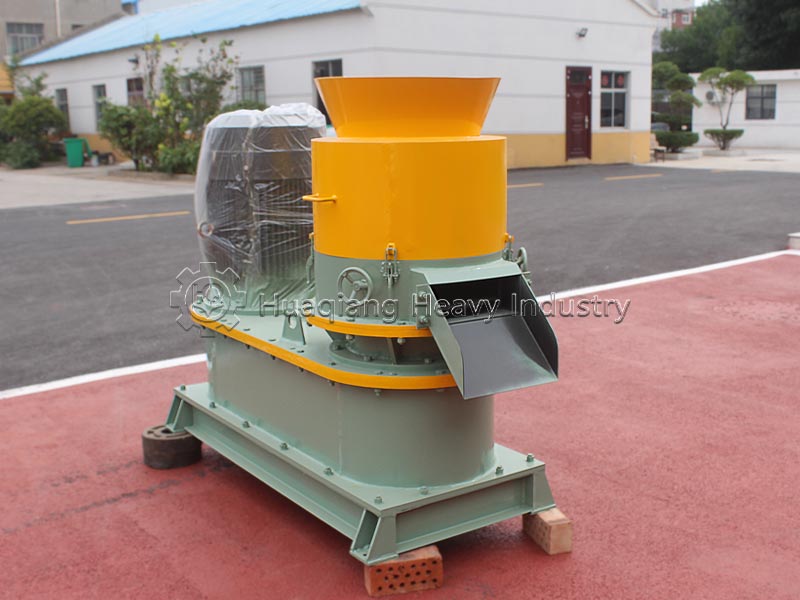
In organic fertilizer production, the choice between wet and dry granulation is crucial, determining the selection of core equipment. Our organic fertilizer granulator series covers both processes. Wet granulation, such as rotary drum granulators and disc granulators, is favored for its ability to produce high-quality spherical pellets and enable large-scale continuous production. In contrast, dry granulation focuses on mechanical compaction. For small-scale or specialized applications, flat die pelleting machines offer a simple, low-cost entry point into dry granulation. Each technology has its advantages: rotary drum granulators offer high sphericity and high throughput, while flat die pelleting machines offer higher energy efficiency and microbial protection. Understanding this technological landscape helps producers choose the optimal granulation path—whether prioritizing excellent spherical appearance or focusing on energy conservation and preserving bioactivity—to better match their raw materials, production scale, and market objectives.
If you are planning an organic fertilizer production line, you can choose the following model: For small to medium scale (annual production less than 10,000 tons) with limited funds, a disc granulator (wet process) is a good choice, requiring less investment and quick to set up; for medium scale (annual production 10,000-50,000 tons), focusing on energy conservation and environmental protection or producing bio-organic fertilizers, a roller extrusion granulator (dry process) is recommended, offering outstanding overall benefits; for large scale (annual production more than 50,000 tons) requiring continuous production, a drum granulator (wet process) is a mature and reliable choice.