
2026-03-28
In fertilizer production, the strength and density of the particles directly determine the product's performance during transportation, storage, and application. The double roller press granulator, with its unique dry compaction process, is becoming the preferred granulation equipment for an increasing number of overseas companies. So, how exactly does this equipment transform loose powder into high-strength, dense particles? This article will delve into its core structure and compaction mechanism.
Core Structure: Three Systems Working Together
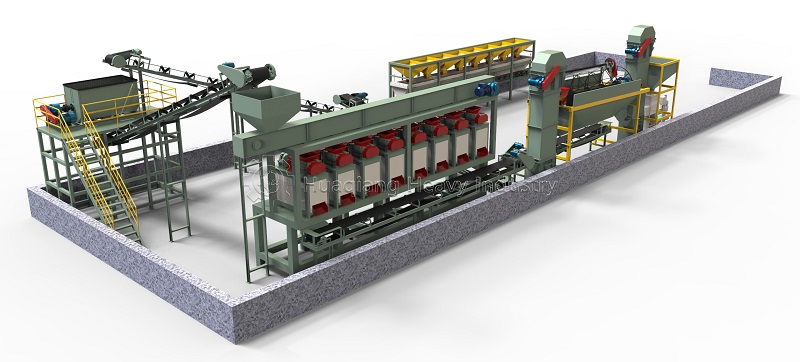
The core structure of the double roller press granulator consists of three main parts: a forced feeding system, a double roller compactor, and a crushing and screening unit. The forced feeding system employs a conical spiral design to ensure continuous and uniform material entry into the roller gap, avoiding uneven particle density caused by feeding fluctuations. The double roller compactor contains two opposing rotating rollers, one fixed and the other floating, with controllable pressure provided by a hydraulic system. The roller surfaces are decorated with precisely engraved grooves with an accuracy of ±0.02mm, and are often coated with a tungsten carbide coating to enhance wear resistance. The crushing and screening unit breaks down and grades the compacted flaky material.

Compaction Process: Four-Step Forming, Closed-Loop Production
The workflow of the double-roller press granulator can be summarized as a four-step closed loop: compaction, crushing, screening, and return. After pretreatment (moisture content ≤5%, fineness 80-200 mesh), the material enters the hopper and is pushed into the gap between the double rollers by a forced feeder. Under an adjustable pressure of 5-30 MPa, the material undergoes a gradient of increasing extrusion pressure between the rollers, maximally compressing the voids between particles and increasing the material density by 1.5-3 times. Through van der Waals forces, crystal bridging, and other molecular forces, the material is bound into dense flaky particles. The compacted flaky material falls into the crushing chamber and is cut into irregular particles by rotating blades. The screening machine grades the particles: qualified particles enter subsequent processes, oversized particles are returned for crushing, and fine powder is sent back to the buffer hopper at the front of the compactor via the return system, achieving zero-emission continuous production.
Compaction Parameter Control: Tailored to Material Requirements, Precise and Controllable
The core of effective compaction lies in parameter control. The hydraulic system of the roller granulator allows for stepless pressure adjustment from 5-30 MPa—for easily moldable raw materials such as ammonium sulfate and potassium chloride, the pressure can be controlled at 10-20 MPa; for materials with higher hardness or fibrous materials, the pressure can be increased to 25-30 MPa. Roller speed is typically adjustable within the range of 10-25 r/min; excessive speed may lead to insufficient material filling, while excessively slow speed will affect production capacity. Matching the feeding speed with roller pressure is equally crucial; modern equipment often uses frequency conversion speed regulation for automatic control.
Technological Upgrades: Energy-Saving Compaction and Intelligent Control
The new generation of roller extrusion granulators continues to make breakthroughs in energy saving and intelligence. Adopting a dry, room-temperature molding process, it eliminates the need for a drying step, reducing overall line energy consumption by 40%-60% compared to wet granulation. The intelligent control system monitors roller pressure changes in real time through pressure sensors, dynamically adjusting hydraulic pressure and roller gap to ensure stable particle density. Some high-end models support IoT platform access, enabling real-time uploading of production data and remote parameter adjustment.
Practical Case: Compaction Effect of Urea and Fly Ash
Taking urea granulation as an example, with the raw material moisture content controlled at 1%-3% and under roller pressing at 20MPa, the compressive strength of the output granules can reach 25-30N, the particle diameter is 2-4mm, and the forming rate is over 95%. Fly ash raw material, due to its lack of stickiness, requires the addition of a small amount of bentonite (3%-5%). Under 25MPa pressure, the particle strength can still reach over 15N, meeting storage and transportation requirements.
From forced feeding to precise compaction, the roller extrusion granulator achieves efficient "powder → granules" conversion through pure mechanical force. For production enterprises pursuing particle strength and reduced energy consumption, understanding its compaction mechanism and precisely controlling parameters is a key step in unlocking the value of the equipment.
The double roller press granulator is the core of a roller press granulator production line, functioning as a powerful fertilizer compactor to achieve efficient fertilizer granules compaction. This equipment is a prime example of advanced fertilizer production machine technology, playing a pivotal role in the modern npk fertilizer manufacturing process. Its dry, room-temperature compaction method is particularly advantageous for moisture-sensitive materials and for reducing overall energy consumption. In a complete npk fertilizer line, a double roller press granulator is often chosen for its ability to produce high-density, strong granules without the need for subsequent drying, significantly streamlining the production flow. The precision of its hydraulic pressure control and the wear resistance of its roller surfaces are critical factors in ensuring consistent product quality and long equipment life. For manufacturers seeking to produce high-strength, compact granules—whether for standard NPK blends or specialty fertilizers—this fertilizer compactor technology represents a strategic investment in efficiency and product performance.