
2026-03-26
In the production of compound fertilizers and organic-inorganic compound fertilizers, converting powdered raw materials into uniform granular products has always been a key technological challenge. Low forming rate, organic-inorganic stratification, uneven particle size, and weak equipment adaptability—these four major industry pain points have long plagued production enterprises, restricting the improvement of product quality and economic benefits. Disc granulators, with their unique technical principles and flexible process control, are becoming an ideal choice for solving these problems.
The difficulty in granulating powdered compound fertilizers and organic-inorganic compound fertilizers stems from the complex combination of raw material characteristics. First, powdered raw materials have poor flowability and insufficient binding properties; traditional equipment often results in a return powder rate as high as 30%-40%, leading to a forming rate of only about 70%. Second, in organic-inorganic compound fertilizers, organic powders are lighter and inorganic powders are heavier; traditional stirring methods are difficult to achieve uniform mixing, easily causing nutrient stratification within the granules, with nitrogen, phosphorus, and potassium content deviations exceeding ±1%. Furthermore, the large fluctuation in particle size (1-5mm) leads to inaccurate packaging and metering, and can easily cause localized seedling burn or nutrient deficiency during fertilization. Finally, traditional equipment takes 4-6 hours to changeover between different formulations (such as high-nitrogen and high-phosphorus), resulting in high costs for small- and medium-batch production.
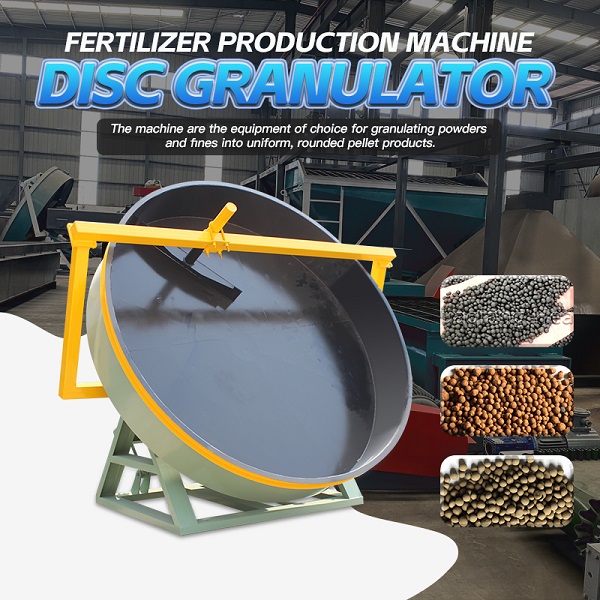
The disc granulator effectively addresses these challenges thanks to its "gradual granulation process" and optimized structural design. Its working principle follows a three-step process: "powder premixing - atomization humidification - rolling granulation." After premixing, the powdered raw material enters a granulation disc with an adjustable inclination angle (35°-55°). Atomizing nozzles precisely spray a binder, causing the powder to initially form small nuclei of 1-2mm. These nuclei continuously absorb surrounding powder as the disc rolls, gradually growing into uniform particles of 2-4mm. This gradual granulation method results in tightly bound molecules within the particles, achieving a compressive strength of 15-25N, far exceeding industry standards.
To address the issue of organic-inorganic stratification, a spiral guide plate is installed on the inner wall of the disc, creating an "up-down convection" airflow during rotation to thoroughly mix the light and heavy powders. Simultaneously, a variable frequency speed-regulating motor can precisely adjust the speed within the range of 10-20 r/min, and combined with an adjustable tilt angle, achieves a particle size deviation of ≤±0.2mm. An edge material recovery device collects and re-granulates powder scattered at the edge of the disc, reducing the return powder rate to below 8%.
The effectiveness of the disc granulator is highly dependent on raw material pretreatment and parameter adjustment. Raw materials need to be crushed to 80-120 mesh, with an initial moisture content controlled at 10%-15%. During granulation, water is added through atomizing nozzles to bring the moisture content to 20%-25%—the standard for judging by feel is that it "can be formed into a ball by hand and does not crumble when dropped." The parameter settings differ depending on the type of fertilizer: For high-nitrogen compound fertilizer, a disc inclination angle of 45°-50°, a rotation speed of 18-20 r/min, and a binder addition of 3%-5% are suitable; for high-phosphorus compound fertilizer, an inclination angle of 40°-45°, a rotation speed of 15-18 r/min, and a binder addition of 5%-6% are needed; for compound fertilizer with 40% organic content, an inclination angle of 35°-40°, a rotation speed of 12-15 r/min, and a binder addition of 6%-8% are required.
The moisture content of the granulated particles is approximately 20%-25%, requiring a drying process. Special attention should be paid to using low-temperature drying (60-80℃) to avoid carbonization of organic matter and nitrogen loss due to high temperatures. High airflow helps to quickly remove water vapor, preventing secondary moisture absorption by the particles.
Application Results: Data Demonstrates Improved Quality and Efficiency
After using a disc granulator, the forming rate of powdered raw materials can be increased to over 90%, the particle uniformity reaches 95%, and the nutrient deviation of organic-inorganic compound fertilizer is controlled within ±0.5%. Compared to traditional rotary drum granulators, this equipment eliminates the need for extensive steam conditioning, reducing energy consumption per ton by 25%-30%. The amount of binder added is reduced by 40% compared to extrusion granulation, resulting in a cost reduction of 100-150 yuan per ton. For small- to medium-scale production, the flexibility of this equipment is particularly significant—whether used in conjunction with disc granulator machines for mass production or in collaboration with other molding equipment, it enables rapid changeovers and high-efficiency output, providing reliable technical support for upgrading powder fertilizer granulation.
Disc Granulators for Powder Fertilizer Granulation
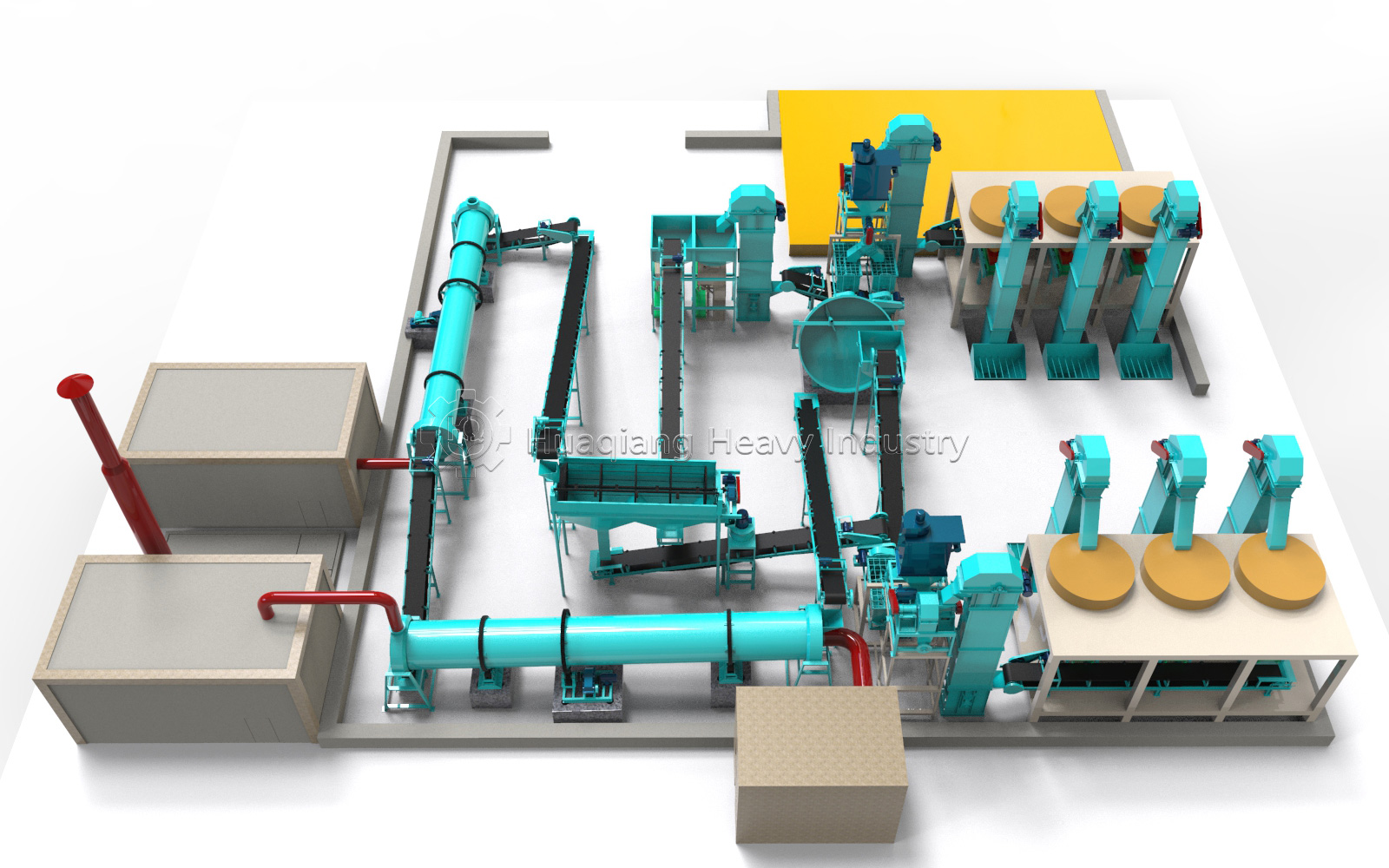
The disc granulator's effectiveness in addressing the challenges of powder granulation makes it a cornerstone of a disc granulation production line. Its ability to create uniform, strong granules through a gentle rolling action positions it as a key piece of equipment for many organic and organic-inorganic compound fertilizer applications. However, it is important to view this technology within the broader spectrum of granulation options. A rotary drum granulator, for instance, is the preferred choice for large-scale, high-capacity NPK production, using steam to create spheres. For dry, moisture-sensitive materials, a double roller press granulator within a roller press granulator production line achieves fertilizer granules compaction without heat or binders. For very small-scale or specialty applications requiring simple cylindrical pellets, a flat die pelleting machine provides a low-cost entry point. The choice between a disc granulator machine and these other technologies is a strategic decision based on the specific raw material characteristics, target product form, and production scale. The disc granulator machine excels in its gentle, flexible process, making it ideal for formulations containing organic matter and for producers who prioritize precise particle size control and high granule sphericity over the maximum possible throughput. Understanding the distinct strengths of each technology—from the gentle tumbling of a disc granulator machine to the high-pressure compaction of a double roller press granulator—is essential for selecting the optimal path for converting powder into a high-value granular product.