
2026-03-25
In the procurement of fertilizer and chemical granulation equipment, the choice between hydraulic roller granulators and conventional twin-roller extrusion granulators often presents a dilemma for decision-makers. While they appear similar, their core technologies and applicable scenarios are drastically different. Choosing the wrong equipment can result in substandard granule quality or, more seriously, limited overall production line efficiency. This article will clarify the essential differences and selection logic between the two types of equipment from four dimensions: technical principles, performance, cost structure, and suitable scenarios.
The fundamental difference between the two types of equipment lies in their pressure control methods. Conventional double-roller extrusion granulators use mechanical springs or fixed roller gaps, causing pressure to fluctuate with material hardness, making it difficult to maintain a constant pressure. Hydraulic roller granulators, on the other hand, drive floating rollers through a hydraulic system, equipped with pressure sensors and proportional valves, achieving millisecond-level response and ensuring constant roller pressure at the set value. This generational difference leads to a qualitative change in granule quality—the particle density variation coefficient of hydraulic equipment is ≤5%, while that of conventional equipment often exceeds 10%.
In terms of granule quality, hydraulic roller granulators have a significant advantage. Its constant-pressure molding characteristic allows for granule compressive strength of 20-30N with uniform distribution, while ordinary equipment often exhibits granule strength deviations of ±5N or more due to pressure fluctuations. Regarding raw material compatibility, hydraulic equipment, with its stepless pressure adjustment (5-30MPa), can handle a wide range of materials from soft catalysts to hard mineral powders; ordinary equipment is only suitable for easily moldable raw materials such as ammonium sulfate and potassium chloride. In terms of energy consumption, the hydraulic system supplies energy on demand, saving 15%-20% more electricity than mechanical equipment. The level of automation is also vastly different—hydraulic equipment comes standard with a PLC and touchscreen, supporting recipe storage and one-click recall; ordinary equipment is mostly manually adjustable, making changeovers time-consuming and labor-intensive.

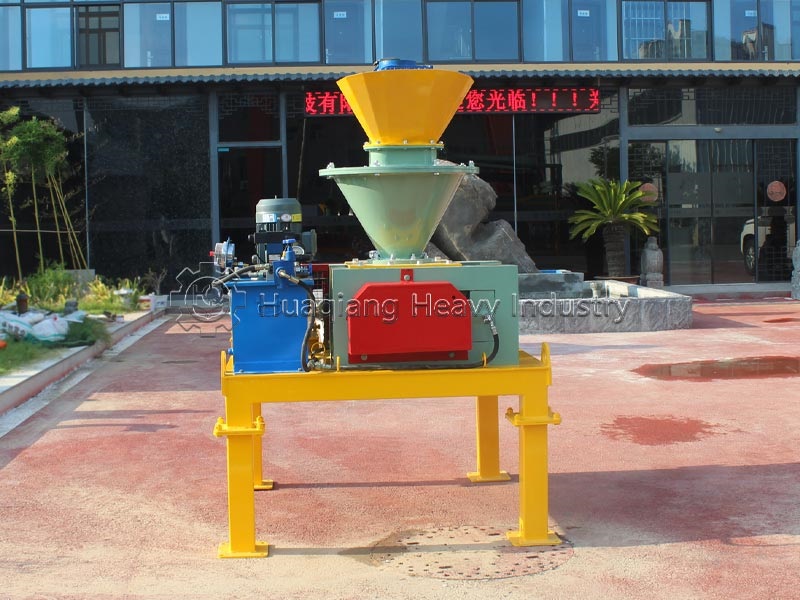
In terms of initial investment, hydraulic roller granulators are 30%-50% more expensive than ordinary equipment due to their hydraulic system and intelligent control module. However, long-term operating costs need to be comprehensively considered: hydraulic equipment has a longer lifespan for wear parts—the rollers use tungsten carbide welding, with a lifespan exceeding 8000 hours, 2-3 times that of ordinary high-chromium rollers; energy consumption is lower, saving over 100,000 yuan annually for a 50,000-ton production line; the return rate is controlled below 15%, 5-8 percentage points lower than ordinary equipment, reducing ineffective cyclical energy consumption. Comprehensive calculations show that the unit product granulation cost of hydraulic equipment is 15%-20% lower than that of ordinary equipment, with the investment difference typically recovered within 1.5-2 years.
Hydraulic roller granulators are the preferred choice for the following scenarios: high-end compound fertilizer and controlled-release fertilizer production with stringent requirements for granule quality; comprehensive fertilizer plants with diverse raw materials and frequent formula changes; chemical projects processing difficult-to-form materials such as phosphate rock powder and catalysts; and large-scale production lines with an annual output of over 30,000 tons. Its core advantages lie in "constant pressure molding to ensure quality, broad-spectrum adaptability to reduce risk, and intelligent control to reduce labor."
Ordinary double-roller extrusion granulators are suitable for: processing low-end blended fertilizer raw materials with low particle quality requirements; small production lines with single raw materials and unchanged formulas year after year; start-up projects with an annual output of less than 10,000 tons; and startups with extremely limited budgets. It should be noted that with increasingly stringent environmental and quality requirements, ordinary equipment is gradually being phased out by the market.
For small enterprises with an annual output of 10,000-30,000 tons, if funds are sufficient and the target market is high-end, it is recommended to choose hydraulic equipment from the outset to avoid repeated investment in later upgrades and modifications. For medium-sized enterprises with an annual output of 30,000-50,000 tons, hydraulic equipment is the optimal solution balancing quality and cost, and its automation features can reduce the number of operators by 2-3. For large-scale bases with an annual output of over 50,000 tons, hydraulic roller granulators must be chosen—their economies of scale are significant, and the overall cost per unit product is more than 20% lower than that of ordinary equipment.
.jpg)
Our company's hydraulic roller granulators adopt dual-cylinder synchronous control technology, with pressure fluctuations ≤±0.5MPa; the rollers are equipped with tungsten carbide surfacing as standard, with a lifespan of 15,000 hours; the hydraulic system integrates air cooling for heat dissipation, making it suitable for continuous operation in tropical regions. The equipment supports dual voltages of 380V/50Hz and 460V/60Hz and comes standard with a remote monitoring module. Based on a 100,000-ton-per-year compound fertilizer project, our equipment is 30% cheaper than similar imported brands, while maintaining the same core performance indicators such as particle strength and molding rate, shortening the investment payback period to 1.2 years.
The comparison between hydraulic and conventional roller granulators highlights a key evolution in dry granulation processes. Both are core components of a roller press granulator production line, functioning as a fertilizer compaction machine to achieve fertilizer granules compaction. However, the hydraulic roller granulator represents a significant advancement in fertilizer production machine technology. Its precise, real-time pressure control, enabled by the hydraulic system, transforms the granulation process from a mechanical extrusion into a form of intelligent compaction. This results in a qualitative leap in product quality, with the double roller press granulator (the hydraulic variant) producing granules of unparalleled uniformity and density. While the conventional double roller press granulator remains a viable option for basic, low-cost applications, its limitations in pressure consistency and material adaptability are becoming increasingly apparent in a market demanding higher quality and efficiency. For producers targeting high-end markets, processing challenging materials, or seeking long-term operational savings, the investment in a hydraulic roller granulator is a strategic decision that leverages the latest dry granulation processes to build a more robust and competitive manufacturing capability.
From equipment selection to long-term operation, the hydraulic roller granulator, with its comprehensive advantages of "high quality, low consumption, and long lifespan," is becoming the upgrade direction for particle production in the fertilizer and chemical industries. Please contact us for detailed technical parameters and targeted selection advice.