
2026-03-27
In organic fertilizer and biomass pellet production, flat die pelleting machines have become core equipment in small and medium-sized production lines due to their simple structure, moderate investment, and wide raw material adaptability. However, many users often encounter the dilemma of "different results with the same machine"—processing chicken manure smoothly and efficiently, but frequently causing die clogging when using straw. The root cause lies in the significant differences in the physical properties of different raw materials, requiring differentiated pretreatment and parameter control. This article will analyze the raw material adaptability range and practical operating techniques for flat die pelleting machines.
Compatible Raw Material Map: From Livestock Manure to Wood Chips and Straw
The flat die pelleting machine is mainly suitable for three types of organic raw materials: Livestock manure (chicken manure, pig manure, cow manure), after full fermentation and decomposition, has softened fibers and moderate moisture content, making it an ideal granulation material; Straw (corn stalks, rice husks, wood chips), with high fiber content, needs to be crushed to 2-5mm and the moisture content controlled at 8%-12%; Single organic fertilizers (such as soybean meal, mushroom residue) have good binding properties and can be directly granulated or have a small amount of bentonite added to enhance strength. For NPK compound fertilizers or mixed raw materials, roller extrusion granulators are more advantageous, while flat die pelleting machines are more suitable for pure organic materials.
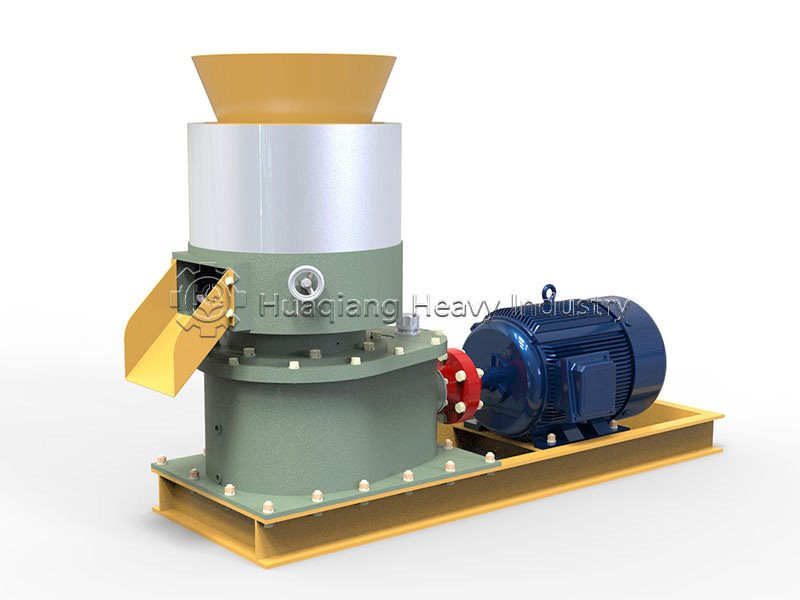
Raw Material Pretreatment: Fermentation, Crushing, and Moisture Conditioning in Three Steps
Pretreatment is crucial to the success of flat die granulation. The first step is fermentation and decomposition: Fresh livestock manure needs 15-20 days of aerobic fermentation to kill pathogens, decompose coarse fibers, and make the raw material loose and soft. The ideal C/N ratio after fermentation is 20-25:1. The second step is fine grinding: fibrous materials such as straw and sawdust need to be ground to 2-5mm; excessive coarseness will easily clog the die holes. Fermented manure only needs to be ground to below 5mm. The third step is moisture control: the moisture content of the raw materials must be strictly controlled between 8%-15%—too high a moisture content will cause material adhesion and die clogging; too low a moisture content will result in loose particles and a decreased forming rate. The standard for judging by feel is that it "can be formed into a ball by hand, but crumbles easily when lightly pressed."
Parameter adjustment for different raw materials: precise matching of pressure and speed. The core adjustable parameters of the flat die pelleting machine include the pressure roller pressure and the spindle speed. The pressure roller pressure is achieved by adjusting the gap between the pressure roller and the flat die (0.1-0.3mm)—too small a gap will cause excessive material compression and heat generation; too large a gap will reduce the forming rate. The spindle speed directly affects the residence time of the material in the die holes and the extrusion frequency.
For livestock and poultry manure (moisture content 12%-15%, low fiber content): a "medium pressure, medium speed" strategy is recommended—roller gap 0.15-0.2mm, rotation speed 120-150r/min, achieving a pelleting rate of over 90%. For straw and sawdust (moisture content 8%-10%, high fiber content): a "high pressure, low speed" strategy is required—roller gap narrowed to 0.1-0.15mm, rotation speed reduced to 80-100r/min, extending the compression time of the material within the die orifice and improving pellet density. For mushroom residue (naturally loose, poorly cohesive): 3%-5% bentonite or starch can be added, using "medium pressure, medium speed" with appropriately increased rotation speed, utilizing centrifugal force to promote pellet formation.
Common Granulation Problems and Solutions: Blockage of high-fiber raw materials is the most common problem. This is caused by fiber entanglement in the rollers or material buildup in the die orifice. The solution is to optimize the die design—using a tapered die orifice (the feed end diameter is slightly larger than the discharge end) to reduce material resistance; adding oblique knurling to the surface of the pressure rollers to enhance fiber gripping force. If abnormal current fluctuations are detected during operation, the machine should be stopped immediately to clean the die orifice, avoiding forced operation that could damage the die.
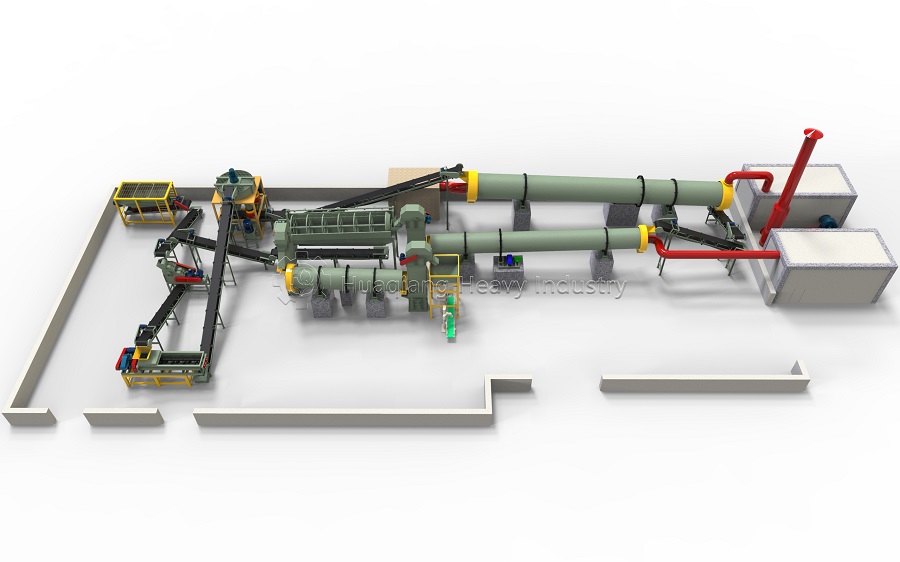
Loose granules are often caused by insufficient moisture in the raw material or excessive gap between the pressure rollers. Water can be sprayed to adjust the moisture content to 9%-11%, or the pressure roller gap can be narrowed by 0.02mm for gradual testing. If the problem persists, check for wear in the flat die orifice; if severely worn, replace the die.
From chicken manure to sawdust, from fermented materials to fiber materials, the flat die pellet mill doesn't have a "universal parameter" for raw material adaptation, but it does have a scientific control logic. Understanding raw material characteristics, optimizing pretreatment, and precisely adjusting parameters allow this economical equipment to unleash its maximum efficiency, providing reliable support for the utilization of organic resources.
The flat die pelleting machine is a cornerstone of columnar fertilizer granulation technology, offering a simple, cost-effective solution for transforming a wide range of organic materials into uniform cylindrical pellets. Its adaptability to different feedstocks—from fermented manure to fibrous straw—makes it a versatile tool within the broader organic fertilizer granulator series. However, understanding its place in the spectrum of fertilizer production machine technology is crucial. For applications requiring the highest sphericity or extremely high throughput, other technologies may be more suitable. A disc granulator machine, for instance, is ideal for producing smooth, spherical organic granules, while a rotary drum granulator is the workhorse for large-scale, continuous NPK production. The key to successful granulation is matching the technology to the raw material and the desired product. The flat die pelleting machine excels in its niche: processing pure organic materials into dense, strong cylindrical pellets with a moderate investment. By mastering the specific pretreatment and parameter control for different feedstocks, producers can leverage this technology to create high-value products from a diverse array of agricultural and organic wastes.