
2026-07-10
I. What is a New Type Stirring Tooth-Drum Granulator?
A New Type Stirring Tooth-Drum Granulator, also known as an internal rotary New Type Stirring Tooth-Drum Granulator or wet granulator, is a new type of organic fertilizer granulation equipment that utilizes high-speed rotating mechanical stirring force and the resulting aerodynamics to continuously mix, granulate, pelletize, and densify fine powdery materials within the machine, thereby achieving the purpose of granulation. The granules are spherical, with a sphericity of over 0.7, and a particle size generally between 0.3-5 mm, achieving a granulation rate of over 93%.
The core technological advantage of the New Type Stirring Tooth-Drum Granulator lies in its ability to allow for a relatively high moisture content in the material (typically 20%-50%). Fermented organic materials can be directly granulated without a strict drying process, followed by appropriate drying and sieving. This feature greatly simplifies the organic fertilizer production process and reduces energy consumption and equipment investment in the drying stage.
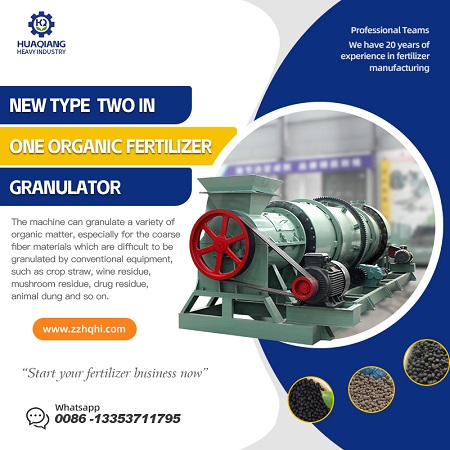
II. Centrifugal Granulation Principle: Synergy of Mechanical and Aerodynamic Forces
The working principle of a stirring tooth granulator can be summarized as "mechanical forced agglomeration." Its core logic is: utilizing the centrifugal force and shearing force generated by the high-speed rotating stirring teeth to break up the material like "beating eggs" and re-knead it into spheres.
The specific process is as follows: After the material enters the granulation chamber through the feed inlet, the main shaft drives the stirring teeth to rotate at high speed (typically reaching several hundred rpm), generating strong mechanical stirring force and aerodynamic force. Under the action of centrifugal force, the material is thrown against the cylinder wall and forms a rotating material ring along the inner wall; the shearing action of the stirring teeth breaks up the agglomerated material, making the fine powder evenly dispersed; the material particles collide, embed, and adhere to each other under high-speed motion, gradually growing into spheres; finally, under the combined action of centrifugal force and the material's own gravity, spherical particles are formed and compacted.
This process is more like "kneading dough"—as long as the material itself contains a certain amount of colloidal properties (fully fermented manure is inherently sticky), even without adding clay, it can quickly clump together into balls when the moisture content is around 30%.
III. Internal Structure Disassembly: Precise Fit of Rotor, Agitator Teeth, and Cylinder
The core structure of the agitator granulator consists of five main components: motor, reducer, rotor, cylinder, and frame.
The rotor is the heart of the equipment, typically divided into three sections: mixing section, granulation section, and polishing section. Each section is equipped with a different arrangement of agitator teeth—the mixing section is responsible for quickly and evenly dispersing the material, the granulation section completes the granulation and balling, and the polishing section refines the surface of the formed granules. The rotor's agitator teeth are precisely designed so that each tooth can simultaneously agitate and convey material axially, preventing the material bed from becoming excessively thickened within the cylinder.
The inner wall of the cylinder is usually lined with wear-resistant material, which, in conjunction with the high-speed rotation of the rotor, provides the physical space and friction interface for granulation. Material is fed in from the inlet and granulated inside the cylinder through a special structure, finally flowing out from the outlet.

IV. Finished Pellet Pressure Test Data
The stirring tooth granulator outperforms traditional granulation equipment in terms of finished pellet quality:
Pelletization Rate: The qualified pelletization rate is as high as 80%-90% or more, with some high-quality models reaching over 98%.
Pellet Strength: The compressive strength of organic fertilizer pellets is higher than that of disc granulators and rotary drum granulators.
Large Pellet Ratio: The large pellet ratio is less than 15%, and the uniformity of pellet size can be flexibly adjusted through a stepless speed regulation function.
Pellet Size Range: The pellet diameter is generally between 0.3-5 mm, which can be controlled according to user requirements by adjusting the material mixing amount and the main shaft speed.
Summary: The stirring tooth granulator uses high-speed centrifugal mechanical force as its core drive, integrating the four processes of mixing, granulation, pelletizing, and densification into a single device. Its high moisture adaptability, high pelletization rate, and high pellet strength make it the preferred equipment for organic fertilizer wet granulation production lines.
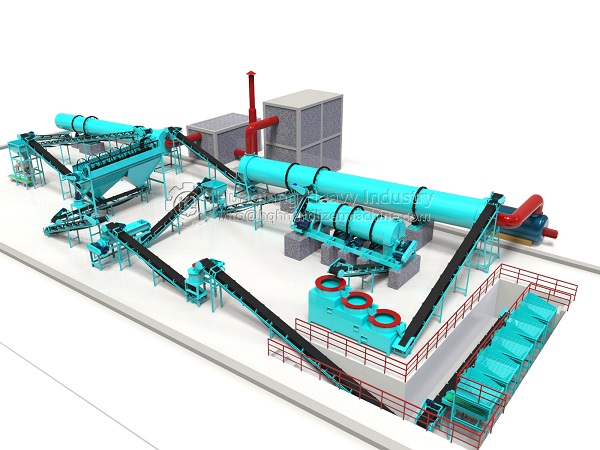
The new type stirring tooth-drum granulator represents a significant advancement in fertilizer production machine technology, addressing the long‑standing challenges of high‑moisture organic feedstock granulation. As a key member of the organic fertilizer granulator series, it uniquely integrates mixing, granulation, pelletizing, and densification into a single high‑speed centrifugal unit, delivering a granulation rate exceeding 93% and spherical granules with a sphericity above 0.7—all without the need for pre‑drying or chemical binders. This capability makes it the preferred solution for organic fertilizer production granulation, particularly for fermented manure, biogas residue, and other high‑moisture organic wastes that are difficult to process with conventional disc or drum granulators. When deployed in a complete bio organic fertilizer production line, the stirring tooth granulator seamlessly integrates with upstream fermentation and crushing equipment, and downstream drying, screening, and packaging systems, enabling a streamlined, energy‑efficient process from raw waste to premium granular product. By eliminating the drying bottleneck and reducing overall energy consumption by 30‑40%, this technology not only lowers operating costs but also preserves the biological activity of organic fertilizers—delivering a higher‑value product that meets the growing global demand for sustainable, soil‑building agricultural inputs.