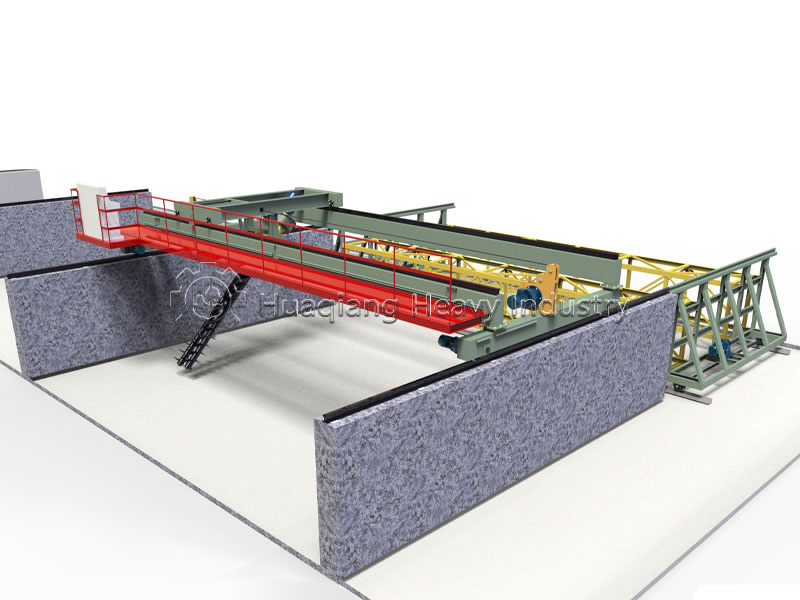
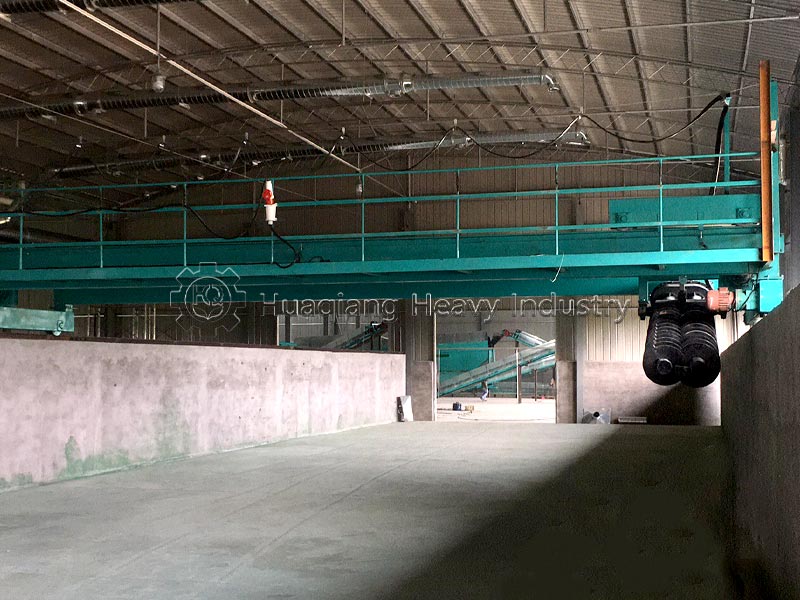
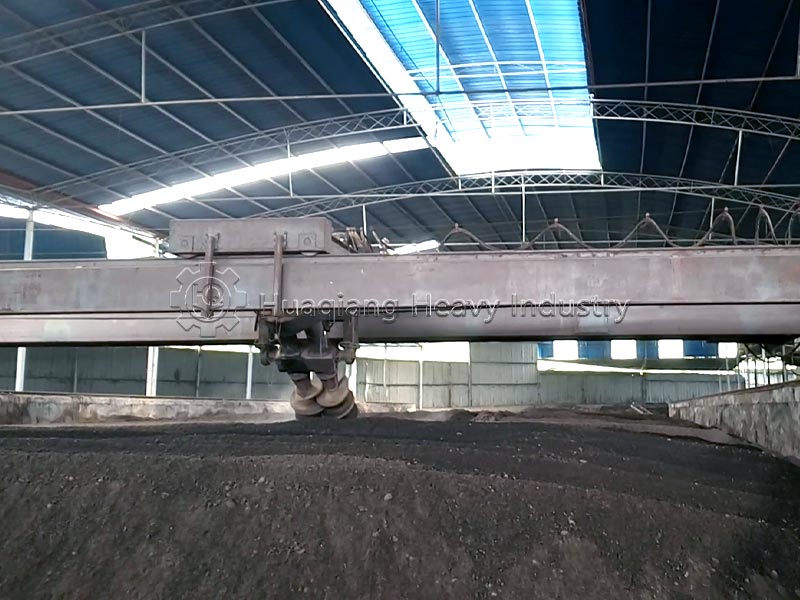
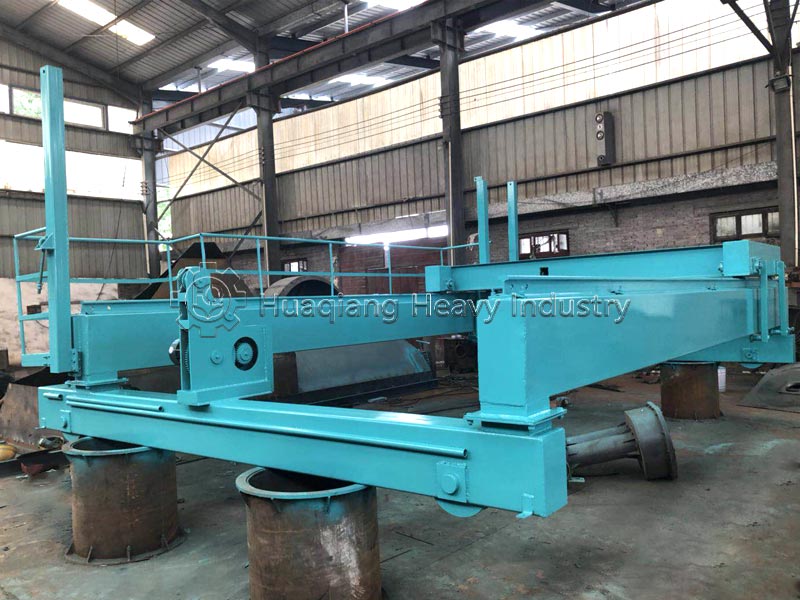
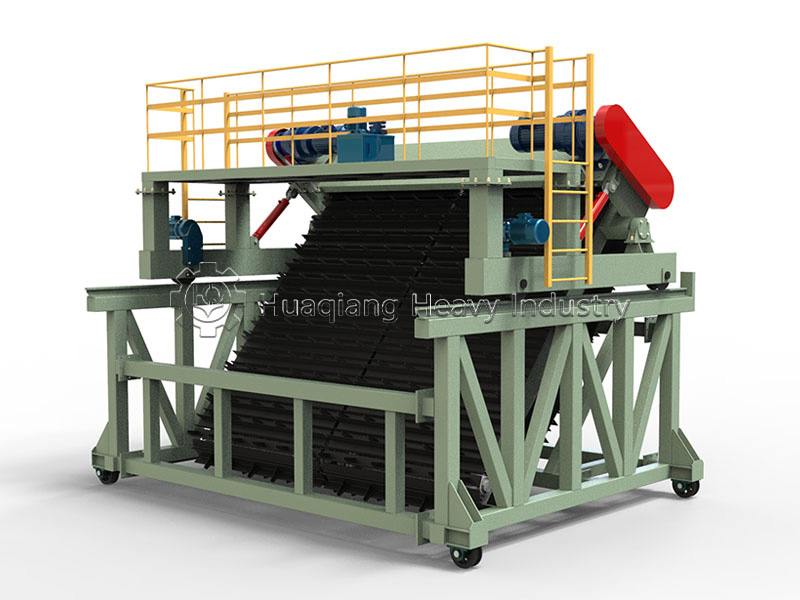
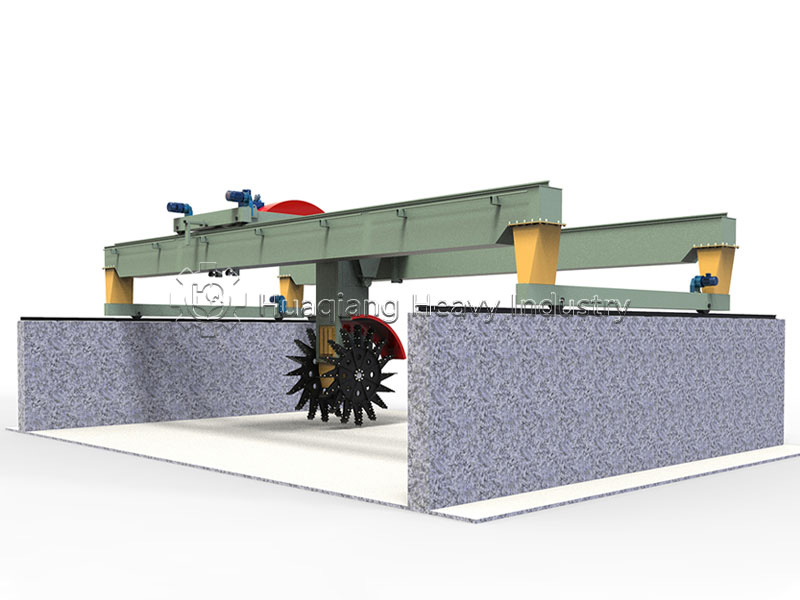
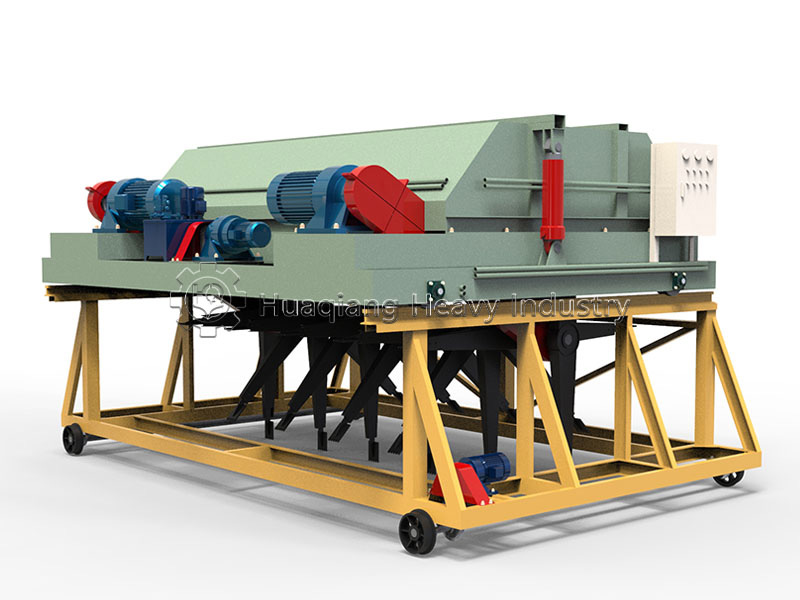
The Double Screws Compost Turning Machine is a high-efficiency trough-type fermentation equipment specifically designed for the aerobic composting of organic waste. Its core feature lies in the use of two symmetrically distributed, counter-rotating screws shafts as the turning and composting components. This equipment continuously lifts and scatters material from the bottom of the fermentation trough to the upper layer of the pile through the screws blades, simultaneously achieving lateral and longitudinal displacement of the material, thus realizing multiple functions such as oxygenation, cooling, crushing, and uniform mixing.
As a core piece of equipment for modern industrial production of organic fertilizer and the harmless treatment of organic waste, the Double Screws Compost Turning Machine is widely used in the deep aerobic fermentation treatment of materials such as livestock and poultry manure, municipal sludge, urban organic waste, and agricultural and forestry waste. Compared to traditional rotary tillage or large wheel compost turning equipment, the Double Screws Compost Turning Machine has significant technical advantages, including a greater turning depth (up to 1.5–3.0 meters), a wider processing span (up to 6–11 meters), and stronger adaptability to high-humidity and high-viscosity materials. It is particularly suitable for deep fermentation processes of materials with low organic matter and high moisture content.
Equipment Structure and Components
The double-screws compost turner mainly consists of the following core components:
1. Double-screws Turning Device (Core Working Component)
The core working component of the equipment is two sets of symmetrically arranged spiral augers (spiral shafts). Spiral blades and material-feeding teeth are welded onto the spiral shafts. The blades employ a variable pitch design—a small pitch at the feed end increases the pushing density, while a large pitch at the discharge end promotes material discharge and effectively prevents blockage. The spiral blades and main shaft are typically made of thick-walled seamless steel pipes and high-chromium alloy steel castings, with surfaces treated by supersonic arc spraying or wear-resistant welding, achieving a hardness of HRC60 or higher. The two spiral shafts rotate relative to each other (in opposite directions) driven by a hydraulic motor, with the blades interlacing.
2. Walking Device
This consists of a walking motor (or hydraulic motor), transmission sprockets, transmission shafts, and walking wheels. The equipment spans across the fermentation tank, with the walking wheels on both sides moving smoothly along the tracks. The walking system is mainly divided into wheeled and tracked types. The wheeled type is suitable for trough-type fermentation workshops with hardened ground, while the tracked type is suitable for soft, muddy windrow-type fermentation sites. 3. Hydraulic Lifting System: Composed of a hydraulic pump station, solenoid valve body, hydraulic oil pipes, and hydraulic cylinders, this system adjusts the auger shaft position in real time according to the stack height to ensure consistent turning depth. The hydraulic system also features automatic extension/reversal of the auger shaft; in case of current overload, the system automatically activates reverse mode to clear entangled materials.
4. Power Transmission System: Employing a "motor-reducer-chain/gear" transmission method, this system provides stable power to the double-screws auger and traveling mechanism. Some high-end units are equipped with a frequency converter, allowing flexible adjustment of the turning speed and traveling speed based on material moisture and thickness. The transmission system is equipped with an overload protection device that automatically cuts off power in case of large hard objects or material overload.
5. Frame and Intelligent Control Cabinet: The frame adopts a modular welded structure made of thickened carbon steel, offering high strength and stability. The control cabinet allows for manual, automatic, or remote operation.
6. Transfer vehicle (shifting vehicle) Composed of a walking motor, transmission gears, drive shaft, walking wheels, etc., it provides a transport tool for the turning machine to change troughs, realizing one machine to operate multiple troughs.
Applications of the Equipment
The double-screws compost turner is suitable for aerobic fermentation in earthen troughs and is a core piece of equipment for the industrial-scale harmless treatment of livestock farming, municipal waste, and urban sewage sludge. Specific applications include:
Application Field
Typical Scenarios
Large Organic Fertilizer Plant
Fermentation and maturing process for large-scale and standardized production of organic fertilizers
Large-scale Livestock & Poultry Farm
Centralized fermentation treatment of livestock and poultry manure to realize resource utilization of manure waste
Solid Waste Environmental Disposal Center
Harmless and resourceful treatment of organic solid wastes such as municipal sludge and kitchen waste
Compound Fertilizer Factory
Fermentation pretreatment of raw materials for compound fertilizer
Horticultural Farm
Composting treatment of garden waste
Button Mushroom Plantation
Fermentation preparation of mushroom culture substrate
Food / Brewing / Sugar Manufacturing Industry
Treatment of industrial organic wastes such as distiller's grains and sugar mill filter sludge
Compared to traditional compost turning equipment, the double-screws compost turner overcomes the problems of shallow turning depth, small turning span, and large footprint of ordinary earthen trough compost turners. It achieves an effective turning depth of up to 1.7 meters and an effective turning span of 6–11 meters, significantly improving the utilization rate of the work site. It is particularly suitable for the fermentation of low-organic-matter materials such as sludge and municipal waste—due to their low organic matter content, sufficient fermentation depth is required to increase the fermentation temperature and thus shorten the fermentation time.
Applicable Raw Materials for the Equipment
The double-screws compost turner can process a variety of organic waste materials:
1. Livestock and Poultry Manure
Chicken manure, pig manure, cow manure, sheep manure, etc. The equipment is particularly adept at processing high-moisture, high-viscosity, and large-clump livestock and poultry manure, and is less prone to jamming or shutdown. A pig farm with 10,000 heads has seen its annual manure processing capacity exceed 120,000 tons after application.
2. Crop Straw
Corn stalks, wheat stalks, rice stalks, etc. The double-screws structure has a minimal crushing effect on materials, making it particularly suitable for high-fiber materials such as straw and coconut coir.
3. Industrial Organic Waste
Sugar mill filter mud, winery residue and cake, traditional Chinese medicine factory dregs, etc.
4. Municipal Sludge and Kitchen Waste
Large amounts of sludge from urban sewage treatment plants, as well as high-viscosity materials such as kitchen waste.
5. Garden Waste
Dried branches, fallen leaves, weeds, etc., generated during urban greening.
6. Other Organic Waste
Sawdust, spent mushroom cultivation substrate, etc.
The equipment is suitable for materials with a moisture content of 30%–80%, requiring no complex pretreatment. The special angle design of the spiral blades automatically gathers large pieces of material towards the center and crushes them, achieving excellent crushing and pretreatment results.
Working Principle of the Equipment
The core working principle of the double-screws compost turner lies in the synergy of "screws lifting" and "bidirectional shearing."
The working process is as follows: The equipment spans above the fermentation tank, with wheels on both sides moving smoothly along tracks. During operation, two shafts equipped with continuous helical blades rotate relative to each other (in opposite directions) driven by hydraulic motors. The helical blades cut deep into the material, lifting the oxygen-deficient, cold material at the bottom along the axial direction and throwing it towards the center.
This unique turning and turning method creates a "W"-shaped material flow:
1. Deep Turning: The double helical shafts penetrate deep into the material layer (up to 2 meters), completely turning the bottom material to the surface, effectively preventing the formation of an anaerobic environment at the bottom.
2. Forced Aeration: The material comes into full contact with air during the turning process, achieving self-oxygenation—the turning action itself is mechanical aeration, reducing or eliminating the need for an auxiliary forced air supply system.
3. Uniform Mixing: The two sets of spiral augers rotate in opposite directions, generating opposing thrust and shear forces, causing the material to tumble up and down and convect left and right, achieving axial and radial double turning and mixing.
4. Crushing and Conveying: The spiral blades crush large pieces of material while simultaneously pushing them backward by 0.2–1.5 meters, achieving simultaneous turning and relocation.
Compared to single-shaft equipment, the double-screws structure increases the throwing height and dwell time of the material, improving moisture evaporation efficiency by more than 30%, and allowing the pile temperature to rise to 70℃ within 24 hours. The equipment can be equipped with biological deodorization nozzles and temperature control sensors to achieve integrated intelligent control of turning, cooling and deodorization. Common Equipment Faults and Solutions
Fault Phenomenon
Possible Causes
Solutions
Excessive equipment vibration & abnormal noise
Damaged bearings; worn transmission parts; deformed or loose spiral blades; unstable foundation; uneven load caused by agglomerated materials
Shut down for inspection and replace damaged bearings; repair or replace gears and couplings; calibrate or replace deformed blades and fasten loose components; reinforce equipment foundation; clean agglomerated materials
Motor overload or overheating
Excessive load caused by high material viscosity; unstable voltage; poor motor heat dissipation; insufficient lubrication of transmission system; failure of electrical components
Reduce feeding volume or process in batches; detect power supply voltage to ensure it is within rated range; clean motor heat dissipation channels; inject lubricating oil as specified; inspect electrical circuits to eliminate short circuits
Spiral blade jamming
Metal foreign objects mixed in materials; too small gap between blades and frame; damaged bearings; overload operation
Shut down immediately and clean foreign objects; adjust blade clearance; replace damaged bearings; control operating load within rated range
Insufficient turning depth & short material throwing distance
Insufficient hydraulic system pressure; severe wear of spiral blades; too low rotating speed; excessive material moisture
Check hydraulic pump and valve group to eliminate internal leakage; replace or repair blades; adjust variable frequency rotating speed to rated value; add dry materials to reduce moisture content
Travel mechanism malfunction
Fault of travel motor; fracture of transmission chain; jamming of travel wheel bearings; deformed tracks or foreign objects on tracks
Inspect motor and frequency converter; replace chains and bearings; clean tracks and calibrate deformation
Hydraulic system failure (slow lifting or no lifting)
Internal leakage of hydraulic pump; stuck solenoid valve; internal or external cylinder leakage; contaminated hydraulic oil or insufficient oil volume
Overhaul or replace hydraulic pump; disassemble, clean or replace valve groups; replace cylinder sealing parts; replace hydraulic oil and clean oil tank
Control system failure
Aging electrical components; poor circuit contact; sensor failure; incorrect program settings; excessively high ambient humidity
Replace aging components; re-plug circuits; calibrate or replace sensors; restore factory settings or re-program; improve environmental humidity of control cabinet
Long fiber winding on spiral shaft
Insufficient material pretreatment; reduced blade cutting capacity; failure of stripping device
Pretreat and cut off overlong fibers; grind or replace cutting blades; check stripping plate and air flow system
Equipment Operation Method
I. Pre-operation Inspection
1. Power System: Check if the motor wiring connection is secure and the grounding is reliable; check if the motor voltage meets the rated requirements (380V industrial power).
2. Transmission System: Check the lubrication of the screw shaft, chain, and gearbox; add sufficient lubricating oil (grease); check the chain tension.
3. Working Parts: Check if the screw blades are intact, without deformation, cracks, or severe wear; clean any residual material from the screw shaft and frame.
4. Safety Devices: Confirm that the emergency stop button, limit switches, guardrails, and other safety components are intact and effective.
5. Hydraulic System: Check if the oil pressure is normal and if there are any oil leaks.
II. Site and Material Preparation
1. Remove stones, metal, and other hard objects from the fermentation tank to avoid damaging the screw blades.
2. Confirm that the moisture content of the material to be turned is 50%–60% (suitable for aerobic fermentation); if it exceeds 70%, dry straw needs to be mixed in to adjust; if it is below 40%, water needs to be sprayed in advance.
3. The material pile height must meet the equipment's rated turning height requirements.
III. Start-up and Trial Run
1. Turn on the power switch, press the start button, and observe whether the motor runs smoothly.
2. Start the screws turning device, run it idle for 1-2 minutes, and check whether the screws shaft rotation direction is correct, without jamming or abnormal noise.
3. Operate the walking device to confirm that the walking is smooth and the braking is effective.
4. If the rotation direction is reversed, stop immediately and change the three-phase circuit connection to change the rotation direction.
IV. Formal Operation
1. Adjust the walking speed (commonly 0.5-3 km/h) and screws shaft speed according to the material characteristics and fermentation requirements.
2. When the material viscosity is high or the fiber content is high, reduce the walking speed and increase the screws shaft speed.
3. Align the equipment with the material pile, slowly lower the screws auger to the set turning depth, and start the walking system to begin the turning operation.
V. Shutdown Operation
1. After turning is complete, raise the screws auger to a safe height.
2. Turn off the screws rotation power, walking power, and main power.
VI. Operating Precautions
1. 1. No one may pass in front of or behind the turning machine during production. Before starting the machine, observe the surrounding area and keep personnel away from it.
2. No maintenance or lubrication is allowed during production.
3. Turning must be done according to the prescribed procedure; reverse operation is strictly prohibited.
4. No one other than the machine operator may operate the machine without authorization.
5. Lubricating oil is strictly prohibited during production or maintenance.
Equipment Maintenance Methods
Adhere to the shift maintenance and handover system; do not carry over maintenance or malfunctions from the previous shift to the next.
1. Pre-shift checks:
Check all fasteners for tightness, and ensure proper bearing clearances in transmission components (too loose will cause slippage, too tight will result in excessive rotational resistance).
Add grease to bearing housings and check the gearbox oil level.
Check the security of electrical connections.
2. Post-shift maintenance:
Clean up any residue and leftover materials from the machine and surrounding area.
Add lubricating oil to all lubrication points.
Disconnect the power switch.
3. Weekly maintenance:
Check the gearbox oil level and add sufficient gear oil.
Check the hydraulic tank oil level and the sealing of all oil line joints; replace seals (O-rings) if leaks are found.
Check the contactors in the electrical control cabinet; replace any damaged ones immediately.
4. Periodic checks:
Check the operation of the motor and gearbox; stop the machine immediately if abnormal noises or overheating are detected.
Check the wear of all bearings; replace those with excessive wear.
Stop the machine after 2-3 hours of continuous operation to check equipment temperature and lubrication.
Check the wear of the helical blades.
5. Lubrication and Maintenance:
Add hypoid gear oil or No. 50 machine oil to the reducer.
Change all reducer oil after 200 hours of continuous operation during the first startup.
Change the oil every six months for the second time, and annually thereafter.
Regularly check the oil level and replenish it promptly when necessary.
6. Helical Blade Wear Treatment:
Replace or repair the helical blades if wear is severe.
For minor wear, use a professional metal repair compound to fill and strengthen the worn areas.
Applications in Organic Fertilizer Production Lines
The double-screws compost turner is the core fermentation equipment in an industrial organic fertilizer production line. It is typically located at the very beginning of the production process, undertaking the task of harmless and stabilizing the organic raw materials.
1. Typical Production Line Configuration
1) Annual production line of 10,000–50,000 tons of powdered organic fertilizer:
Raw material pretreatment (crushing/dehydration) → Ingredient mixing → Tank fermentation (double-screws compost turner) → Crushing → Screening → Packaging
2) Annual production line of 30,000–100,000 tons of granular organic fertilizer:
Raw material pretreatment → Ingredient mixing → Tank fermentation (double-screws compost turner) → Crushing → Screening → Granulation (disc/drum/extrusion) → Drying → Cooling → Screening → Coating → Packaging
2. Supporting Equipment
1) Fermentation Tank: Concrete or steel structure, width 2–11 meters, depth 1.5–3.0 meters, length designed according to production capacity (usually 30–100 meters);
2) Transfer Machine: Used for lateral switching of the double-screws turner between different fermentation tanks, achieving one machine for multiple tanks;
3) Aeration System: Perforated pipes are laid at the bottom of the fermentation tank, with forced oxygen supply in conjunction with a blower;
4) Temperature/Humidity Monitoring: Real-time feedback from online sensors, automatically starting and stopping the turner.
3. Process Integration
After fermentation and composting, the material is transported to subsequent stages by forklift or belt conveyor. Modern intelligent fermentation systems use AI algorithms to compress the fermentation cycle from the traditional 25 days to approximately 15 days, increasing nitrogen retention to over 92%, significantly improving the overall efficiency of the production line.
Matching Granulation Process (Processing of Well-Decomposed Material into Granular Organic Fertilizer)
For powdered organic fertilizer raw materials that have been fully decomposed by a double-screws compost turner, the complete granulation process for processing into commercial granulated organic fertilizer is as follows: Decomposed fermented powder → Secondary batching and mixing machine (addition of trace elements, binders, and functional microbial agents) → Organic fertilizer granulator (disc granulation / roller extrusion granulation / new type of stirring tooth granulation) → Drum dryer → Cooler → Finished product grading drum screen → Automatic packaging of finished granulated organic fertilizer;
The supporting role of the double-screws compost turner in the granulation process:
1. The double-screws bidirectional deep turning and turning ensures thorough decomposition of the material, completely breaks up clumps, results in uniform and stable particle size, and increases the granulation rate by 20%. The above;
2. Precise hydraulic lifting and turning can control the moisture content of the composted material, reduce energy consumption in the drying section, and lower the rate of particle cracking and pulverization;
3. The composted material has a higher humic content, and its particle strength, water solubility, and nutrient slow-release effect are superior to those of raw materials processed by ordinary compost turners.
Supporting Fermentation Process(Complete double-screws Tank Aerobic High-Temperature Fermentation Process)
I. Complete Fermentation Process Flow:
Organic raw material collection → Solid-liquid dehydration pretreatment (optional for high-moisture manure) → Straw auxiliary material crushing → Ingredient mixing (manure + straw + fermentation agent, adjusting moisture content to 50%~65%, carbon-nitrogen ratio to 20~30:1) → Uniform distribution in fermentation tank → Segmented timed turning and fermentation by double-screws turning machine → Discharge of matured material → Crushing and screening/granulation for further processing → Packaging of finished organic fertilizer.
II. Staged Fermentation Process Parameters (Adapted to the Advantages of double-screws Deep Turning)
Total fermentation cycle: 15-25 days, controlled in three stages, leveraging the deep turning capabilities of the double-screws to meet the process requirements of each stage:
1. Heating Stage (Days 1-5 of Fermentation)
Process Objective: Rapidly raise the temperature to above 55℃, quickly eliminating odors from the pile;
double-screws Turning Parameters: Shallow turning to a depth of 0.8-1.0m, turning once every 1-2 days;
Process Effect: Shallow turning quickly breaks up material clumps, introduces air to activate aerobic microorganisms, raises the pile temperature to above 50℃ within 16 hours, and completely eliminates anaerobic odors from the pile within 3-5 days.
2. High-Temperature Decomposition Stage (Days 6-15 of Fermentation) Process Objective: Maintain a high temperature of 55-70℃ for at least 7 days to completely kill insect eggs, pathogens, and weed seeds. double-screws Turning Parameters: Deep turning to a maximum depth of 1.4-1.8m, turning once every 2-3 days. Process Function: The double-screws deep turning completely brings the bottom anaerobic material to the surface for heat dissipation, stabilizes the high-temperature range of the pile, ensures complete material replacement throughout the entire pit, and fully aerates the deep material, achieving simultaneous decomposition and harmless maturation of the entire pit's material.
3. Cooling and Stabilization Stage (Days 16-25 of Fermentation) Process Objectives: The pile temperature gradually drops below 40℃, organic matter is completely degraded, and the material is dehydrated and stabilized. double-screws Turning Parameters: Medium-depth precise turning at a depth of 1.0-1.4m, once every 3-5 days. Process Benefits: Precise height-controlled turning accelerates moisture evaporation from the pile, ensures uniform material maturation, and enriches humus, providing high-quality and stable raw materials for subsequent granulation and powdered organic fertilizer processing.
III. Core Technological Value of the double-screws Turner in Fermentation Process
1. Full-cycle Adaptability to Turning Depth: Unlike ordinary drum turners with fixed heights, the double-screws turner can adjust the turning depth in real time according to the fermentation stage, shortening the fermentation cycle by 3-7 days and significantly improving material turnover efficiency in the fermentation workshop.
2. Flexible Heavy-duty Adaptability to Complex Materials: Under conditions of high-resistance materials such as high-moisture, viscous pig manure and municipal sludge, the double-shaft balanced structure has stronger load buffering capacity, resulting in a much lower equipment failure rate than single-shaft or drum turners, ensuring continuous fermentation production without interruption.
3. Improved Quality of Finished Organic Fertilizer: Deep, uniform, bidirectional turning ensures completely consistent material maturity, resulting in finished organic fertilizer with consistently high levels of organic matter, effective viable bacteria, and humus, meeting the national standard NY525-2021 for organic fertilizer. The fertilizer fertility and slow-release effect are superior to those of ordinary machines, making it more competitive in the market.
Safety Operating Procedures
Operators must not operate the compost turner after consuming alcohol, or when feeling unwell or unwell.
For safety reasons, all tracks of the compost turner must be grounded.
Power must be disconnected when replacing cable trays or cables.
No one may pass in front of or behind the compost turner during production. Before starting the machine, observe the surrounding area and keep personnel away from the machine.
No maintenance or lubrication is permitted during production.
Turning must be performed according to the prescribed procedures; reverse operation is strictly prohibited. Unauthorized personnel are prohibited from operating the machine.
Lubricating oil must not be added during production or maintenance. Handling stacked materials must adhere to the principles of "precise preparation, standardized startup, and scientific operation."
As an upgraded replacement for the trough-type compost turner, the double-screws compost turner, with its unique double-screws counter-rotating structure, exhibits significant advantages in material turning depth, mixing uniformity, and aeration efficiency. Compared to traditional single-shaft or chain-plate type compost turners, the double-screws compost turner possesses the following core competitive advantages:
1. Uniform turning without dead angles: The double screwses work in opposite directions in synergistic operation, achieving fermentation uniformity of over 92%.
2. Large turning depth: Effective turning depth can reach 1.7–2.0 meters, more than 30% deeper than single-drum trough-type compost turners.
3. Energy-saving and efficient: Energy consumption is reduced by 15%–20% compared to traditional equipment, with power consumption ≤0.8 kWh per ton of material processed.
4. Short fermentation cycle: The traditional 60–90 day composting cycle can be shortened to 7–25 days.
5. Wide adaptability: It can process various organic wastes with a moisture content of 30%–80%.
The double-screws compost turner marks a leap from "intermittent processing" to "continuous production" in organic fertilizer fermentation. For enterprises facing environmental pressures and pursuing high-quality organic fertilizer production and large-scale continuous production, the double-screws compost turner is a powerful tool for cost reduction, efficiency improvement, and compliant pollution discharge.
If you have any questions about fertilizer production equipment, fermentation equipment, production processes, granulation processes, or fermentation processes, or would like to learn more about customized solutions, please contact us immediately. Whether it's equipment selection and quotation, installation, commissioning and operation training, or after-sales maintenance and process upgrades, we can provide you with professional and timely answers and support, offering full-process services.
Parameters
Double Screws Compost Turning Machine
model
Main Motor
Small Car Moving Motor
Big Car Moving Motor
Hydraulic Pump Motor
SLP-10m
15KW
1.5KWX2
1.5KWX2(4)
4KW
SLP-12m
SLP-15m
SLP-20m
Inquiry
Note:We promise that the personal information(Name, Email, Phone, Country, Content)you leaved will get the protection, and will never used for other methods. For details, please see the privacy policy.