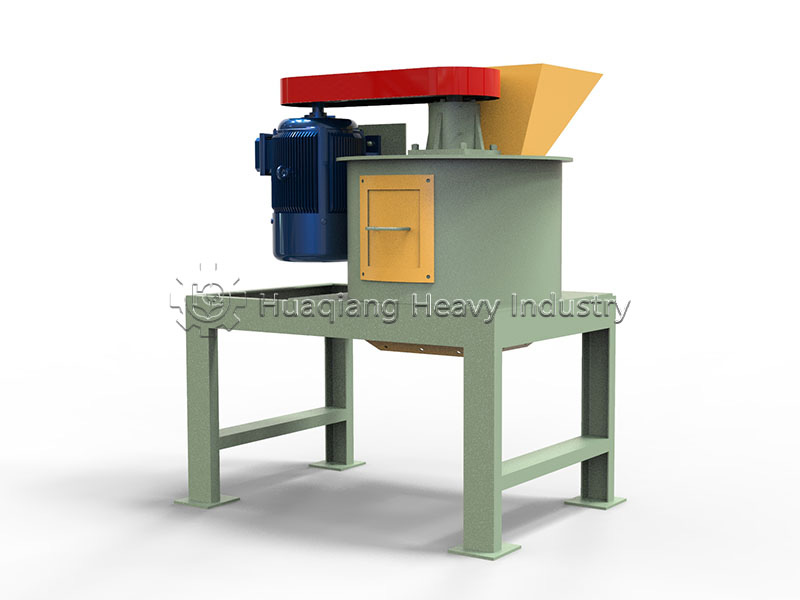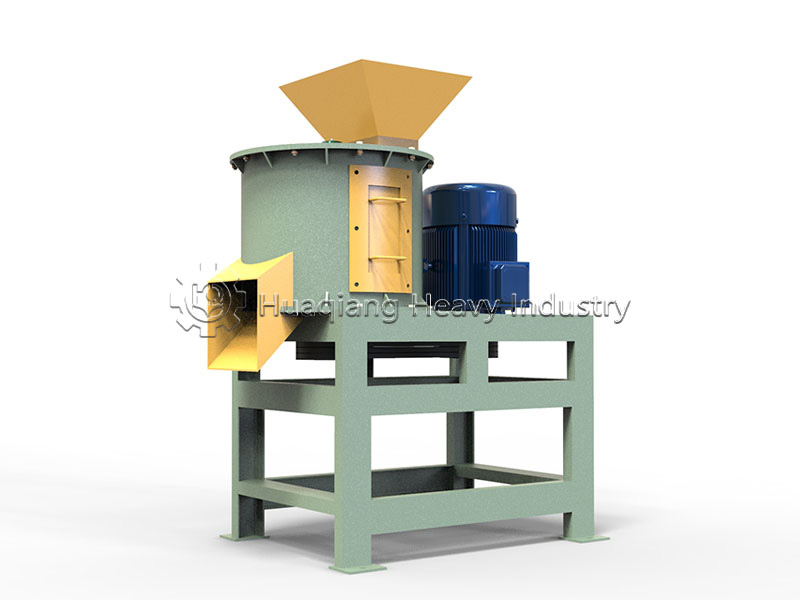
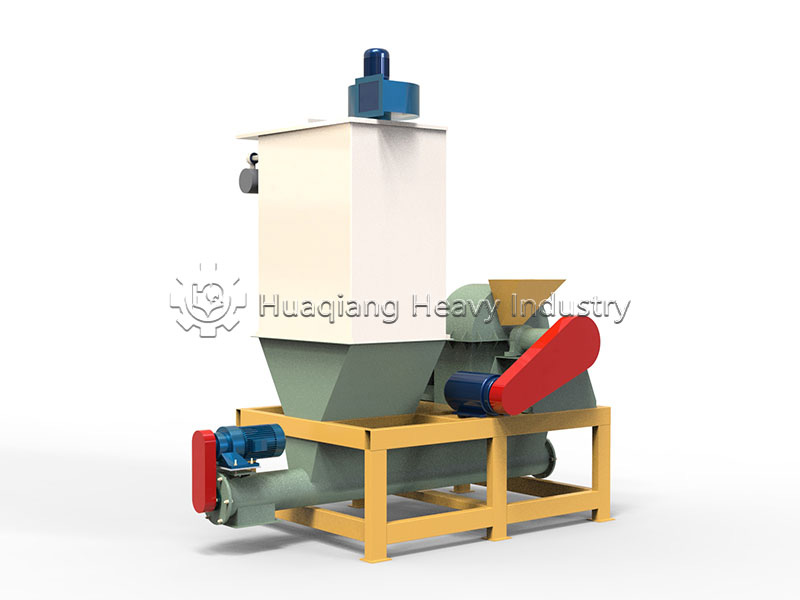
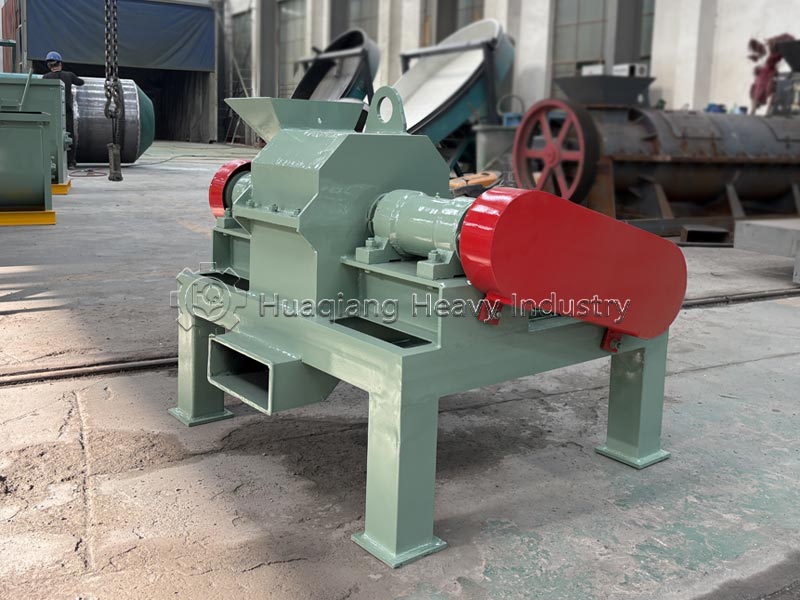


The cage crusher, also known as a squirrel cage crusher, cage-type crusher, or cage sand crusher, is a medium-sized horizontal cage bar crusher designed based on the principle of impact crushing. This equipment is widely used in numerous industrial sectors, including mining, metallurgy, building materials, highways, railways, water conservancy, chemicals, brick and tile production, and organic fertilizer and compound fertilizer production.
The cage crusher uses two opposing high-speed rotating cages to repeatedly impact materials, crushing them to a specific particle size. Its core advantages lie in its simple structure, high crushing efficiency, good sealing performance, stable operation, and ease of cleaning and maintenance. The equipment is particularly widely used in brick and tile factories because the crushed material has a high proportion of fine powder particles (≤0.2mm), which is beneficial for brick forming.
However, this equipment also has certain limitations, such as relatively small production capacity, high power consumption, frequent replacement of easily worn parts, and relatively high operating costs.
Equipment Structure Composition
The entire machine is divided into six main modules: frame assembly, shell assembly, dual rotor cage, transmission system, feeding and discharging system, and protective auxiliary components.
1. Frame Base: A welded load-bearing base made of channel steel/I-beams, supporting the entire machine, motor, and bearing seats; pre-drilled mounting holes allow for fixing to a concrete platform or steel structure support.
2. Sealed Crushing Shell: A thickened steel plate welded shell with a side inspection door; the inner wall can be lined with wear-resistant plates to prevent material erosion; the shell flange is sealed to reduce dust leakage.
3. Core Crushing Unit – Dual Cage Rotors (Inner and Outer Cages)
1) Inner Cage (Small Rotor): The inner cage disc, with multiple wear-resistant cage bars evenly arranged radially;
2) Outer Cage (Large Rotor): The outer cage disc, with cage bars arranged alternately with the inner cage; During operation, the two cages rotate concentrically and in opposite directions at high speed, forming an interlaced impact gap.
3) Cage Bars (Wearing Parts): Mainly made of high-manganese steel and high-chromium alloy, heat-treated for wear resistance; a core component directly impacting materials.
4) Main Shaft and Bearing Housing: Bears the rotor rotation, equipped with heavy-duty rolling bearings.
4. Dual Drive Transmission System: Two independent drive units, generally using a motor + V-belt pulley drive; large models can be directly connected with a coupling; two motors drive the inner and outer cages to rotate in opposite directions respectively. Equipped with belt guards and overload protection.
5. Feeding and Discharging Structure:
1) Feed Hopper: Top feeding, can be equipped with a leveling screw and iron remover;
2) Bottom Discharge Port: Crushed material is discharged by gravity, can be directly connected to a belt conveyor.
6. Optional Components: Pulse dust collector interface, feed iron remover, variable frequency speed control motor, shock absorber, local operation start/stop box, inspection lighting.
Working Principle of the Equipment
The cage crusher employs the "reverse high-speed impact" principle: Material enters the center of the inner cage through the side feed inlet. Under the action of centrifugal force, the material is thrown towards the high-speed rotating cage ribs. The inner and outer cages rotate in opposite directions driven by two motors. As the material shuttles between the inner and outer cage ribs, it undergoes extremely violent repeated impacts, friction, and collisions.
1. Multi-stage crushing: The material first contacts the inner cage ribs, is crushed, and then flies towards the counter-rotating outer cage ribs.
2. Self-collision crushing: The material also undergoes violent collisions with each other during high-speed motion, further refining the particle size.
Finally, the material that meets the particle size requirements is discharged from the bottom under the combined action of gravity and centrifugal force.
Applications of the Equipment
The cage crusher has a wide range of applications, mainly covering the following industries and scenarios:
1. Fertilizer Industry (Main Application Area)
Compound Fertilizer Production: Crushing hard granular raw materials such as monoammonium phosphate, diammonium phosphate, urea, ammonium chloride, ammonium sulfate, superphosphate, and heavy calcium carbonate.
Organic Fertilizer Production: Processing fermented livestock and poultry manure, straw, biogas residue, sludge, and other organic materials.
Blended Fertilizer Production: Raw material pretreatment and return material crushing.
BB Fertilizer Production: Raw material refinement.
2. Chemical Industry
Fine crushing of various chemical raw materials.
Material crushing in salt production.
3. Building Materials and Mining Industry
Crushing of low-hardness materials such as limestone, shale, gypsum, slag, and coal.
Crushing of ceramic raw materials such as clay and earthenware.
Fine crushing in iron ore processing.
4. Feed and Food Industry
Crushing of feed raw materials such as grains and soybean meal.
Fruit and vegetable crushing (dedicated cage crusher).
Crushing of traditional Chinese medicine and food additives.
5. Other Industries
Plastics, pharmaceuticals, environmental protection (sludge treatment), etc.
Suitable Raw Materials for the Equipment
Cage crushers have certain requirements for raw materials and are mainly suitable for materials with the following characteristics:
| Material Characteristics | Specific Requirements |
|---|---|
| Hardness | Low to medium hardness materials are optimal, with Mohs hardness of 1–3. |
| Moisture Content | Generally required moisture content below 6%; some improved models can handle materials with moisture content of 10%–20%; new dust-free type can process single chemical fertilizer with moisture content below 40%. |
| Material Form | Block, granular and agglomerated materials |
| Typical Raw Materials | Urea, Monoammonium Phosphate, Diammonium Phosphate, Potassium Chloride, Potassium Sulfate, Fermented Livestock & Poultry Manure, Straw, Shale, Slag, Coal, Gypsum, Clay, etc. |
| Prohibited Materials | High-hardness materials (accelerate steel rod wear), high-moisture and high-viscosity materials (prone to blockage), hard foreign objects such as metals. |
Operation and maintenance methods
1. Operating procedures: Two motors must be started first, and then feeding is allowed after the speed is stable; starting with load is strictly prohibited; feeding should be even and avoid piling up materials.
2. Lubrication maintenance: The bearing seat is a critical point and needs to be injected with high-temperature grease regularly, and is usually inspected once per shift.
3. Check the cage bars: Check the wear of the cage bars regularly. If the cage bars are severely deformed or worn and become thinner, it will affect the discharging granularity and dynamic balance and should be replaced in time.
4. Dynamic balance calibration: After repairing or replacing cage bars, dynamic balance calibration must be performed again to prevent severe vibration of the equipment.
Typical Application Layout of Cage Crusher in Production Lines
Scenario 1: Compound Fertilizer (NPK) Production Line Layout
Raw Material Bin → Belt Conveyor → Cage Crusher → Mixer → Granulator → Dryer → Screening Machine Coarse material from the screening machine is returned to the cage crusher for further crushing, forming a closed loop.
Scenario 2: Organic Fertilizer Granulation Production Line Layout
Fermented and composted raw materials → Screening → Cage Crusher for fine crushing → Mixer → Granulation Equipment → Post-processing
Function: Crushes large pieces of composted manure and bacterial residue into uniform powder, significantly improving granulation rate and reducing residue.
Scenario 3: Fertilizer Agglomeration Breaking Process
Bagged agglomerated fertilizer → Bin → Belt Conveyor → Cage Crusher → Finished Product Bin / Packaging Line Replaces manual crushing, achieving automated breaking of agglomerated fertilizer.
Common Equipment Problems and Solutions
| No. | Fault Phenomenon | Root Cause | Solutions | Preventive Suggestions |
|---|---|---|---|---|
| 1 | Reduced crushing efficiency & unqualified finished particle size Performance: Output lower than rated value, proportion of large agglomerates increases |
1. Severely worn hammer blades or broken blades 2. Screen blocked or damaged 3. Uneven feeding with material surges |
1. Dismantle rotor assembly and replace worn hammer blades 2. Clean or replace screen 3. Install quantitative feeding device for steady feeding |
Implement "Three Checks Daily": inspect wear condition, bearing temperature and feeding uniformity before startup, during operation and after shutdown. |
| 2 | Severe equipment vibration & abnormal noise Performance: Obvious vibration during operation with impact noise |
1. Rotor unbalance (uneven hammer weight or excessive unilateral wear) 2. Bearing failure or damage 3. Uneven gap between rotor and liner causing periodic impact 4. Loose anchor bolts or unstable foundation |
1. Replace hammer blades of uniform weight and perform dynamic balance test 2. Clean or replace bearings; fill grease to proper level (2/3 of bearing housing) 3. Adjust gap between rotor and liner plate 4. Fully tighten all anchor bolts |
Check rotor balance monthly; equip vibration monitoring device to reduce vibration damage. |
| 3 | Feed blockage & frequent equipment overload shutdown Performance: Material accumulation at feed inlet, production interruption |
1. Excess material moisture (over 15%) or large agglomerates 2. Excessively fast feeding speed and large feeding volume 3. Poor discharge flow and blocked finished material outlet 4. Screen holes blocked by sticky materials |
1. Stop feeding and clean accumulated materials; forbid forced feeding while running 2. Equip drying equipment, control material moisture within 6%–12% 3. Install screening device before feeding to remove large lumps 4. Inspect discharge pipeline to ensure smooth output |
Strictly control pretreatment standard, feeding speed and material moisture; forbid cleaning blockages during running status. |
| 4 | Overheated Bearing Performance: Bearing temperature rises abnormally above 70℃ |
1. Uneven bearing base or rotor eccentricity 2. Excessive / insufficient / deteriorated lubricant 3. Excessively tight fitting between bearing housing and shaft 4. Long-term overload operation |
1. Stop machine to inspect and eliminate rotor eccentricity 2. Fill grease according to specification (70%–80% of bearing housing) 3. Repair fitting clearance between bearing housing and shaft 4. Adjust feeding capacity to avoid sustained overload |
Regularly inspect lubrication system, replace grease periodically; check rotor running status during seasonal maintenance. |
| 5 | Heavy dust emission (traditional model) Performance: Severe dust leakage during crushing |
Poor sealing of hammer mill, massive dust generated during crushing | 1. Upgrade to dust-free crusher equipped with dust removal system 2. Reinforce equipment sealing and replace aged sealing strips |
Select new models matched with dust collection system; periodically check equipment sealing performance. |
| 6 | Short service life of hammer blades Performance: Service life far shorter than expectation (normal: 400–600 hours) |
1. Excess material hardness beyond equipment adaptation range 2. Improper rotor speed setting 3. Hammer material fails to meet manufacturing standard |
1. Select wear-resistant hammer blades made of qualified alloy material 2. Adjust rotor speed to suitable value for materials 3. Forbid feeding ultra-hard foreign materials |
Purchase genuine spare parts from formal manufacturers; strictly control raw material hardness; prevent hard foreign objects entering crushing cavity. |
Target Customers for Cage Crusher
1. Organic and Compound Fertilizer Manufacturers
The production of organic and compound fertilizers is the primary demand for cage crushers. Fermented and decomposed organic fertilizer materials require secondary crushing (decomposition) to meet granulation requirements. This is especially suitable for small to medium-sized organic fertilizer plants with an annual production capacity of 10,000 to 200,000 tons.
2. Brick and Building Material Manufacturers
Brick and tile plants are a traditional application area for cage crushers. They need to finely crush raw materials such as industrial slag, dry clay, shale, and coal gangue. A high proportion of fine powder particles after crushing is beneficial for brick forming.
3. Fertilizer Manufacturers
Cage crushers are ideal for companies that need to crush monoammonium phosphate (MAP), diammonium phosphate (DAP), urea, and other fertilizer granules, especially when processing damp and caking fertilizer raw materials.
4. Chemical and Mining Enterprises
Companies that need to process brittle materials with medium to low hardness, such as limestone, coke, coal powder, and glassy ore. 5. Selection Recommendations
Small users: Models with an hourly output of 1-4 tons, suitable for laboratories and small processing plants.
Medium users: Models with an hourly output of 4-10 tons, suitable for small to medium-sized compound fertilizer plants and brick and tile factories.
Large users: Models with an hourly output of 10-15 tons, suitable for large-scale production bases.
Selection should be based on your industry, material type, and daily processing capacity, with a 10%-20% capacity margin.
Prioritize models equipped with wear-resistant steel rods and variable frequency speed control.
| Model | Rotate speed | Power | Prod Capacity | Overall Dimensions L×W×H | Quality |
| mm | r/min | kw | t/h | mm | kg |
| WLF650 | 2000 | 26 | 4-6 | 1800×1300×1160 | 2300 |
| WLF800 | 2000 | 37 | 6-10 | 2200×1500×1360 | 2550 |
.jpg)