
2026-08-05
The footprint of a fertilizer production line mainly depends on its annual production capacity, process complexity, and equipment selection. Generally speaking, a small-scale organic fertilizer production line with an annual output of 10,000 tons typically requires approximately 500–800 square meters of plant space; a medium-sized production line with an annual output of 30,000–50,000 tons requires approximately 1,500–3,000 square meters; and a large-scale production line with an annual output of over 100,000 tons requires over 5,000–10,000 square meters. Actual land use must also consider auxiliary areas such as raw material storage yards, finished product warehouses, and vehicle handling routes.
I. Area Reference for Different Production Capacity Scales
Production Scale
Annual Output
Workshop Area Requirement
Auxiliary Area Suggestion
Small‑scale Line
0.5‑10,000 tons
500‑800㎡
Additional 300‑500㎡ for raw material and finished product zone
Medium‑scale Line
30,000‑50,000 tons
1500‑3000㎡
Additional 1000‑2000㎡
Large‑scale Line
Above 100,000 tons
5000‑10000㎡
Additional 3000‑5000㎡
For a small-scale production line with an annual output of 10,000 tons, a typical layout includes: raw material pretreatment area (approximately 100–150㎡), fermentation and turning area (approximately 200–300㎡), crushing and mixing area (approximately 80–100㎡), granulation area (approximately 60–80㎡), drying and cooling area (approximately 100–150㎡), and screening and packaging area (approximately 60–80㎡), totaling approximately 600–860㎡, roughly corresponding to the estimated range above.
II. Five Major Factors Affecting Footprint
Raw Material Characteristics and Pretreatment Methods: High moisture content materials require larger drying or fermentation areas; materials requiring the addition of large amounts of auxiliary materials require a correspondingly larger raw material storage area.
Equipment Selection and Layout: Horizontal equipment occupies a larger area but is easier to maintain; vertical equipment saves space. A reasonable production line layout (I-type, L-type, or U-type) directly affects the total area.
Fermentation Process Selection: Tank fermentation requires a larger area but offers stable operation; closed-system fermentation requires less area but involves higher equipment investment.
Automation Level: Fully automated production lines have compact equipment and require fewer manual passageways, saving approximately 15%–20% of space.
Environmental and Safety Requirements: Dust removal systems, sound insulation facilities, and fire escape routes require additional space.
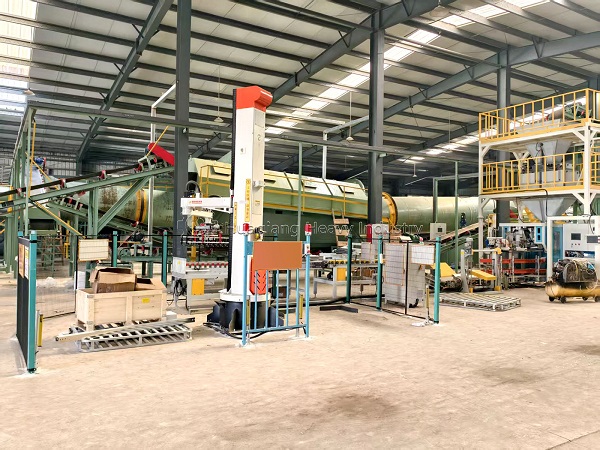
III. Scientific Layout Recommendations: Within limited space, it is recommended to adopt the principle of "process zoning and material flow": raw material storage areas should be close to the feeding port, fermentation areas adjacent to the pretreatment area, and finished product packaging areas close to the warehouse exit to avoid cross-contamination of materials. Simultaneously, a minimum plant height of 8 meters is recommended to accommodate vertical equipment and conveying pipelines. Main passageways should be at least 3 meters wide to ensure smooth passage for forklifts and transport vehicles.
IV. Selection Decision Recommendations: For customers building a plant for the first time, it is recommended to reserve 20%–30% flexibility to accommodate future capacity expansion or environmental equipment upgrades. In areas with limited land resources, vertical equipment combinations and compact production line solutions should be prioritized. For specific land use indicators, it is recommended to communicate with professional fertilizer equipment manufacturers and conduct customized layout design based on actual conditions to balance investment costs and long-term development needs.
Understanding the footprint requirements is only the first step — the real value lies in how that space is utilised to maximise production efficiency and product quality. For an organic fertilizer plant design and layout, the area allocation must balance not only the fermentation, granulation, and finishing sections, but also future expandability. When selecting granulation equipment, the organic fertilizer granulator series (including disc and drum types) offers flexible options for different capacities, while the rotary drum granulator is particularly suitable for high‑output npk fertilizer production line and npk fertilizer manufacturing process due to its large throughput and robust granulation performance. For materials that require densification, a fertilizer compactor or fertilizer granules compaction system can be integrated, which reduces dust and improves particle strength, though it may require additional floor space for the compaction rolls and sizing screens. In practice, we recommend a modular layout approach: position the raw material receiving and pretreatment zones adjacent to the fermentation area, then arrange the granulation, drying, screening, and coating sections in a linear or U‑shaped flow to minimise material handling distances. Always reserve at least 20‑30% extra space for auxiliary equipment like dust collectors, conveyors, and future line upgrades. Ultimately, a well‑planned plant design — tailored to your specific capacity, raw materials, and product portfolio — ensures not only optimal space utilisation but also smooth operations, lower maintenance costs, and the agility to adapt to changing market demands.