
2026-03-10
In today's increasingly stringent environmental regulations, NPK compound fertilizer manufacturers face mounting pressure—dust emissions from the drying process and wastewater treatment during granulation each test their environmental compliance capabilities. The rise of dry granulation technology offers the industry a new option: no drying required, no wastewater discharge, and energy consumption reduced by over 50%. Huaqiang's double roller press granulator, as the core equipment for dry granulation, uses mature and stable technology to help companies significantly reduce operating costs while meeting environmental requirements.
Core Advantages of Dry Granulation: Energy Saving, Environmental Protection, and Simplification
Energy Saving and Consumption Reduction, Significant Benefits
Traditional wet granulation requires large-scale dryers and coolers. The cost of coal or gas in the drying process typically accounts for 15%-20% of the total production cost. Dry granulation completely eliminates this step—materials are directly granulated under high pressure, without the need for heating and dehydration, reducing the energy consumption of the entire line by over 50%. Taking a 50,000-ton-per-year compound fertilizer production line as an example, the dry process can save nearly one million yuan in fuel costs annually.
Environmentally friendly and pollution-free, with worry-free compliance: The dry granulation process involves no water, naturally resulting in no wastewater discharge. Extrusion molding takes place in a closed environment, and with a dust removal system, dust emissions fully meet standards. For regions with increasingly stringent environmental regulations, the dry process eliminates the anxiety of production shutdowns due to non-compliance with emissions standards.
Simplified process, smaller footprint: Eliminating the dryer and cooler shortens the production line length by over 30%, reduces the number of equipment, and requires less space, simultaneously lowering factory investment and subsequent maintenance costs. Equipment linkage is simpler, and operation and maintenance are more convenient.
Process integration: Seamless connection throughout the entire process: A complete dry granulation production line consists of the following equipment, requiring no drying throughout:
Cage pulverizer: Pulverizes raw materials such as urea, ammonium phosphate, and potassium chloride to a fineness of 80 mesh or higher, providing uniform powder raw materials for extrusion granulation.
Fully automatic batching machine: Precisely proportions 3-6 raw materials according to the formula, with an error of ±0.5%, ensuring stable nutrient content in each batch of product.
Double-shaft mixer: Rapidly and uniformly mixes various raw materials, providing homogenized material for extrusion granulation.
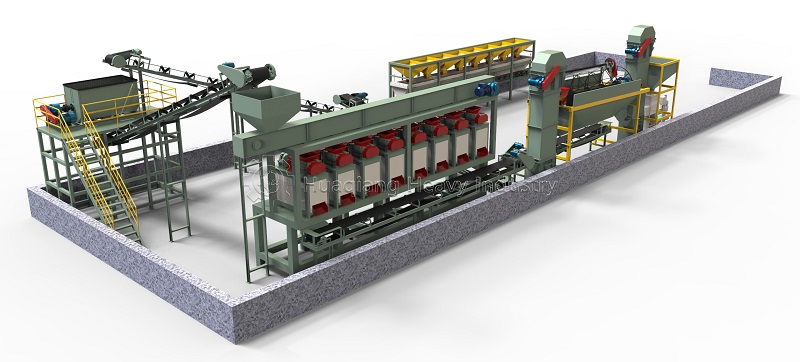
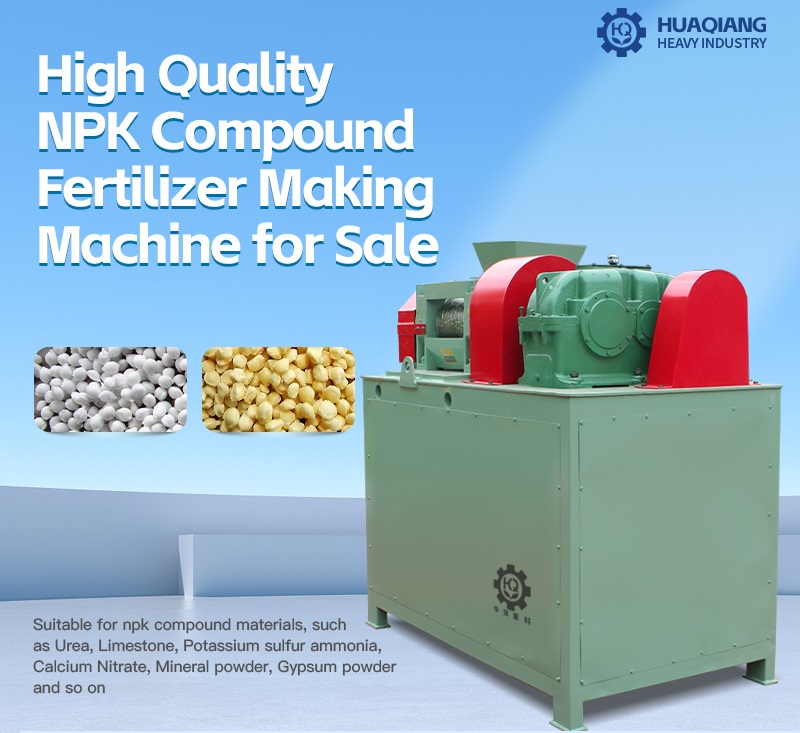
Double roller press granulator: The core granulation equipment, which high-pressure extrudes the mixture to produce high-hardness granules.
Vibrating screen: Grades the granulated material, packaging qualified products and returning unqualified products for reuse.
Customized services: Designed to your needs, one-stop solution. Huaqiang Heavy Industry offers a series of dry granulation production lines with capacities ranging from 5-40 tons/hour. Deep customization is available based on customer raw material characteristics, site conditions, and product positioning:
For high-nitrogen formulations: Optimized roller surface material and enhanced corrosion resistance.
For high-hardness raw materials: Increased hydraulic system power to improve pressing capacity.
For limited spaces: Compact layout design to maximize space utilization.
From raw material crushing to finished product packaging, from single machines to complete lines, Huaqiang's dry granulation solutions focus on energy conservation and environmental protection, helping you create a high-efficiency NPK compound fertilizer production line while meeting environmental requirements.
The dry granulation process, centered on the double roller press granulator, represents a significant advancement in fertilizer granulation technology. This equipment acts as a fertilizer compactor, forming the heart of a roller press granulator production line. It achieves fertilizer granules compaction by applying immense mechanical pressure to dry powder, creating dense, hard granules without any need for heat or liquid binders. This contrasts sharply with wet granulation methods. A rotary drum granulator, for instance, relies on steam and chemical reactions to agglomerate material, requiring subsequent energy-intensive drying. A disc granulator machine also uses a wet, tumbling process to form spherical pellets. While these wet methods have their place, the double roller press granulator offers a compelling alternative for many applications, particularly for moisture-sensitive formulations or when energy savings and environmental compliance are paramount. By completely eliminating the drying stage, this fertilizer compactor technology simplifies the production line, reduces the plant's carbon footprint, and delivers significant operational cost savings, all while producing high-quality granules suitable for modern agriculture.