
2026-03-19
In compound fertilizer production, rotary drum granulation technology has become the preferred choice for many companies due to its advantages such as large-scale continuous operation and high granule sphericity. However, building a production line often requires an investment of several million yuan. How to achieve "high cost-effectiveness" within a budget—meeting capacity requirements while controlling costs and complying with environmental regulations—is a challenge every investor must face. This article will analyze the core principles and configuration schemes for building a rotary drum granulation production line.
Core Principles of Production Line Construction: Capacity Matching, Cost Control, and Environmental Compliance
The primary principle of a high-cost-effective production line is "capacity matching"—the rated capacity of the equipment must precisely correspond to the target output to avoid waste from "over-powered" equipment or bottlenecks from "under-powered" equipment. At the same time, a 15%-20% capacity margin should be reserved to cope with raw material fluctuations or seasonal demand increases. Cost control must be implemented throughout the entire process: from equipment selection to layout design, every investment should serve the core function. Environmental compliance is the bottom line—dust emissions and wastewater treatment must meet local regulations to avoid huge investments in later rectification.
Core Equipment Selection: Synergy Between Rotary Drum Granulator and Auxiliary Systems
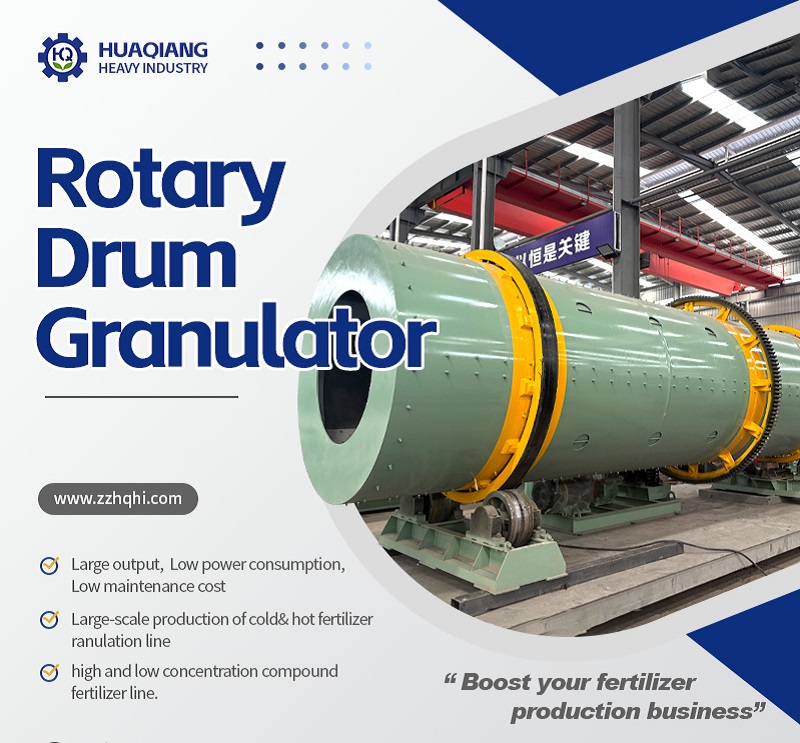
The rotary drum granulator is the core of the entire production line, and its model selection must be based on production capacity and raw material characteristics. For small to medium-sized production lines with a daily output of 50-80 tons, a φ1.8m×6m granulator can be selected, equipped with a variable frequency speed control and steam conditioning system. For large production lines with a daily output of over 200 tons, a φ2.8m×8m or larger granulator is required. Some models use rubber linings for automatic scale removal, improving operating efficiency.
The selection of auxiliary equipment directly affects the overall production line cost. Automatic batching systems use weight-reduction metering with an error of ≤±0.5%. While the initial investment is higher than traditional belt scales, the long-term benefits are significant. Dryers and coolers should be matched to the granulator's capacity at a ratio of 1:1.2, with buffer space reserved. A drum screen can be selected for screening, with the screen aperture customized according to product specifications.
Process Optimization: Reducing Secondary Screening and Improving Efficiency
Traditional rotary drum granulation production lines often require secondary screening due to the wide particle size distribution, leading to increased equipment investment and energy consumption. There are two optimization paths: First, by precisely controlling granulation parameters, the proportion of qualified granules can be increased to over 85%; second, a classifier can be added at the granulator outlet, allowing coarse granules to return directly to the granulator while fine powder enters the return system, reducing the number of screening devices. Some production lines adopt a three-in-one "granulation-drying-cooling" equipment, integrating the three processes, reducing floor space by 30% and energy consumption by 20%.
Different budget configuration options: Small, Medium, and Large
Small production line (10,000-30,000 tons/year): Budget approximately 2-3.5 million RMB. Configuration: 1.8m rotary drum granulator, equipped with a manual batching system, single-layer vibrating screen, and intermittent dryer. Advantages: Low investment, fast return on investment, but limited automation, requiring manual assistance.
Medium production line (50,000-100,000 tons/year): Budget 4-7 million RMB. Configuration: 2.2m rotary drum granulator, equipped with an automatic batching system, drum screen, continuous drying and cooling machine, and connected to a PLC control system. Significantly improved automation and stable pellet quality.
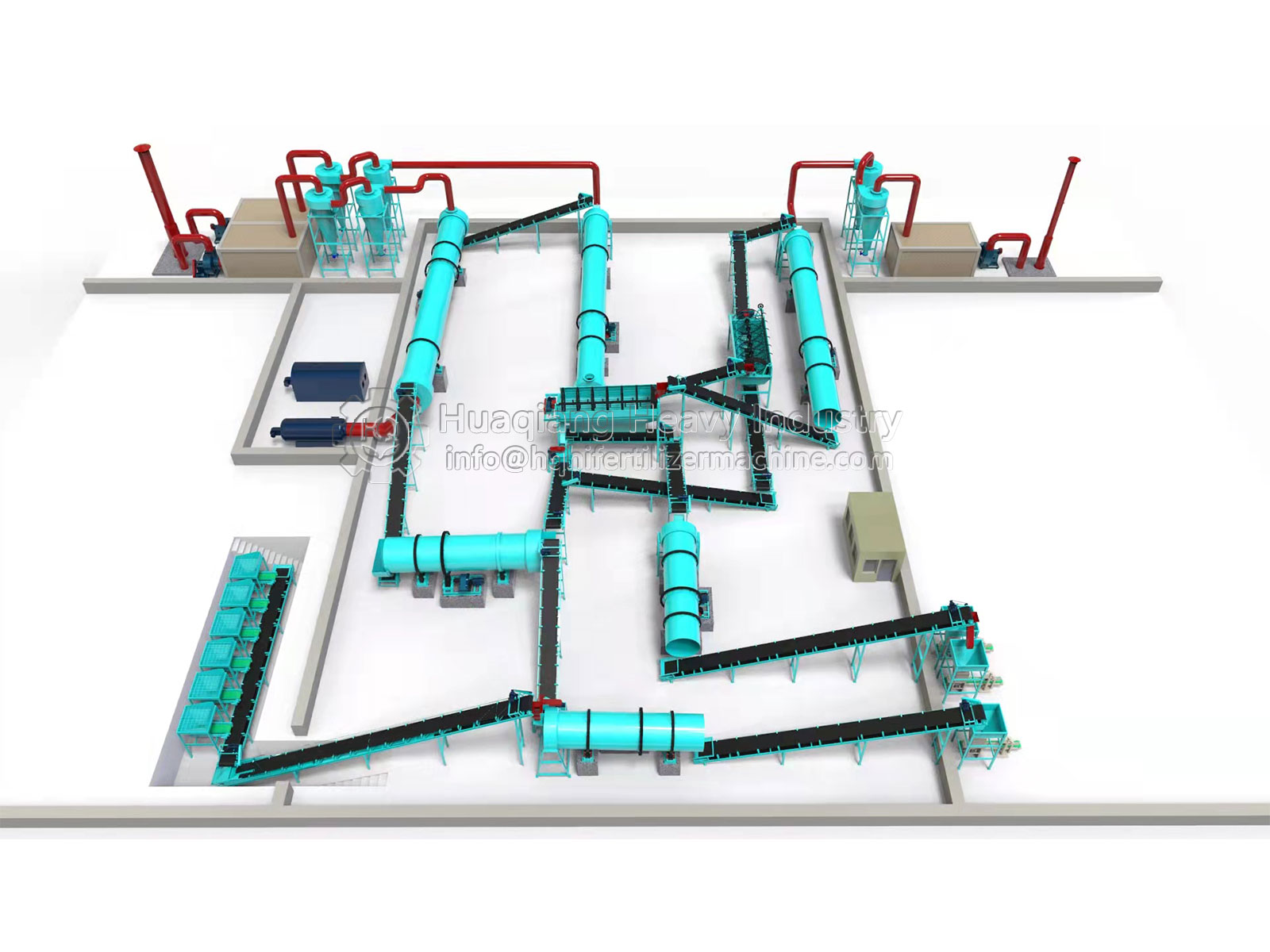
Large-scale production line (150,000-300,000 tons/year): Budget 12-20 million RMB. Configuration: φ2.8m or larger rotary drum granulator, equipped with DCS control system, online moisture analyzer, and automatic return system. Fully automated operation, traceable data, meeting European and American market access standards.
Customized configuration service: Professional support from needs to implementation. Each production line has different raw material characteristics, site conditions, and budget scale, making standardized solutions often difficult to accurately adapt. Our company provides a one-stop customized service from raw material analysis and process design to equipment manufacturing, installation, and commissioning—first, trial operation to verify raw material compatibility, then designing layout diagrams, and finally delivering a turnkey project. For investors seeking high cost-effectiveness, having a professional team tailor the most suitable solution is far more reliable than blindly purchasing standardized equipment.
Cost-Effective Rotary Drum Granulation Lines
The focus on cost-effectiveness for a rotary drum granulation production line highlights the importance of precisely matching equipment to scale and budget. The rotary drum granulator is the workhorse of large-scale, continuous compound fertilizer production, prized for its high throughput and excellent sphericity. However, for investors with smaller budgets or different product goals, other granulation technologies may offer a more suitable entry point. A disc granulator machine, for example, provides a much lower initial investment and is ideal for smaller-scale or organic-inorganic blends. For dry, moisture-sensitive materials, a double roller press granulator within a roller press granulator production line eliminates the need for a dryer, significantly reducing both capital and operating costs. Even within the realm of drum granulation, the principles of capacity matching and process optimization apply universally. The key is to avoid the trap of "one-size-fits-all" solutions. Whether the core equipment is a massive rotary drum granulator for a 200,000-ton plant or a compact flat die pelleting machine for a small startup, the most cost-effective line is one where every piece of equipment, from the batching system to the packaging machine, is precisely sized and integrated to work in harmony, eliminating bottlenecks and waste while meeting the specific production targets.