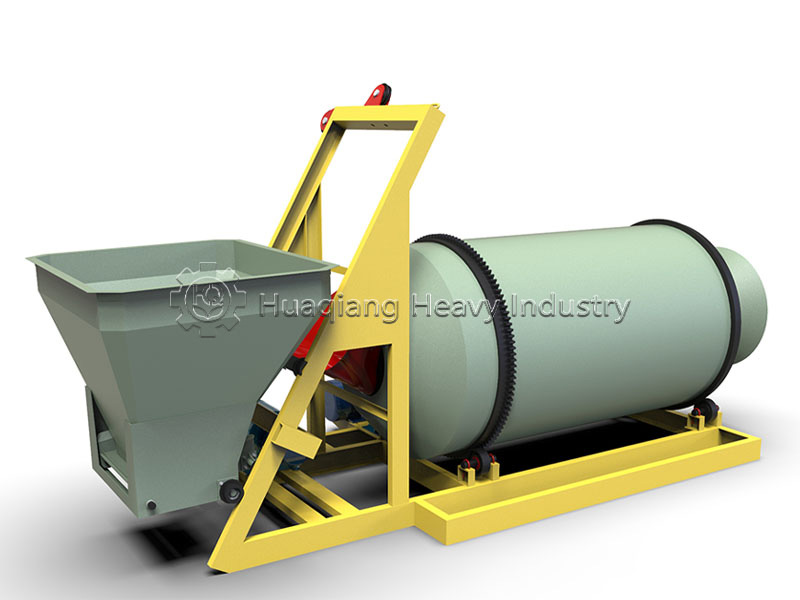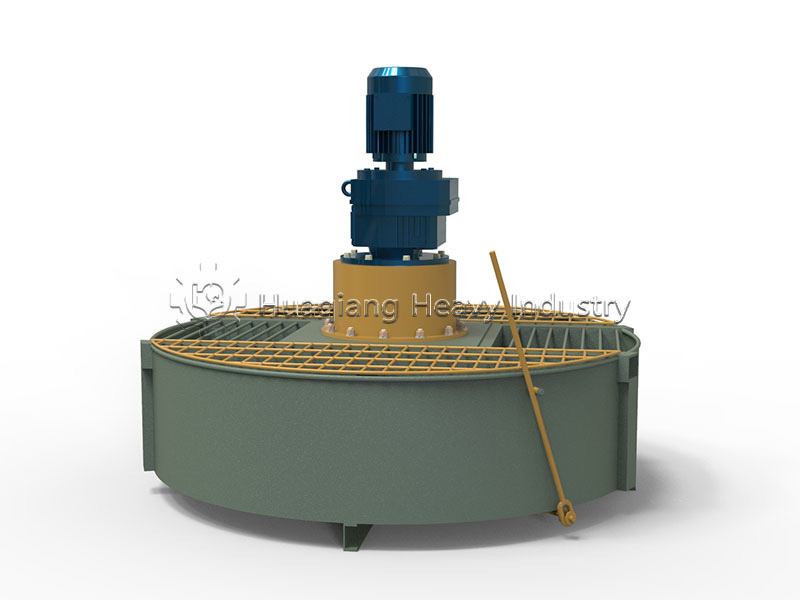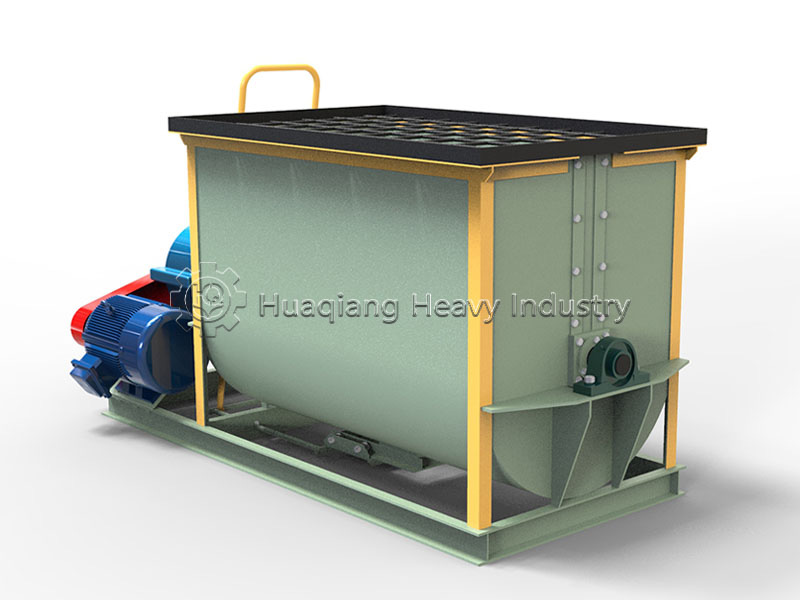
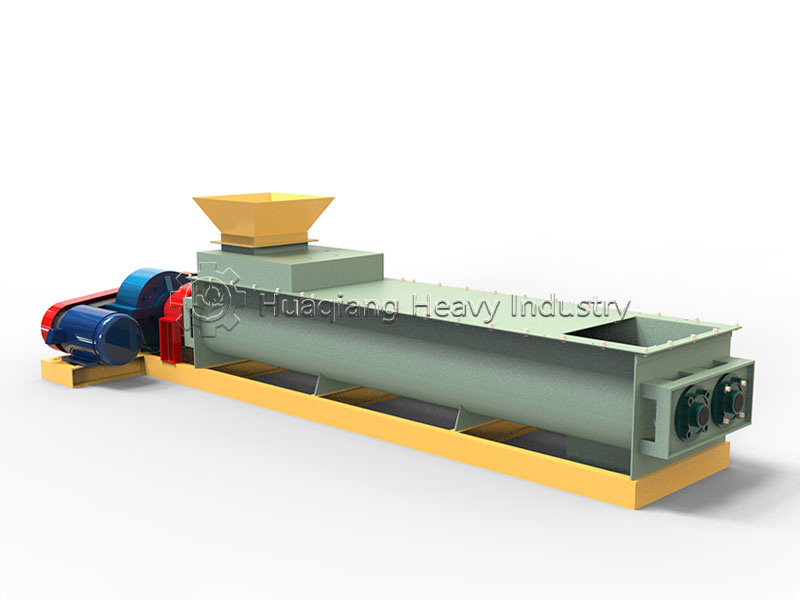
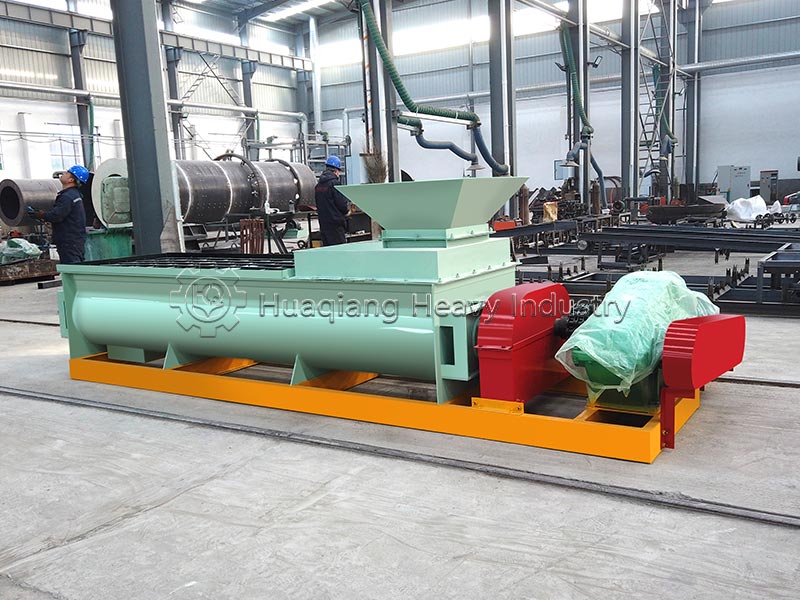
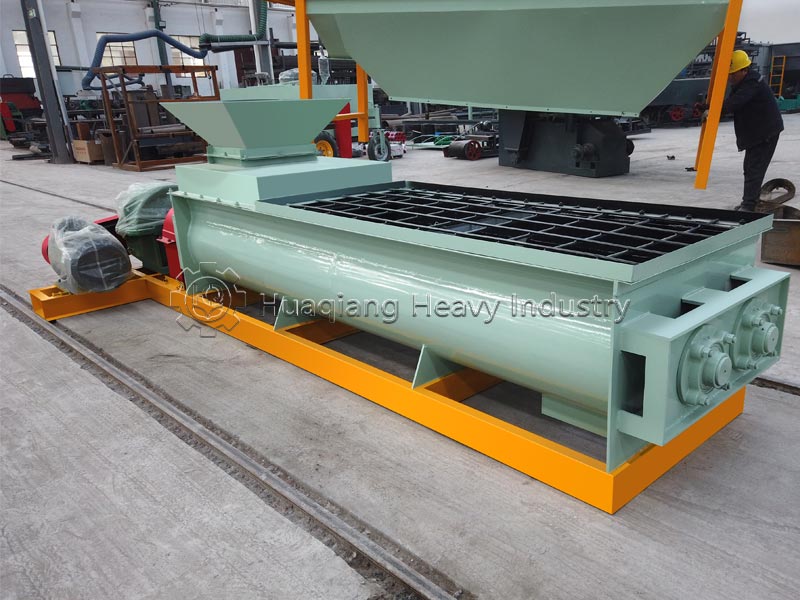
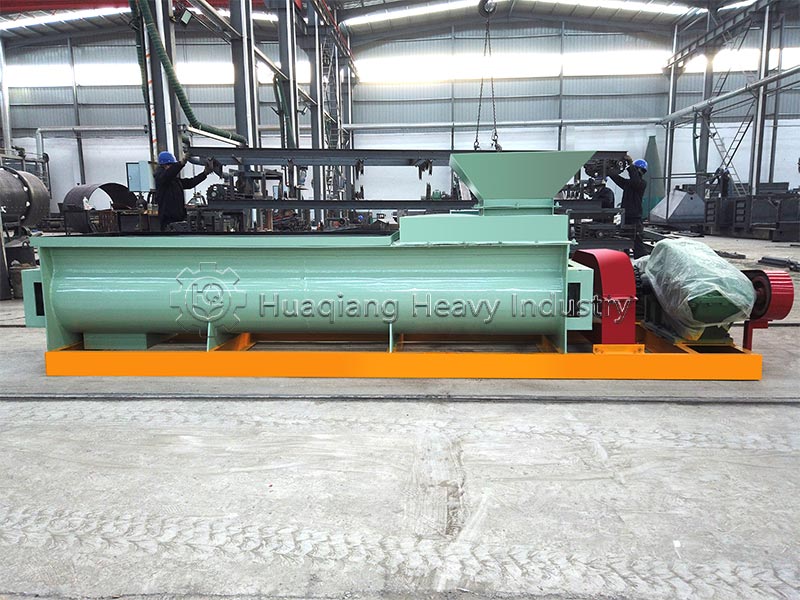
Equipment Introduction
A double-shaft paddle mixer, also known as a double-shaft paddle mixer or double-shaft blade mixer, is a horizontal mixing device that uses two parallel, counter-rotating mixing shafts as its core, employing paddles to powerfully shear and convectively mix materials.
Double-shaft mixers are among the most widely used mixing equipment in industries such as organic fertilizer, compound fertilizer, chemicals, building materials, and feed. Their greatest advantages lie in their strong adaptability to high-moisture materials, high mixing efficiency, and large production capacity, effectively solving the pain points of traditional mixing equipment such as uneven mixing, inconsistent moisture content, severe dust generation, and material stratification. Unlike ordinary single-shaft or ribbon mixers, double-shaft mixers are characterized by high-moisture, non-clogging operation, fast mixing speed, and large batch production capacity, making them suitable for organic materials with high viscosity, high moisture content, and a tendency to clump, such as chicken manure, cow manure, and sheep manure.
In the fertilizer industry, double-shaft mixers are often referred to as "gravity-free mixers" or "gravity-free double-shaft paddle mixers"—when two opposing rotating shafts drive the paddles to rotate at high speed, the material forms a momentary weightless state in the overlapping area, as if it were in a weightless environment, achieving rapid and uniform mixing.
Equipment Structure
The double-shaft paddle mixer mainly consists of the following six systems:
1. Body (Cylinder/Tank): It has a horizontal W-shaped or twin-circular structure, with two overlapping teardrop-shaped cavities inside. The shell is mainly welded from plates and shaped steel, ensuring a tight seal and preventing dust leakage. The cylinder and parts in contact with materials are often made of stainless steel (304, 316L) or carbon steel (Q235).
2. Mixing Mechanism (Core Part): It consists of two horizontally arranged mixing shafts and multiple sets of specially angled blades mounted on the shafts. The two shafts are arranged parallel and symmetrically, with the blades arranged in a spiral pattern on the shafts. The blade material is selected from wear-resistant composite ceramics or wear-resistant alloys that are not prone to dust adhesion.
3. Transmission System: It consists of a motor, reducer, transmission gears, sprockets, and chains. A cycloidal pinwheel reducer or a ZQ series reducer drives the two rotors to rotate in opposite directions. The sprocket and chain adopt a three-row chain structure, providing high transmission torque, smooth operation, and low wear.
4. Feeding and Discharging Devices
1) Feed Inlet: Located at the top of the tank, material enters through this inlet.
2) Discharge Mechanism: The bottom adopts a full-length double-door structure for rapid discharge and minimal residue.
5. Auxiliary Systems
1) Atomizing Humidification System: Atomizing nozzles are installed at the top for even spraying of water or nutrient solution.
2) Sealing Device: The shaft end uses a combination of labyrinth and packing seals for excellent double sealing performance.
3) Flying Knife Device: For fibrous materials, a high-speed flying knife can be added for cutting before mixing.
4) Variable Frequency Speed Control System: Operating parameters are flexibly adjusted according to material humidity and output.
6. Frame Section
The entire frame is constructed from high-quality carbon steel plates and channel steel, with all working parts mounted and fixed on the frame.
Working Principle
1. Power Transmission: The motor drives two main shafts to rotate synchronously in opposite directions at low speeds via a reducer and sprocket (industry average speed 30~46 r/min, SG600 is 36 r/min);
2. Three-Dimensional Convection Mixing: The staggered blades propel the material, simultaneously generating three types of motion:
1. Axial Motion: The blades spirally push the material forward and backward along the tank;
2. Radial Convection: The counter-rotating dual shafts cause the material to surge upwards between the two shafts, forming a gravity-free suspension layer;
3. Shearing and Crushing: The blades knead and break up clumps and coarse fibrous materials, eliminating the stratification of coarse and fine materials;
4. Synchronous Humidification and Conditioning: During the material mixing process, the top spray system evenly sprays water to precisely control the material's moisture content;
5. Continuous Discharge: The material is mixed and humidified while being uniformly pushed axially to the discharge port, achieving continuous and uninterrupted operation.
Raw Materials for the Equipment
This equipment is adaptable to a wide range of raw material forms, but the following basic characteristics must be met:
1. Form: Powdered, granular, short-fiber, and lightweight flake materials are all acceptable; for highly viscous materials such as filter cake and sludge, the sufficiency of the impeller thrust must be assessed.
2. Moisture Content: The moisture content should ideally be <15% when mixing dry powders; if humidification and granulation are required, the continuous twin-shaft mixer can adjust the moisture content to 20%–35% (e.g., for organic fertilizer raw materials). Excessive moisture content (>50%) can easily lead to sticking to the walls, clumping, and reduced mixing efficiency.
3. Particle Size: Raw materials should be pre-crushed and screened to prevent large stones, iron blocks, woven bags, and other foreign objects (>50 mm) from entering, which could jam the main shaft or damage the impeller. Examples of common raw materials:
1) Organic fertilizer: well-rotted chicken manure, pig manure, cow manure, straw powder, biogas residue, humic acid, functional microbial agents
2) Compound fertilizer: urea, monoammonium phosphate, potassium chloride, fillers (bentonite, talc)
3) Feed: corn, soybean meal, wheat bran, amino acids, mineral premix
Equipment Applications in Production Lines
1. Core Position in Organic Fertilizer and Compound Fertilizer Production Lines
In a complete organic fertilizer production line, the double-shaft paddle mixer is typically located after the crushing process and before the granulation process, playing a crucial role in bridging these two stages.
Complete Processing Flow: Livestock and poultry manure and other raw materials → Crushing and screening → Mixing and batching in a double-shaft paddle mixer (humidification, conditioning, and inoculation) → Granulation → Drying → Screening → Packaging
2. Specific Role in the Production Line
1) High-moisture material mixing: Well-rotted wet manure can be directly mixed without deep drying, greatly simplifying the production process.
2) Dry-wet blending: Dry, semi-wet, and high-moisture materials are mixed in proportion to adjust the material moisture content to the appropriate range for granulation.
3) Microbial agent application: Microbial agents or nutrient solutions are evenly sprayed through an atomizing spray system.
4) Nutrient homogenization: The main materials are fully integrated with trace elements and fermentation agents, solving problems of uneven mixing and fertility stratification.
5) Continuous production: 24-hour continuous and stable operation, seamlessly connecting the entire production line from crushing, granulation, drying, to packaging.
3. Impact on Subsequent Processes
The material uniformly mixed by the double-shaft paddle mixer has a loose, fine, and uniform texture without hard lumps or clumps. Uniform material significantly improves the granulation rate and reduces the output of broken and waste materials. Meanwhile, the material's nutrient distribution is even, resulting in stable fertilizer efficacy and preventing localized seedling burn or uneven fertilization after application.
4. Automated Configuration: The equipment is equipped with a variable frequency drive (VFD) system, allowing for flexible adjustment of operating parameters based on material moisture content and production requirements. It can be connected to conveyors, batching machines, and granulators to form a fully automated production line, achieving continuous assembly line operation for crushing, mixing, and granulation.
Equipment Applications:
| Application Industry | Specific Application Scenarios | Processable Materials |
|---|---|---|
| Fertilizer & Compound Fertilizer Industry (Core Application) |
Intensive material mixing for organic‑fertilizer production line; Granular organic fertilizer, compound fertilizer, functional formula fertilizer production; Uniform mixing of humus materials |
Livestock manure (chicken, cattle, sheep manure), straw raw materials, fermented materials, humus raw materials; NPK granular materials, inorganic salt raw materials, crushed lump‑material powder; Humus, livestock manure soil, straw powder, peat, sludge |
| Feed Processing | Compound feed, premix, aquatic‑feed mixing; Puffed feed processing |
Livestock complete compound feed, premix, aquatic‑feed raw materials; Powder & granular puffed‑feed raw materials |
| Chemical & Pharmaceutical Industry | Powder drying & mixing; Fine chemical product processing |
Lime, dyestuff, pigment, detergent, rubber additives; Fine‑chemical products, plastics, resins |
| Food & Additives | Food‑raw‑material mixing; Powder & granular‑food processing |
Monosodium glutamate, milk powder, edible salt, food additives; Powder and granular food raw materials |
| Building Materials & Ceramics | Building‑material raw‑material mixing; Glass‑raw‑material processing |
Dry‑mixed mortar, refractory materials, ceramic raw materials; Glass‑raw‑material powder |
| Other Industries | Fly‑ash additive treatment; Powder‑material mixing & conveying |
Thermal‑power‑plant fly ash; Mining‑industry powder materials |
Standard Operating Procedures (Start-up and Shutdown Guidelines)
Target Customers for this Equipment:
1. Organic Fertilizer and Compound Fertilizer Manufacturers:
The double-shaft paddle mixer is an indispensable core mixing equipment in organic fertilizer production lines. It is especially suitable for processing high-moisture, high-viscosity organic materials such as livestock and poultry manure. It can meet the needs of organic fertilizer and organic-inorganic compound fertilizer manufacturers with an annual output of 10,000 to 500,000 tons.
2. Compound Fertilizer and Chemical Fertilizer Manufacturers:
For companies that need to precisely mix various powdered raw materials. Suitable for mixing nitrogen, phosphorus, and potassium powders, inorganic salt raw materials, and finely crushed powders from agglomerated return materials.
3. Feed Processing Companies:
Suitable for large, medium, and small feed mills, premix plants, pet food factories, and aquatic feed factories.
4. Chemical and Pharmaceutical Companies:
For companies that need to mix pesticides, dyes, pigments, detergents, rubber additives, and fine chemical products.
5. Food and Additive Manufacturers:
For manufacturers of monosodium glutamate (MSG), milk powder, salt, food additives, etc.
Common Equipment Faults, Causes and Solutions
| Fault Phenomenon | Fault Cause | Standard Treatment Solution |
|---|---|---|
| Difficult motor start‑up & frequent overload | Excessive feeding; material blockage in tank; jamming by large foreign objects | Stop machine immediately and clear blocked materials; strictly follow start‑before‑feeding procedure; install feeding impurity‑removal sieve |
| Abnormal noise & heavy vibration during operation | Bearing oil shortage / damage; loose blade bolts; poor parallelism of two shafts; gear wear | Replenish lubricant; fasten all blades and base bolts; calibrate double‑shaft parallelism; replace damaged bearings / gears |
| Continuous shaft‑end material leakage & powder blowing | Worn sealing plate / oil seal; shaft surface scratched by hard granular materials | Stop machine and clear shaft‑end deposits; replace corrosion‑resistant sealing fillers; regularly clean shaft attachments |
| Uneven material mixing & caking at discharge outlet | Severely worn blades; blocked spray nozzle with insufficient water supply; too low rotating speed | Replace worn blades; unblock / replace atomizing nozzles; check rotating speed of motor and transmission system |
| Abnormal temperature rise of bearing housing & reducer | Insufficient lubricating oil; deteriorated oil quality; long‑term overload | Add specified‑grade lubricating oil; thoroughly replace deteriorated oil; reduce single‑batch feeding quantity |
| No water from spray nozzle & uneven material humidity | Insufficient water pressure; clogged nozzle; water‑inlet pipeline leakage | Install booster water pump; disassemble and clean spray nozzle; repair pipeline leakage points |
| Slow discharging speed & reduced production capacity | Offset blade angle; large‑area material buildup inside tank | Recalibrate blade fixing angle; thoroughly clean residual materials on tank inner wall per shift |
Double-shaft paddle mixers/Twin-shaft mixers are highly efficient core equipment in the modern powder and granular material mixing field. Through a unique mechanism of counter-rotating twin shafts, three-dimensional impeller scattering, and instantaneous homogenization of the weightless zone, they achieve mixing precision far exceeding that of traditional single-shaft equipment in a very short time. Whether for raw material premixing and humidification in continuous fertilizer production lines or for high-precision batching in the intermittent feed and food industries, this equipment meets the needs of large-scale industrial production with stable performance, low residue levels, and convenient maintainability. Proper installation accuracy, reasonable control of raw material moisture content and filling rate, and implementation of standardized maintenance are key to ensuring its long-term efficient operation.
| Model ZYQ-QZ | Speed reducer JZQ | Electric motor | Spindle speed (Y/mm) | Rotating diameter (mm) | Prod Capacity | Weight KG |
| 400 | 400-1V-2 | Y160M-4-11 | 52 | 400 | 20 | 2350 |
| 450 | 500-1V-2 | Y160L-4-15 | 52 | 450 | 25 | 2620 |
| 500 | 500-1V-2 | Y180M-4-18.5 | 53 | 500 | 30 | 2980 |
| 550 | 650-1V-2 | Y180L-4-22 | 53 | 550 | 35 | 3450 |
| 600 | 650-1V-2 | Y200L1-4-30 | 52 | 600 | 40 | 3850 |
| 650 | 750-1V-2 | Y225S-4-37 | 52 | 650 | 45 | 4260 |